A Veteran’s Question: What Happens After the Arrest?
Guest Opinion by Ryan Anderson, Retired U.S. Army Sergeant
Guest Opinion by Ryan Anderson, Retired U.S. Army Sergeant
I served in the Army, where the mission mattered. But so did the rules, the training and the responsibility to account for what happened.
Good intentions did not remove the need for supervision. A successful briefing was not the same as a successful mission. And if something went wrong, the people affected did not get to walk away when the presentation ended.
I bring those lessons to the way I look at online sting operations today.
Children deserve protection from abuse. Survivors deserve to be heard and supported. Investigators need the tools to pursue crimes and preserve evidence. None of those goals should stop us from asking hard questions when private groups, law enforcement, donations and cameras come together.
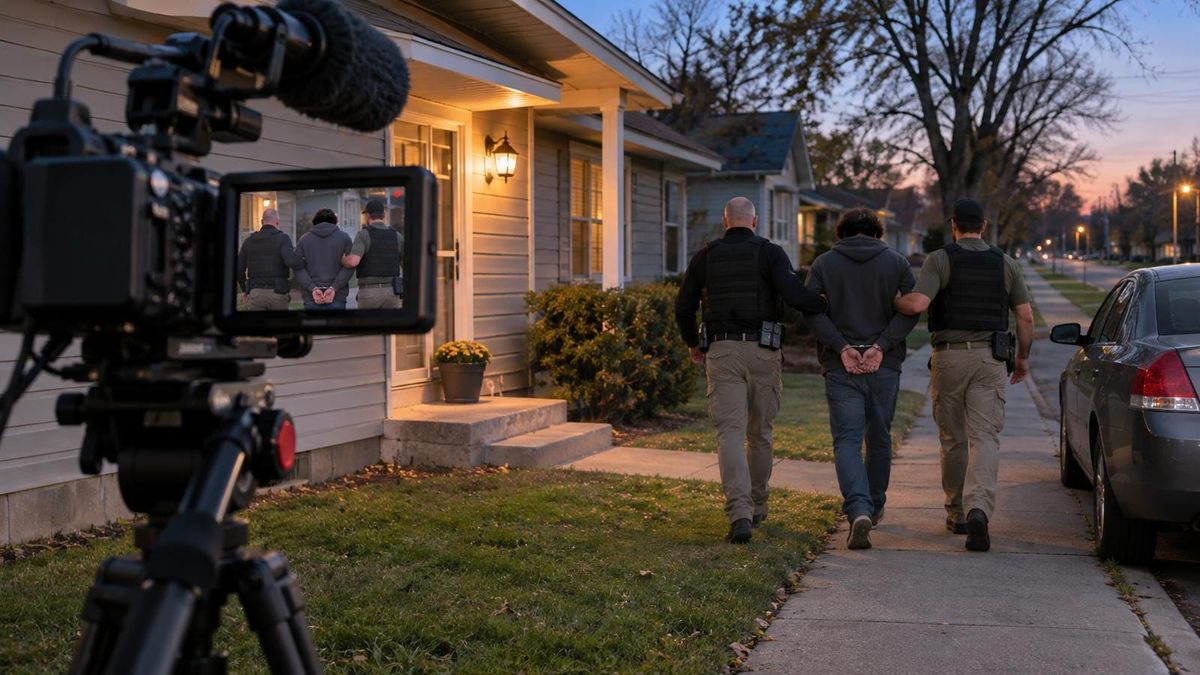
My argument is simple: when an undercover operation becomes public entertainment, we must look beyond the arrest and the video. We need to know who was trained, who was supervising, how the work was funded, what happened in court and what evidence shows that children are safer.
The military connection is real
Military investigators are part of the wider system that investigates online crimes against children. In 2023, Army Criminal Investigation Division reported that its agents led a multi-agency undercover operation at Fort Bliss, Texas, that resulted in two civilian arrests.
The Air Force Office of Special Investigations says it established an Internet Crimes Against Children operations branch in 2024. These examples show that military and civilian investigators can work within the same broader child-protection system.
That does not establish military involvement in every operation. In particular, I have not seen evidence that military investigators took part in SOSA’s Counting House operation. I make that distinction because credibility matters. A connection should be shown, not assumed.
Veterans can also be defendants in these cases. The Justice Department reported that a retired Navy veteran received a ten-year sentence after an Air Force OSI online decoy operation. That case is a documented outcome. It is not proof that veterans are targeted as a group or appear in stings at a higher rate. To make either claim, we would need reliable numbers and a fair comparison.
Military service does not excuse a crime. It also does not erase the right to a fair process.
What a camera can and cannot show
Safe from Online Sex Abuse, known as SOSA, is a nonprofit that says it works with police and prosecutors to address online child sexual abuse. Its series, SOSA Undercover, follows its team during investigations. Its fifth season is called The Counting House.
SOSA says it creates decoy accounts, communicates with adults and organizes evidence for law enforcement. The organization says it works with police approval. A private team working with police is not automatically the same as an independent group confronting someone on its own. Those differences matter.
SOSA also says that filming follows its operations rather than driving them. That is its position, and it deserves to be included.
My concern is about what viewers can know from an edited account. A video may show a troubling exchange and an arrest. It may not show every message, every decision, the defense evidence, the final charge or the outcome in court. That does not prove the edit is dishonest. It means an episode cannot replace the complete record.
When a suspect’s face or a dramatic moment becomes the center of a program, we should ask what happens to everyone else: the survivor, the accused person’s family, the investigators and the community watching from home.
Why do these stories draw us in?
In a Daily Beast interview, Law & Order: Special Victims Unit showrunner Michele Fazekas discussed why a fictional series about disturbing crimes can be a comfort show. She suggested that people find hope in the idea that someone will help and that change is possible.
I understand that feeling. When the subject is frightening, a story with a clear hero and an ending can make the world feel safer. Some survivors may also find comfort in seeing someone listen.
But fiction and a real investigation are different. The Daily Beast article is not a study of SOSA or proof of what motivates its viewers. My point is that the same audience appeal can be present when real investigations are filmed. We should not mistake a satisfying ending on screen for a complete account of what happened afterward.
Views and memberships can help pay for media production. Donations can support nonprofit work. Those facts make financial arrangements worth examining. They do not prove a group manufactured fear or acted only for money.
Who is trained and who is protected?
The Justice Department describes training and wellness resources for Internet Crimes Against Children personnel. So the question is not whether training exists. It is which rules apply to each person in a particular operation and who makes sure those rules are followed.
If a civilian helps run a decoy account, who approves that person’s role? Who reviews the conversation? Can a supervisor stop it? Are complete messages preserved, including parts the audience never sees? What happens when a concern is raised?
I also think about the people asked to do this work. Some may have survived abuse themselves. Being a survivor does not make someone unfit to help. It does mean that access to training, confidential support and a genuine choice to step away deserves attention. Anyone exposed again and again to disturbing material deserves care.
SOSA says it supports survivors and helps cover therapy for some people who otherwise could not access it. I have not seen the specific support arrangements for every decoy in every operation. That is a question to investigate, not a reason to assume support is absent.
Follow the money without skipping steps
Public agencies and nonprofits can have different sources of money and different responsibilities. SOSA says donations support its programs and that membership fees help cover episode production. Police may also use staff time, equipment and other public resources when they participate in an investigation.
Florida’s records show why we need to follow each dollar carefully. A 2023 state request sought $750,000 for SOSA-related training and operations. A later proposal showed $350,000, and a subsequent conference offer showed no funding for the item. FAC’s review did not verify a final award or payment from that request.
A request is not a payment. A partnership is not proof that a producer received public money. We should ask for the agreements, invoices and spending records rather than fill the gaps with assumptions.
What happened after the arrest?
There are documented results from operations involving SOSA. An Oklahoma sheriff’s office reported a conviction and sentence following a 2024 SOSA-partnered operation involving a fictitious child. I have not independently reviewed the judgment, but that official report is a reason not to claim that the work has produced no results.
At the same time, a single conviction does not answer the larger question. How many cases were filed? How many ended in conviction, dismissal or another result? How many actual children were identified and helped? What support did they receive? What were the public costs?
The Justice Department’s ICAC performance measures distinguish arrests from other measures, including cases accepted for prosecution and newly identified child victims. Those distinctions matter. Arrests can be an important part of an investigation. They are not, alone, a complete measure of prevention.
A veteran’s view of accountability
My own experience with registration requirements has made me look beyond the arrest announcement. I think about employment, housing, family stability and the chance to rebuild. Those concerns do not cancel the needs of victims. They are part of asking whether a system protects people while allowing lawful lives to move forward.
I do not want less protection for children. I want protection that can be examined honestly. I want survivors supported, investigators trained, evidence preserved, rights respected and outcomes reported.
As a veteran, I believe a mission should be judged by more than how it looks on a screen. The public deserves to know the rules, the costs and the results.
Strong child protection and strong accountability belong together.
Ryan Anderson
Retired U.S. Army Sergeant
Ryan Anderson is a retired U.S. Army sergeant (E-5), former Abrams tank maintainer and combat veteran who was injured while serving in Iraq. He is a member of the Florida Action Committee and writes about public safety, accountability and the challenges people face while rebuilding their lives. Please visit floridaactioncommittee.org to learn more.
Opinions do not reflect the views and opinions of ALPolitics.com. ALPolitics.com makes no claims nor assumes any responsibility for the information and opinions expressed above.