A Vote for Tuberville Could Hand the Gubernatorial Election to Doug Jones
Guest Opinion by Samuel Barrett

Guest Opinion by Samuel Barrett
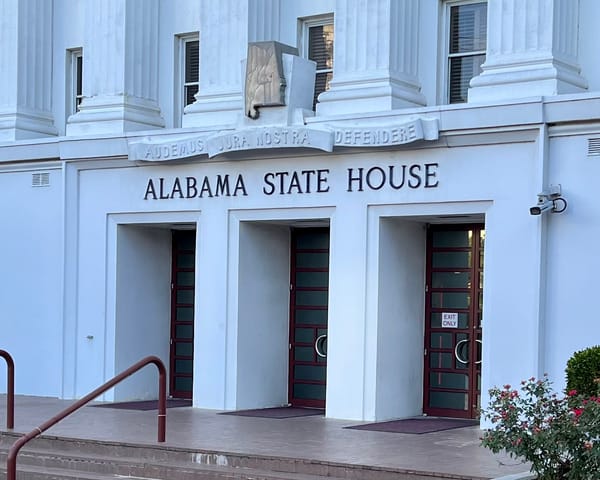
The ongoing saga regarding Alabama gubernatorial candidate Tommy Tuberville’s residency hit a new high on March 24 when, at the Alabama State Capitol, fellow Republican candidate Ken McFeeters announced at a press conference that he had filed a lawsuit against both Tuberville and the Alabama GOP. The lawsuit demands an emergency trial, as allowed by the Seventh Amendment to the Constitution of the United States, to determine whether Tuberville does or does not hold a primary domicile in Alabama.

The argument from McFeeters and others opposed to Tuberville is that Tuberville has not maintained a residence substantial enough to qualify him to run for governor under Article V, Section 117 of the Alabama Constitution, which states that “the governor and lieutenant governor shall each be at least thirty years of age when elected, and shall have been citizens of the United States ten years and resident citizens of this state at least seven years next before the date of their election.” The phrase “seven years next” has been widely accepted to mean seven years immediately prior to the election.
Translation: since this year’s gubernatorial election is on November 3, 2026, Tuberville would have needed to continuously maintain a primary domicile in Alabama beginning no later than November 3, 2019, and to have held it since that point.
Recent evidence seems to indicate that this is not the case.
A Carfax report run on Tuberville’s vehicle reveals that in 2024, the truck was serviced in and around Destin, Florida—not far from Santa Rosa Beach, where his beachside mansion is located. However, in 2025, when Tuberville announced his run for governor*, the service listings suddenly show work being done in Auburn. Unless he really liked a mechanic in the Florida Panhandle enough to drive from Auburn to Destin, this does not suggest that Tuberville was living in Alabama during one of the years required to qualify for governor.
At McFeeters’ Montgomery press conference, he had copies of both the lawsuit and Tuberville’s flight records during his tenure as a U.S. senator. The logs show every flight Tuberville took from the beginning of his tenure until mid-September 2025. From 2021 to 2024, there are 109 flights logged in that report, only 14 of which either took off from or landed in Alabama. Some others included stops in Alabama, but none began or ended where Tuberville claims to live. Fourteen out of 109 means only 13% of Tuberville’s flights during the first four years of his time as a senator involved Alabama.
Then, something changes. In 2025, 30 flights are logged, and 18 either take off from or land in Alabama. In one year, Tuberville’s flights into or out of Alabama jumped from 13% to 60%.
That suggests someone may have realized residency would be an issue and attempted to correct course at the last minute.
Now, that is the cold, hard evidence, but there are also factors that simply do not make sense. A look at Auburn’s Cherry Street, where Tuberville’s wife and son own the house he claims as his residence, shows modest homes. The property in question has three bedrooms and one bathroom. The Santa Rosa Beach mansion obviously offers far more space and luxury.
To accept that Tuberville meets the qualifications to be governor would mean believing that his family—wealthy after his prominent college football coaching career—chose to live for six years in a three-bedroom, one-bathroom house rather than a far more luxurious Gulf Coast property. It would also mean assuming Suzanne Tuberville was willing to share one bathroom with two other men during that time.
I have had to share a bathroom with my sister for only a weekend. I loathed every minute of it.
Once again, the claim that Tuberville has been living in Alabama as required begins to fall apart.
Now, to be clear, I understand the appeal of his beachside home. It certainly sounds more attractive than a smaller house in the middle of a busy college town. Most people would agree. This is not about criticizing that choice.
It is about the fact that he does not qualify to be governor of Alabama because of it.
And before anyone raises the “homestead exemption,” Tuberville’s name is reportedly not on the deed of the Auburn home, making that argument moot.
Even if such an exemption somehow qualified him to run, do we really want a nominee for the highest office in our state to rely on a technicality? Or do we want a governor who is unquestionably a tried-and-true Alabamian, fully in tune with the needs of over five million residents?
I think that choice is clear.
If all of this is true, then a vote for Tuberville on May 19 in the primary is effectively a vote for Doug Jones in November.

If McFeeters’ lawsuit advances as he hopes and a Covington County jury rules that Tuberville does not live in Alabama, the Alabama GOP could be forced to remove him from the race. Alternatively, Tuberville could withdraw under pressure if he cannot produce sufficient documentation. In that case, the Republican primary would come down to two candidates: McFeeters and Will Santivasci. McFeeters would likely be the frontrunner, having entered the race earlier and had more time to campaign.
However, if the lawsuit does not force Tuberville out before the primary, a larger problem emerges.
If Tuberville wins the Republican primary and Democrat frontrunner Doug Jones wins the Democratic primary (with respect to other candidates such as Will Boyd, Chad “Chig” Martin, JaMel Brown, Yolanda Flowers, and Nate Mathis), McFeeters has claimed that a lawyer connected to Jones’ camp indicated plans to file a lawsuit immediately after the primary. Jones’ campaign has denied this, but it would not be surprising if such a strategy were being considered.
With more resources, time, and legal support, Jones’ campaign could pursue the case through the Alabama Supreme Court, potentially resulting in Tuberville being removed from the ballot.
And then what happens for Republicans?
Nothing.
If Tuberville wins the nomination and is later disqualified, there may be no Republican candidate on the ballot.
In one of the reddest states in the country, a Democrat could run unopposed for governor.
Doug Jones would be the next governor.
If you are a Democrat, that scenario likely sounds appealing. But if you are a Republican, this should be a wake-up call.
Tommy Tuberville will not be the next governor. He does not meet the qualifications, and the courts—whether before or after the primary—are likely to recognize that.
If Republicans want to prevent a Doug Jones governorship, Tuberville cannot win the primary.
Because a vote for Tuberville is a vote for Doug Jones.
(*Tuberville technically did not announce his candidacy. He stated, “I will be the future governor of the great state of Alabama.”)
Samuel Barrett is 25 years old and has written two baseball books but is now turning his attention to state politics and matters he feels important in his home state of Alabama. He joined Ken McFeeters at his aforementioned press conference to distribute materials to media members as well as capture photos and video. He was born in Northport on November 3, 2000, so he will be celebrating his 26th birthday this year by voting and encouraging others to vote on Election Day. After short stints in Fayette and Decatur, he has resided in Phenix City since 2005. Barrett can be reached at rsbarrett00@gmail.com.
Opinions do not reflect the views and opinions of ALPolitics.com. ALPolitics.com makes no claims nor assumes any responsibility for the information and opinions expressed above.