
Alabama Cannot Afford to Hit the Brakes on the Future
Guest Opinion by Perry Hooper Jr.
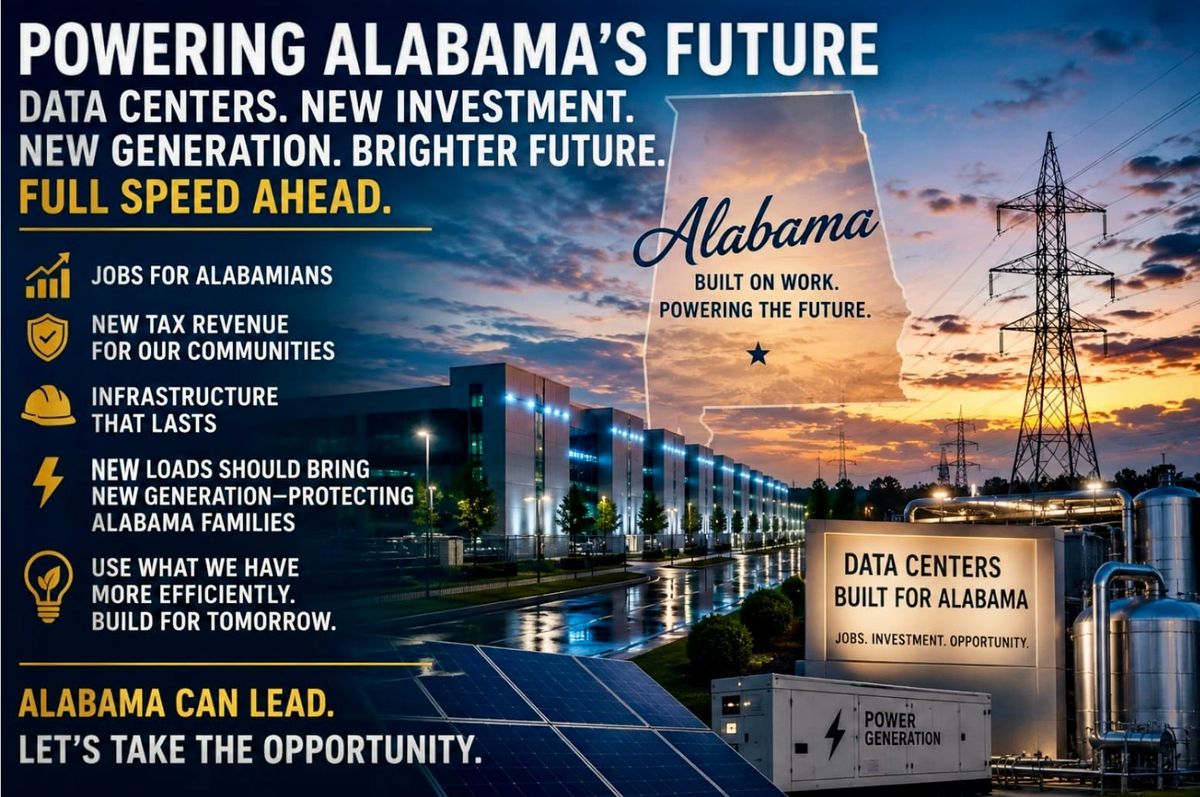
Guest Opinion by Perry Hooper Jr.
There are moments when leadership means listening, studying the facts and proceeding carefully. Then there are moments when the facts have been studied, the opportunity is staring you in the face and continued hesitation becomes its own form of risk. Alabama has reached that moment with artificial intelligence and data centers. Senator Tommy “Coach” Tuberville is right. We should not be talking about putting Alabama’s technology future on 3hold. We should be talking about how quickly and responsibly we can move forward.
Coach has been remarkably consistent while others have begun looking for reasons to hesitate. He has said Alabama is going to be in the data center business, and he has also made clear that Alabama families should not be forced to subsidize it through higher electric bills. His position is straightforward: data centers should pay the costs they create, Alabama ratepayers should be protected, negotiations should be transparent, and taxpayers should not have to shower some of the richest corporations in the world with unnecessary incentives. That is not reckless development. That is common sense economic development.

I understand why some Alabamians have concerns. Communities deserve to know what is being proposed and how it will affect them. Local officials should demand answers, The PSC must protect existing customers, and developers should be required to pay the full freight for the infrastructure their projects require. We can acknowledge every one of those legitimate concerns without accepting the false conclusion that Alabama should therefore stop moving forward.
That is where Coach and Doug Jones have fundamentally different visions for Alabama. Jones has called for a one year moratorium on new AI data centers while the state develops additional protections. I respectfully believe that is exactly the wrong prescription at exactly the wrong time. The artificial intelligence revolution is not going to declare a one year moratorium while Alabama decides whether it wants to participate. Capital will move. Infrastructure will be built. Jobs will be created. Power generation will be developed. The only question is where.
Every month Alabama spends sitting on the sidelines is a month that Georgia, Mississippi, Tennessee, Texas and other competitors can spend telling investors, “Come here instead.” Once billions of dollars of infrastructure are committed somewhere else, we do not get to wave a magic wand and bring those projects back. Alabama has spent decades building a reputation as a state that welcomes investment, understands economic development and knows how to get major projects done. We should not abandon that winning formula just as one of the largest technological investment cycles in American history is beginning.
President Trump understands the stakes. Coach understands the stakes. Artificial intelligence is becoming critical infrastructure for the American economy and American national security. The nation that leads in AI will have enormous advantages in manufacturing, medicine, finance, defense, logistics, agriculture and virtually every other major industry. The computing power behind that revolution has to exist somewhere. I want as much of it as responsibly possible to exist right here in Alabama.
That does not mean writing blank checks. It does not mean giving away Alabama’s resources. It does not mean allowing a billion dollar corporation to arrive in a community and send the bill for its electricity infrastructure to a grandmother trying to keep her house cool in August. Coach has made protecting Alabama ratepayers a central part of his position. That principle should become the foundation of Alabama’s policy: bring your own power when necessary, pay your own way, protect the ratepayer and create lasting value for Alabama.
Building more power, however, is only part of the answer. Using the electricity Alabama already produces more efficiently must be an essential part of our strategy. Before assuming that every additional megawatt of demand requires another megawatt of entirely new generation, we should make certain we are getting every economically practical megawatt out of the system we already have. The fastest and least expensive source of additional capacity may sometimes be electricity we are already producing but are not using as efficiently as we could.
That means reducing wasted energy, improving transmission efficiency, modernizing grid technology, capturing underutilized generation and designing major new power users to operate intelligently around periods of peak demand. It means looking at storage, demand management, microgrids and technologies that can make the entire system more productive. Data center developers should be encouraged to bring innovative energy solutions with them rather than simply plugging into the existing grid and demanding enormous amounts of electricity around the clock.
This is an opportunity for Alabama to lead. Greater efficiency can free existing capacity for economic growth while helping protect residential customers and small businesses from unnecessary costs. Every megawatt we can recover through better efficiency is a megawatt that can support new investment without unnecessarily increasing the burden on Alabama families. Efficiency is not an alternative to growth. Done correctly, it is one of the tools that makes greater growth possible.
Most importantly, Alabama should stop behaving as though somebody is doing us a favor by considering investing billions of dollars here. We have the land. We have the workforce. We have the engineering talent. We have one of America’s great utility systems. We have world class universities. We have Huntsville’s technology and defense ecosystem, Birmingham’s growing technology sector, the Port of Mobile and a manufacturing base stretching across the state. Alabama should negotiate from strength.
There will always be reasons to wait. There will always be another study that can be commissioned, another committee that can be formed and another politician willing to say, “Not yet.” Sometimes caution is appropriate. But history rarely rewards states that respond to an industrial revolution by hanging a closed for study sign on the front door. Alabama did not become an automotive powerhouse by waiting until every question about the automobile industry had been answered. Huntsville did not become a center of American aerospace and defense by deciding technological change was moving too quickly.
Coach Tuberville is willing to say what needs to be said. Alabama is going forward, and I agree with him. We can protect Alabama families, insist upon transparency, make developers pay the full cost of the infrastructure they require, use our existing electricity more efficiently, protect our water and natural resources, negotiate hard on incentives and expand dependable power generation. We can also make certain Alabama schools, communities, workers and taxpayers receive a meaningful share of the economic benefit. None of those protections requires Alabama to stop competing.
Once those principles are established, we need to quit looking for reasons to say no. The AI revolution is coming whether Alabama participates or not. Our choice is whether Alabama becomes one of the states powering it, building it and prospering from it, or one of the states watching from the sidelines while the investment, innovation and jobs go somewhere else.
President Trump has challenged America to win the global race for artificial intelligence. Coach Tuberville is telling Alabama that we intend to be part of that victory. Others may hesitate, but Alabama cannot afford to hesitate with them. This is our opportunity to build the power, attract the investment, create the jobs and help lead America into the next great technological era.
Now is the time for Alabama to go full speed ahead.
Perry O. Hooper Jr. is a longtime Alabama Republican figure, former Alabama Legislator and Montgomery businessman. He served as Co-Chair of “Alabama Trump Victory” in 2016, and served as an at-large delegate to the Republican National Convention. He is a noted civic leader in Montgomery with deep family roots in Alabama’s legal and political history.
Opinions do not reflect the views and opinions of ALPolitics.com. ALPolitics.com makes no claims nor assumes any responsibility for the information and opinions expressed above.