Alabama Republican Party Divided Over Public Service Commission Appointment Bill
Steering Committee members say no authorization was given as numerous Executive Committee members oppose eliminating elected PSC positions

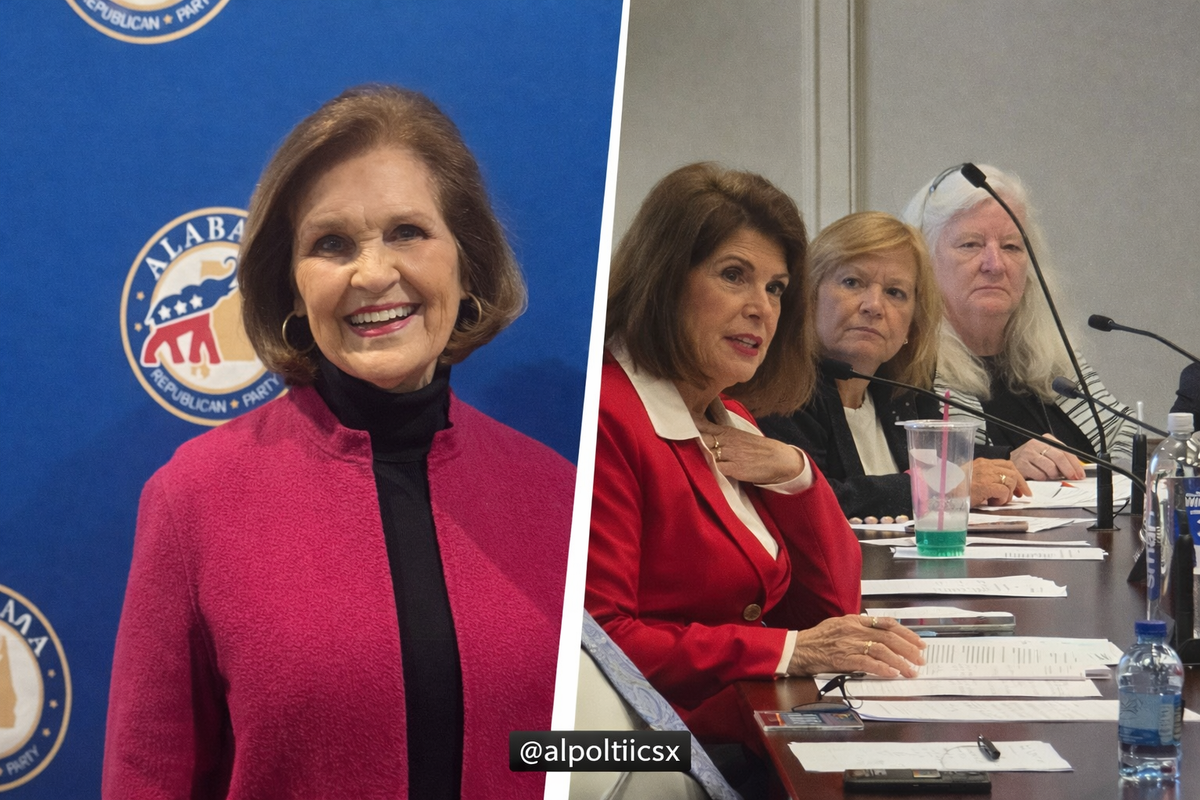
A growing divide inside the Alabama Republican Party (ALGOP) is now fully exposed as party leaders clash over legislation that would eliminate elections for the Alabama Public Service Commission (PSC) and shift the three seats to appointed positions.
At the center of the controversy is Alabama Republican Party Acting Chairwoman Joan Reynolds, who publicly expressed support for the package of utility bills moving rapidly through the State House in a statement released by ALGOP.
Multiple members of the ALGOP Steering Committee, speaking to ALPolitics.com on condition of anonymity in order to protect their positions, said Acting Chair Reynolds was not authorized to issue any endorsement on behalf of the Party. According to those members, no vote was taken by the Steering Committee and no vote was taken by the nearly 400-member Executive Committee to support the legislation. The members all further stated they believe that a majority of Steering Committee members oppose eliminating the elected Public Service Commission, nor were they consulted before the statement was released.
They argue Republicans should never support removing a public office from the ballot. While the PSC Commissioners are not constitutional offices, it is a Statewide elected public office. Critics of the bills — HB392 and its companion SB268 — say stripping voters of the ability to elect Commissioners undermines long-standing principles of accountability.
Several members of the ALGOP Executive Committee have reportedly posted statements on social media condemning the package of bills. Many argue that at a time when President Donald Trump and the National Republican Party are pushing back against progressive Democrat policies, Alabama Republicans should not be advancing legislation that reduces direct voter control over regulatory authority.
The speed of the legislation has intensified concerns.
The bills were introduced Friday afternoon, heard in Committee Tuesday, and placed on the special calendar for a floor vote Thursday. Lawmakers and activists alike are calling it possibly the fastest major piece of legislation moved through the State House in modern history, with virtually no time for grassroots Republicans or the public to research the bills or formally organize opposition.
During Tuesday’s Committee meeting, Rep. Margie Wilcox (R-Mobile) and Rep. Donna Givens (R-Loxley) both raised points of order, sharply criticizing the CEO of Energy Alabama, Daniel Tate. Observers in the room noted the remarks appeared scripted and divisive, with lawmakers reading from prepared documents that attendees were told were provided by the House Speaker’s Office.
The central question circulating among conservative activists is simple: who benefits?
Major utility providers, including Alabama Power and Spire, would operate under a regulatory structure no longer directly accountable to voters. Critics argue that shifting to appointments consolidates influence and removes an important check from the people.
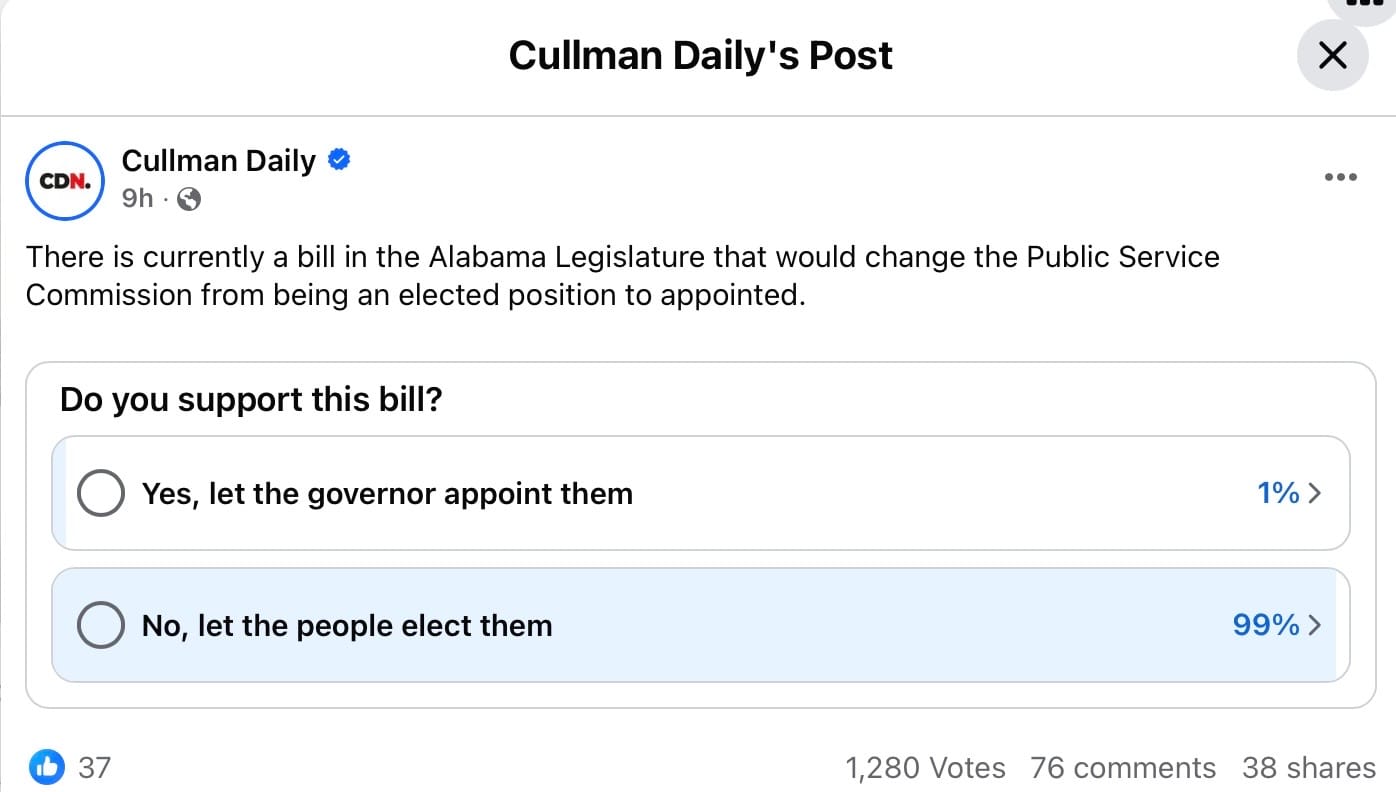
A social media poll by Cullman Daily News had surveyed 1,280 Alabamians at the time of this writing, and found that 99 percent opposed eliminating elections for the PSC and wanted to keep the positions elected. To see or vote in this active poll, go here.
For many grassroots conservatives, this is no longer just a policy debate. It is a referendum on the direction of the Alabama Republican Party itself.
Under Acting Chair Reynolds’ leadership, critics argue the Party is drifting toward institutional alignment with corporate and bipartisan interests. Meanwhile, Trump-aligned conservatives say they are standing firm to protect elected offices and preserve the people’s voice.
Whether the legislation ultimately passes or fails, the internal conflict has exposed significant fault lines inside the Alabama GOP. With numerous Executive Committee members speaking out and Steering Committee members questioning the Chair’s authority, serious questions are now being raised about unity, transparency, and stability within the Party.
UPDATE: ALPolitics.com did not need to seek comment from the Alabama Republican Party prior to the publication of this article. The press release from ALGOP which contained quotes from Acting Chair Reynolds does NOT endorse the bill that would change the PSC Commissioners from elected to represented, but praises the package of bills. A full Clarification may be found HERE.