
Alabama Schools Report Card Show Solid Gains
Overall, the State scores a ‘B’, but Birmingham, Montgomery are still ‘Cs’
Alabama’s public‐school system is showing encouraging signs of progress this year, with several school districts posting gains on the latest annual report cards released by the Alabama State Department of Education (ALSDE).
The Statewide overall score for Alabama reached 87 for the 2024-25 school year, up two points from the prior year. State Superintendent Eric Mackey said the gains reflect a clear strategy: “if you tell people what you need them to do and you give them the resources to do it, they’re going to come through.”
Birmingham City Schools earned a 77 on the 2024-25 report card—its highest ever—marking a three‐point increase over the previous year and a seven‐point gain over the last three years. Superintendent Dr. Mark Sullivan said the district’s absentee rate dropped dramatically from 29 percent in 2023 to 14 percent in 2025, a key factor in the improvement. Additionally, the report card showed a significant reduction of schools rated “F” from 15 to one.
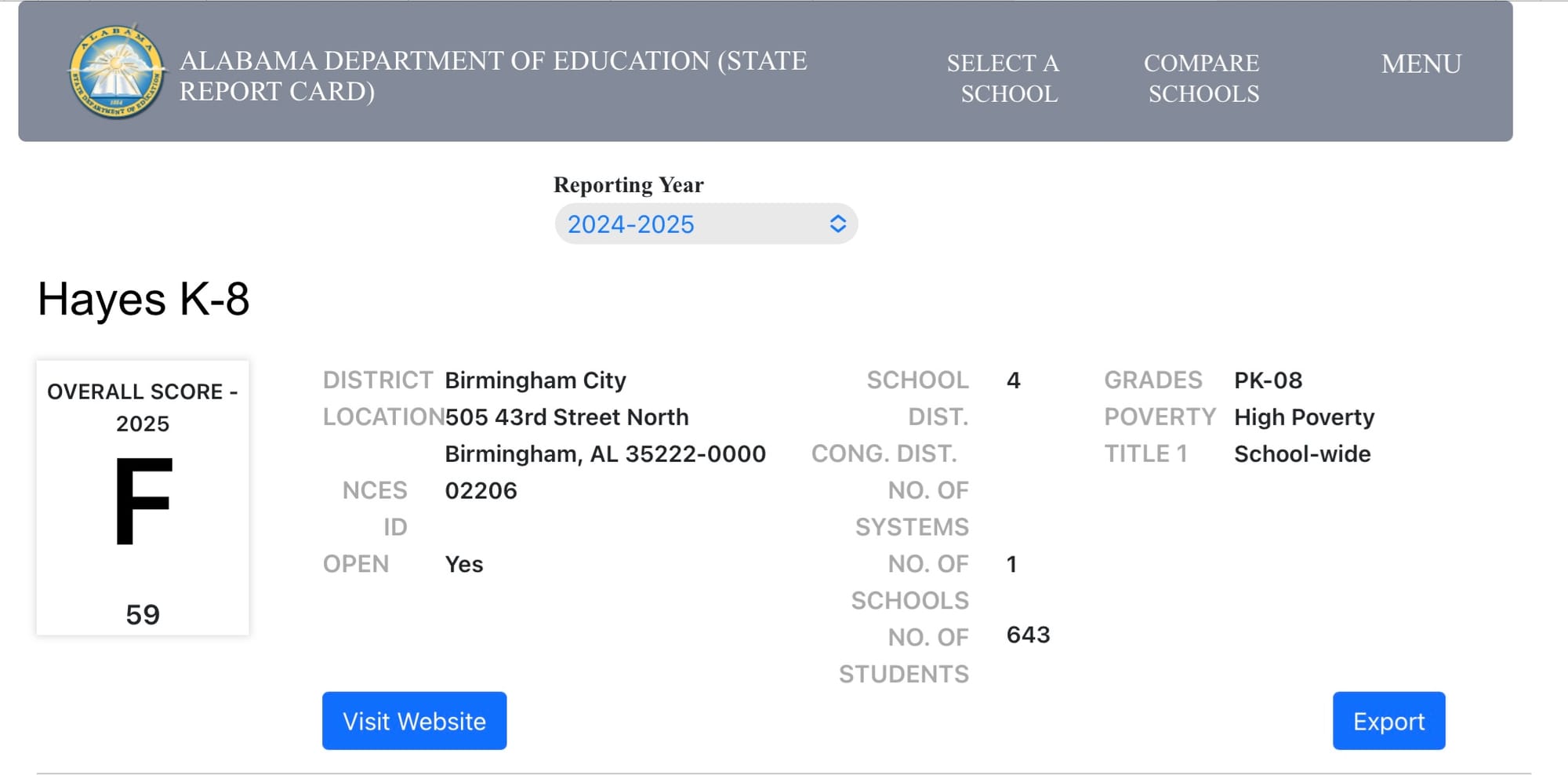
The single failing school in Birmingham was not mentioned in any public comment or release of materials, but according to the report card it is Hayes K-8.
Montgomery Public Schools improved its overall score to 75—its highest since the current report-card system began.
Autauga County Schools recorded a score of 87, showing improvement in nearly every category. Meanwhile, Pike Road Schools earned a 93, with Superintendent Dr. Keith Lankford crediting students, families and the school team for the results.
Despite the good news, State educators emphasize that gains are not automatic. “This report is a milestone—not a finish line,” said Dr. Zickeyous Byrd of Montgomery Public Schools.
ALPolitics.com reached out to the Alabama Education Association (AEA) for their take on the latest report card. Dr. Allison King, AEA’s Government Relations Manager, told us that, “The Alabama Education Association applauds the dedication and resilience of our teachers and school employees whose hard work has directly contributed to the improved scores on the State report card. Their commitment to student success—inside and outside the classroom—continues to elevate our communities and strengthen Alabama’s public schools. These gains reflect not only academic progress, but also the passion and professionalism educators bring to their work every day. We are proud to celebrate their achievements and the positive impact they make across the State.”
These positive steps come amid the backdrop of important education-reform efforts in Alabama, including the Alabama Literacy Act (2019) and the Alabama Numeracy Act (2022). The Literacy Act requires students to demonstrate sufficient reading skills by the end of third grade before moving to fourth grade, while the Numeracy Act focuses on improving math proficiency among K–5 students, supplying instructional coaches, high-quality materials, and targeted interventions. Funding changes also are on the horizon thanks to the recently passed RAISE Act (Renewing Alabama’s Investment in Student Excellence), which tweaks how State education dollars are weighted based on student need.
Next door, Mississippi has captured attention in recent years for its rapid improvement in student outcomes, particularly early-grade literacy and numeracy. Once ranked near last nationally for fourth-grade reading and math, the State has climbed into the top 20 in some key measures. In reading, Mississippi jumped from 49th in 2013 to ninth in 2024; in fourth-grade math it improved from 50th to 16th. According to the Mississippi Department of Education, its fourth graders “lead the nation in gains for both reading and math over time.”
The so-called “Mississippi Miracle” shows how sustained policy focus can gradually shift performance. While Alabama is moving forward, Mississippi serves as a reminder of what long-term consistency and structural reform can accomplish.
For Alabama, the message is hopeful. Progress in districts like Birmingham, Montgomery and Pike Road reinforces that the reforms and investments are beginning to take shape. However, the work is far from done: a score of 77 in Birmingham still falls below the Statewide average of 87, and the goal of reaching a “B” grade or higher remains on the horizon.
Alabama’s public-schools landscape is showing positive signs: test-scores edging up, districts improving and policy frameworks building support for literacy and math. With the Literacy Act, Numeracy Act and RAISE Act all in place, maintaining momentum, supporting educators, engaging families and continuing to focus on foundational skills is essential if Alabama is to sustain this upward trend.
One thing is undeniably clear: at least in public education, Alabama can no longer throw shade on Mississippi.
Want to find your child’s school or see how your alma mater did? The State report cards may be found HERE.