Alabama’s 2026 Ballot Is a Choice Between the America We Grew Up In and a Progressive Takeover — Look at France Right Now
Guest Opinion by Perry Hooper Jr.
Guest Opinion by Perry Hooper Jr.
On November 3, Alabama voters will decide far more than individual races. Every major contest on the ballot is part of a larger national fight over whether the country continues on a path of Freedom, Faith, and Family or whether Democratic Socialists and their allies gain the levers of power needed to remake it. France is showing in real time what that remaking looks like.
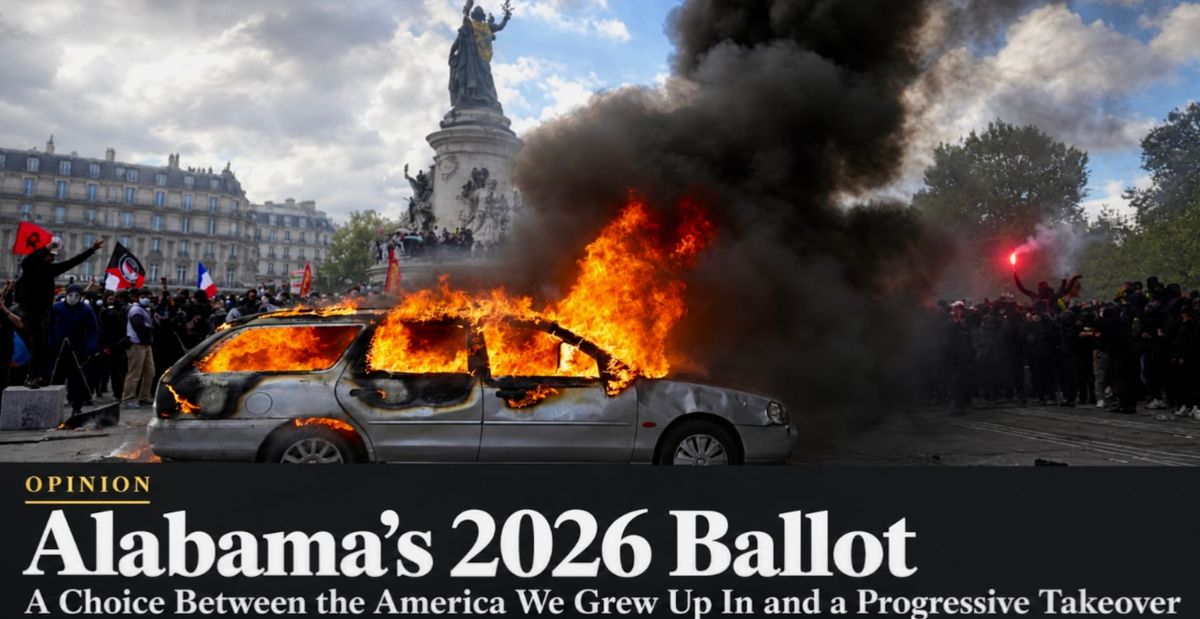
This past weekend, France suffered its worst urban violence in history. Hundreds of thousands marched. Then the riots ensued. They looted shops, torched buildings, and attacked police in Paris, Marseille, Lyon, and other cities. French authorities reported nearly 2,400 arrests and hundreds of injured security personnel. Historic public buildings were damaged, including the city hall in Limoges, which suffered extensive fire damage. The government has imposed localized curfews and announced plans to deploy troops alongside police. President Emmanuel Macron faces deep public dissatisfaction. France’s projected public debt stands at approximately 119 percent of GDP. Bond yields have reached multi-decade highs. The government is weak, fragmented, and struggling to pass budgets. Far-left leader Jean-Luc Mélenchonof France Unbowed, the left wing successor to Macron, has supported the protest movement, while French government officials have blamed ultra-left militants and criminal groups for exploiting the demonstrations and contributing to the violence.
Officials and media cite rising living costs, fuel prices, and school conditions as the stated reasons. The organized far-left element represents something larger than a dispute over prices or school funding: a struggle over France’s institutions, its social order, its cultural foundations, and its national identity. Mélenchon and France Unbowed see the unrest as an opportunity to challenge the existing political system. The same progressive forces that have spent years expanding government, weakening traditional institutions, and prioritizing ideology over order are contributing to the country’s political breakdown.
That is the trajectory Alabama risks accelerating if progressive Democrats win key races here.
At the top of the ticket, Tommy Tuberville faces former U.S. Senator Doug Jones for Governor. Jones aligned with the national Democratic Party during his Senate tenure. A Jones governorship would give the progressive wing a foothold in Montgomery after decades of Republican control, with implications for education policy, law enforcement, and resistance to federal overreach. These are the same fundamental questions about governmental authority, public order, and national character now being debated across France.
In the U.S. Senate race, Barry Moore faces Democrat Everett Wess. One more Democratic vote would affect the party balance on nominations, spending, and legislation involving issues on which Alabama conservatives and national progressives frequently disagree.
The most closely watched House race remains Alabama’s 2nd District, where Democratic incumbent Shomari Figures faces Republican Rhett Marques. Figures voted against the Big Beautiful Bill and the 2026 Farm Bill. He also voted against the SAVE Act in April 2025, legislation requiring documentary proof of U.S. citizenship to register to vote in federal elections. An analysis of congressional votes through September 16 found that Figures voted with his party on 94 percent of votes dividing Democrats and Republicans. These positions illustrate the substantial differences between Figures and Marques on federal policy. The other House races matter as well: Republican incumbents Mike Rogers, Robert Aderholt, Dale Strong, and Gary Palmer face Democratic challengers, while the open 1st District features Republican Jerry Carl against Democrat Clyde Jones.
Down the ballot, the political differences continue. Lieutenant Governor: Republican John Wahl versus Democrat Phillip Ensler. Attorney General: Republican Katherine Robertson versus Democrat Jeff McLaughlin. Secretary of State: Republican Caroleene Dobson versus Democrat Wayne Rogers. Agriculture Commissioner: Republican Corey Hill versus Democrat Ron Sparks. Public Service Commission Place 2: Republican Jim Zeigler versus Democrat Sheila McNeil; Place 1: Republican Matt Gentry versus Democrat James Gordon. These offices exercise important authority over utility regulation, energy policy, election administration, criminal justice, and agricultural regulation. They are among the institutions through which different political philosophies become actual government policy.
France’s current disorder is not merely about prices or schools. It is a warning about what can happen when economic frustration, ideological conflict, institutional weakness, and political polarization collide. The country is struggling with mounting debt, political fragmentation, public anger, and serious questions about its ability to maintain order. The consequences of the unrest are unmistakable.
Alabama’s election raises its own fundamental questions about the direction of government and the principles that will guide it. For those of us who believe in the country we grew up in, where public order matters, borders have meaning, the Second Amendment protects an individual right, and faith and family remain cornerstones of our communities, those questions deserve serious consideration in every race on the November ballot. The events in France cannot tell us exactly what Alabama’s future will be. They can remind us, however, that the preservation of liberty, responsible government, and stable institutions requires the continuing attention of an informed electorate.
Perry O. Hooper Jr. is a longtime Alabama Republican figure, former Alabama Legislator and Montgomery businessman. He served as Co-Chair of “Alabama Trump Victory” in 2016, and served as an at-large delegate to the Republican National Convention. He is a noted civic leader in Montgomery with deep family roots in Alabama’s legal and political history.
Opinions do not reflect the views and opinions of ALPolitics.com. ALPolitics.com makes no claims nor assumes any responsibility for the information and opinions expressed above.