An Alabama Nonprofit Is Taking the Fight Against White Noise Machines to the World
Guest Opinion by Beverly Hansen, RN, MBA
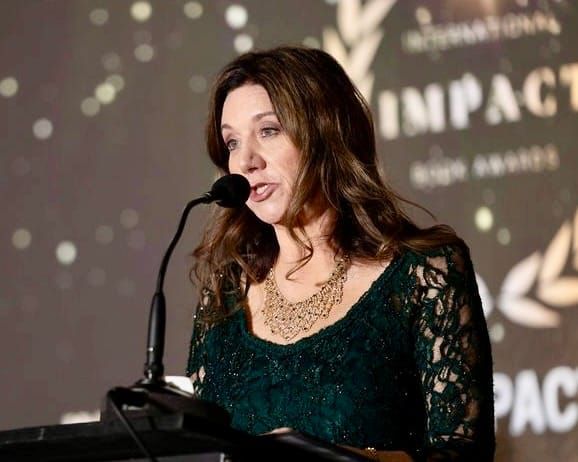
Guest Opinion by Beverly Hansen, RN, MBA | Founder & CEO, Clinical Brainiacs (Birmingham, AL) | clinicalbrainiacs.org
Alabama has a long tradition of producing voices that change the national and global conversation. Today, a Birmingham-based nonprofit is adding a new one: a campaign to protect the brains of the world's babies from a device sitting quietly in millions of nurseries, trusted by exhausted parents everywhere, and regulated by virtually no one.
I am Beverly Hansen, a registered nurse with over 40 years in clinical care, acute medicine, behavioral health, neuroscience-based brain coaching, and healthcare strategy. But the journey that led me here did not begin in a clinic or a research library. It began in my own family's home, watching my grandson.
Like so many babies today, he was raised with a white noise machine running through nearly every nap and every night of sleep. And like so many grandmothers, I started noticing things. Delays in the richness of his babbling. A certain flatness in response to the natural sounds around him. A narrowing of the spontaneous curiosity I expected to see lighting up his face. I noticed the same things in his little peers — babies and toddlers in the same generation of nurseries, all humming with the same steady machine, delayed speech, enunciation issues and sensorineural hearing loss. These were not dramatic symptoms. They were subtle. And that subtlety is exactly what makes this so dangerous.
I did what any clinical mind does when something feels wrong: I went looking for answers. What I found, buried across dozens of peer-reviewed journals that almost never reference each other sent me straight to my keyboard. My research notes became my book and then I founded Clinical Brainiacs — now organized as an Alabama nonprofit and I am launching a nationwide campaign with one mission: protect our babies' brains from a product that has never been proven safe for them, and that no grandmother and no parent should have to discover the hard way.
We've Seen This Before
History keeps teaching us the same lesson: we trust baby products too soon, too widely, and without nearly enough scrutiny. We put infants on their stomachs to sleep — standard medical advice until the "Back to Sleep" campaign reversed course and saved thousands of lives. Thalidomide was given to pregnant women as a safe sedative. Cigarettes were once prescribed for calm to expectant mothers. Each time, the harm was real, the warning signs were early, and the response came late.
White noise machines were invented for adults in the 1960s. They entered the infant market around 2010, not through clinical trials or pediatric safety review, but through clever marketing to sleep-deprived parents. Today they run in nurseries for 8, 10, 12 hours at a stretch, at volumes that would trigger workplace safety regulations for adult workers. Plus, they are used in daycares, hospitals and pediatric neonatal units with the most vulnerable of infants. Yet there is not a single long-term study confirming they are safe for the developing infant brain. Not one.
The Problem Nobody Is Putting Together
Here is what my clinical background allows me to see that no single researcher can: the studies on white noise and children are scattered across audiology, pediatric neurology, sleep medicine, developmental psychology, and occupational health and almost none of them talk to each other. An audiologist publishes findings on decibel risk to infant hearing. A neuroscientist documents delays in auditory cortex organization from chronic noise exposure. A behavioral researcher flags links between sound masking and disrupted emotional regulation. A sleep physician raises concerns about artificial noise interfering with the natural sleep architecture babies need for memory consolidation and brain growth. Havard publishes a study documenting a massive increase in behavioral health conditions in our children that started in 2016, exactly 6 years after the prolific use of these machines commenced. The National Scientific Council on the Developing Child at Harvard University has studied what early stress does to the growing brain. Their findings are clear and they connect directly to what white noise machines may be doing.
Each paper is a piece. Nobody is holding the whole picture. And when you do, when you look at hearing, cognition, language acquisition, emotional development, stress response, and sleep architecture together, what emerges is not reassuring. It is a portrait of a child whose developing brain is being subjected, for thousands of hours in its most critical window, to something designed for adult environments, with no evidence of benefit and mounting evidence of risk.

A 2024 peer-reviewed scoping review in Sleep Medicine — one of the few attempts to synthesize this literature — concluded that extended noise exposure may damage auditory and cognitive development in children and called for government regulation of device volume. The American Academy of Pediatrics has issued hearing risk warnings. EEG expert Jay Gunkelman likens white noise to a brain irritant and Stanford's Dr. Konstantina Stankovic has stressed that infants' auditory systems are tender and uniquely vulnerable to prolonged noise exposure. And critically: not a single long-term study has demonstrated any developmental benefit to the child from white noise use. Not one. The entire case for these devices’ rests on the short-term convenience of sleep, for the parent, not the baby.
During the first three years of life, a baby's brain forms up to one million new neural connections per second, driven by lived auditory experience, voices, music, the creak of a floorboard, a sibling's laugh. These are not background sounds. They are the architecture of language, cognition, and emotional regulation. When we replace that rich, unpredictable environment with engineered monotony for eight, ten, or twelve or more hours a day, we are making a consequential neurological decision for our children without data to support it and without their ability to object.
A Worldwide Campaign, Beginning Here
Clinical Brainiacs is just getting started. From Birmingham, Alabama, we are beginning what we intend to be a worldwide conversation reaching parents, grandparents, pediatricians, and public health advocates in the US and beyond. We are not a well-funded organization. We are a small nonprofit with a big question and the science to back it up- leveraging social media to get our message out. And sometimes that is exactly what it takes to move the needle.
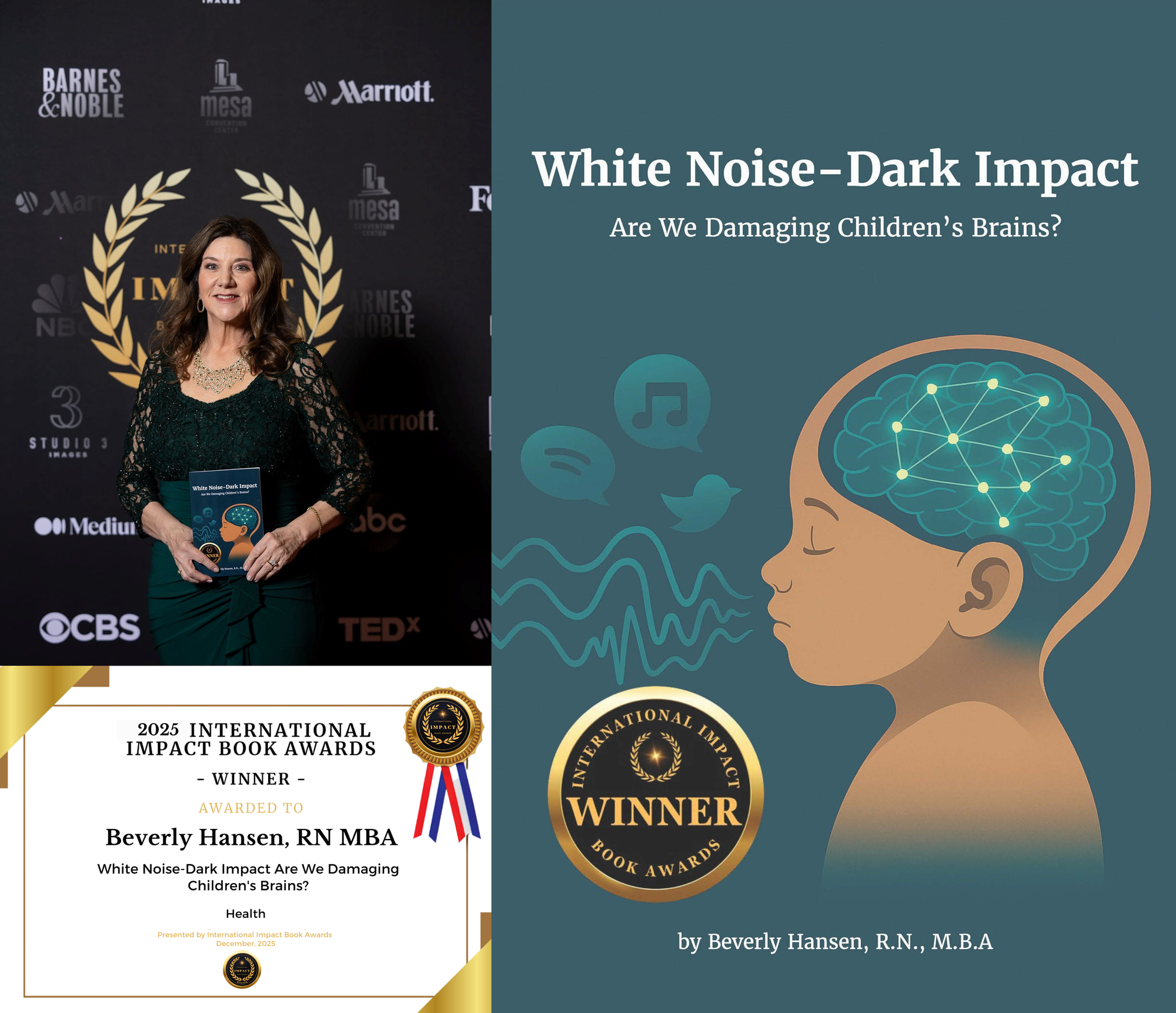
My book, White Noise – Dark Impact: Are We Damaging Children's Brains?, recently recognized with the IIBA Health Award, translates the existing neuroscience into plain language every parent can understand. It is not alarmist. It is a call for the same commonsense precaution we apply to every other product our infants touch, breathe, or consume, except the sound filling their room every night.
Our aim, for now, is simpler than legislation: awareness. We want parents to know this conversation exists. We want pediatricians to ask the question. We want the neuroscience, already published, already peer-reviewed, to reach the people it was meant to serve. Alabama has produced movements that changed the world by starting with one honest conversation. That is what I am hoping for with this important issue, our children deserve neurologically intact brains for their lifetime.
The machine in the nursery has been running long enough without scrutiny. It is time to turn it off — and turn up the pressure on those who should have been asking these questions years ago.
Beverly Hansen, RN, MBA, is the founder and CEO of Clinical Brainiacs, a Birmingham, Alabama-based brain education and advocacy nonprofit. Her book White Noise – Dark Impact: Are We Damaging Children's Brains? is available on Amazon and at clinicalbrainiacs.org.
Opinions do not reflect the views and opinions of ALPolitics.com. ALPolitics.com makes no claims nor assumes any responsibility for the information and opinions expressed above.