An Open Letter to the Alabama Legislature Re: HB80
A Call to Action to vote No on HB80, and suggestions for improving the bill—Guest Opinion by Aaron Palmer
Guest Opinion by Aaron Palmer
Vote “No” on HB80
(1) HB80 is a conflict of interests. This bill is an attempt to use public office for private gain. Representative Mack Butler, the sponsor, is a landlord.
(2) HB80 was poorly drafted without a proper prior research study.
(3) HB80 amends evictions law that affects tens of thousands of Alabamians each year. A small mistake would lead to widespread suffering.
(4) HB80 inadvertently creates a new unrebuttable presumption due to technical language. It says that a service of process return by a special process server is “sufficient proof,” taking away the district court judge’s proper role as a factfinder.
(5) HB80 conflicts with Ala. Code § 6-6-311. Unlawful detainer extends to all estates, whether freehold or less than freehold, while HB80 only comprehends landlord evicting tenants. Therefore, HB80 violates equal protection of the laws principles.
CONFLICT OF INTERESTS
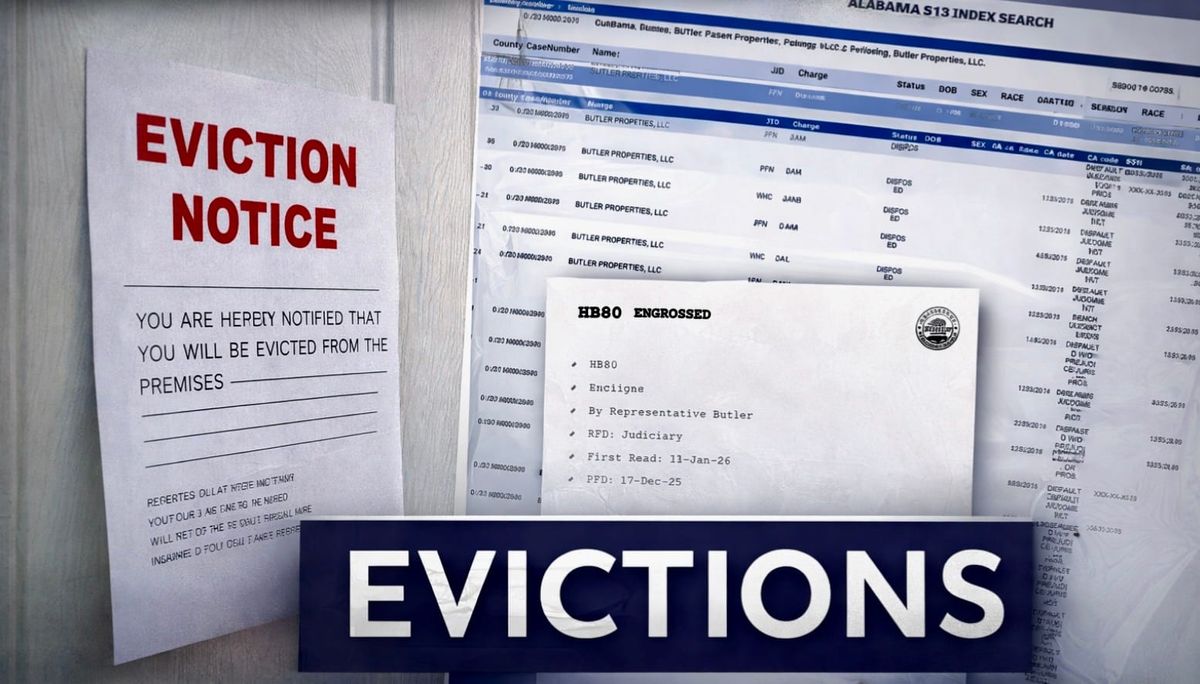
First, I believe that Rep. Butler should have abstained from the floor vote on HB80. Ala. Code § 36-25-5(b) says abstention is necessary in any vote in which a legislator has a conflict of interests, or should know he has a conflict of interests. Representative Mack Butler is himself a landlord. Butler is the owner of Butler Properties, LLC. HB80 advances Rep. Butler’s own material interests at the expense of procedural due process for all and the flexibility of our forcible entry and unlawful detainer statutes. It is the use of public office for private gain.
BILL AFFECTS TENS OF THOUSANDS, YET NO IMPACT STUDY
Second, this bill was not written after sufficient due dilligence. Tens of thousands of Alabamians each year go through the Alabama District Court system under the forcible entry and unlawful detainer statutes, and to amend this statutory scheme like this without carefully studying the issue is foolhardy. Any amendment should require the exercise of extreme caution and study. A bill like this should be created with the advice of the judges and lawyers of this state. District court judges, who preside over eviction cases in this state, should be consulted as a matter of common sense and good practice. A draft would take a committee months to properly amend this law, given the number of evictions each year. Our Uniform Residential Landlord Tenant Act was a committee project.
AN EDIT CREATED AN UNINTENDED IRREBUTTABLE PRESUMPTION
Third, the “special process server” language will result in an increase in default judgments without notice, and under HB80’s current version, a new “sufficient proof” presumption is created that will inevitably clog up the District Courts. The bill, where it says “special process server,” takes away the fact-finding role of the judge. Under HB80, a special process server return is irrebuttable “sufficient proof.”
DIRECT CONFLICT WITH OTHER STATUTES NOT RESOLVED
Fourth, the new mandatory notice in HB80 doesn’t actually agree with other current law. Ala. Code § 35-9A-423 contains a provision that conflicts with the new notice in HB80 – the notice requires the Sheriff to allow the landlord (like Rep. Butler) to move the property out of the premises immediately, but the law says it’s considered abandoned after fourteen days.
Ala. Code § 35-9A-423(d) “If a tenant leaves property in the unit more than 14 days after termination pursuant to this chapter, the landlord has no duty to store or protect the tenant’s property in the unit and may dispose of it without obligation.”
HB80 says the landlord can dispose of it immediately in the notice.
THE NEW NOTICE REQUIRED BY HB80 BREAKS THE REMEDY FOR HOMEOWNERS, FREEHOLDERS, AND OTHER PROPERTY OWNERS, WHO ALSO HAVE RIGHTS
Fifth, the use of “landlord” and “tenant” creates a one-sided remedy, where in the past, language was used (e.g., “plaintiff” and “defendant”) to directly avoid bias and violation of the principle of equal protection of the laws. Ala. Code § 6-6-311 says that the evictions statutes apply to all estates in land, whether freehold or less than freehold, meaning, the remedy is supposed to be available for non-landlords and homeowners, leasees who have trespassers who refuse to leave, and all other citizens. HB80 fails to comprehend this. The forcible entry and unlawful detainer article is supposed to give a remedy to anyone in this state, whether possessing freehold or less than a freehold.
“Forcible entry and detainer and unlawful detainer extend to, and comprehend, terms for years and all estates, whether freehold or less than freehold.”
Ala. Code § 6-6-311. The HB80 mandatory notice is written as a singular notice from one landlord to one tenant.
DESIGN BY COMMITTEE NEEDED
During COVID in 2020, it was estimated that 246,000 people faced eviction that year. Can you imagine 246,000 copies of this bill being posted upon the doors of Alabamians? (Source: AL.com, Jul. 29, 2020)
To amend this law, it is necessary to conduct a comprehensive research study of the applicable laws. Due to the scale of the impact of the unlawful detainer statutes, it is necessary to carefully research each of the applicable sections of law, and study how they work together, for example, Ala. Code § 6-6-310, et seq., Ala. Code 35-9A-101, et seq., and the Alabama Rules of Civil Procedure.
The Senate or House of Representatives would be wise if it consulted the district court judges of this great state, and researched how the experts viewed this law. District court judges hold original jurisdiction over all cases in unlawful detainer, and usually see thousands of cases in this area. A fair estimate of the number of evictions in this state each year is 50,000.
CALL TO ACTION
For all of the foregoing reasons, you should vote against HB80. Piecemeal legislation like this will erode our laws for the profit of Butler Properties, LLC.
Thank you for your time. God Save the State of Alabama.
Very Respectfully,
Aaron Rowe Palmer
The full text of HB80 as engrossed may be found HERE.
Aaron Rowe Palmer lives in Birmingham, Alabama. He is a 2024 admittee of the Alabama State Bar, a graduate of the Thomas Goode Jones School of Law in Montgomery, and the College of Arts and Sciences of the University of Alabama. Palmer has a small law firm in which he practices commercial real estate and business law, in addition to landlord-tenant law, some of which is pro bono. Palmer is a member of the Shelby County Republican Party. He can be reached by email at aaron@palmerpalmer.com.
Opinions do not reflect the views and opinions of ALPolitics.com. ALPolitics.com makes no claims nor assumes any responsibility for the information and opinions expressed above.