Are Absentee Ballots being used as a tool or a weapon in Perry County and other poor rural Alabama communities?
Guest Opinion by Robert Shepherd

Guest Opinion by Robert Shepherd
Using information from the Alabama Secretary of State’s 2024 Primary Election report and an AL.com article about Alabama’s 10 poorest counties, this study looked at whether poverty may be connected to the use of absentee ballots.
Combined totals for the 10 Poorest Counties in Alabama in 2024.
Total registered voters: 124,277
Total primary ballots cast: 33,545
Total absentee ballots: 2,237
Combined absentee share of ballots cast: approximately 6.67%
Average median household income: $31,035
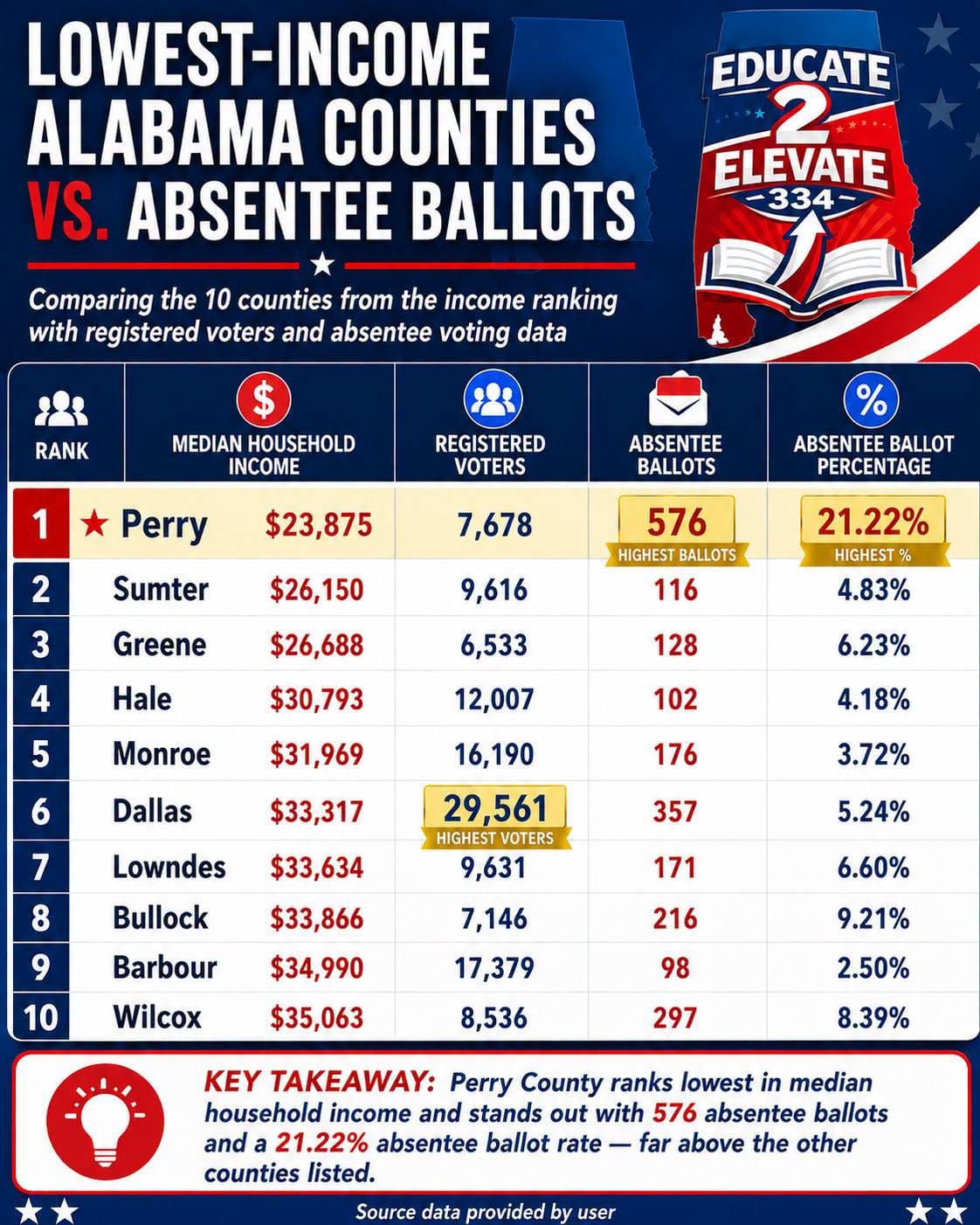
Perry County had an absentee voting rate of 21.22%. That was more than three times higher than the combined rate of 6.67% for the 10 counties and more than 11 times higher than Alabama’s statewide rate of 1.91% in the March 2024 primary election.
About 1 in 4 absentee ballots from these 10 counties came from Perry County.
Alabama 2024 Absentee percentage ranking
1. Perry — 21.22%
2. Bullock — 9.21%
4. Wilcox — 8.39%
5. Lowndes — 6.60%
6. Greene — 6.23%
8. Dallas — 5.24%
11. Sumter — 4.83%
12. Hale — 4.18%
13. Monroe — 3.72%
19. Barbour — 2.50%
The biggest finding was that Perry County had the lowest median household income but also the highest number and percentage of absentee ballots among the 10 counties. This happened even though Perry County had the third-smallest number of registered voters.
The AL.com article ranked the counties by median household income. Median household income is the middle income level: half of the households make more money, and half make less.
The income numbers appear to come from U.S. Census Bureau estimates from 2016 through 2020. Those estimates showed Perry County at the bottom of the list, with a median household income of $23,875.
https://www.al.com/.../the-10-alabama-counties-where...
The voter and absentee ballot numbers below come from Alabama’s March 5, 2024, primary election report.
The absentee ballot percentage shows how many of all the votes cast were absentee ballots. It does not compare absentee ballots to the total number of registered voters.
1. Perry County is the clear absentee-ballot outlier
Perry County had 576 absentee ballots, the largest number among the 10 counties, even though it had only 7,678 registered voters, the third-smallest registration total. They had the third-smallest voting population but the 4th-highest total of absentee ballots in Alabama.
Its absentee ballots represented 21.22% of all primary ballots cast.
That was:
- More than twice Bullock County’s 9.21%, the second-highest rate.
- More than three times the rate in Greene, Lowndes, Dallas and Sumter counties.
- More than eight times Barbour County’s 2.50% rate.
Perry accounted for approximately 26% of all absentee ballots cast in these 10 counties, despite representing only about 6% of their registered voters.
2. Dallas County had the most registered voters
Dallas County had 29,561 registered voters, substantially more than any other county in the group. However, its absentee percentage was only 5.24%.
Dallas had 357 absentee ballots—219 fewer than Perry—even though Dallas had nearly four times as many registered voters.
3. Greene County had the fewest registered voters
Greene County had the smallest registration total at 6,533 registered voters. It reported 128 absentee ballots, representing 6.23% of all ballots cast.
4. Barbour County had the lowest absentee percentage
Barbour County had 17,379 registered voters, the second-largest registered-voter population among these counties, but only 98 absentee ballots.
Its absentee percentage of 2.50% was the lowest in the group.
5. Lower household income did not automatically produce a higher absentee rate
There is no consistent pattern showing that the county with the lowest income always had a proportionally similar absentee rate.
For example:
- Perry had the lowest income and by far the highest absentee percentage.
- Sumter had the second-lowest income but only a 4.83% absentee rate.
- Greene had the third-lowest income and a 6.23% rate.
- Bullock ranked eighth in household income but had the second-highest absentee percentage.
This shows that income may not be the only reason absentee voting rates were different.
Other possible reasons include how people usually vote in the county, the age of voters, health or mobility problems, a lack of transportation, organized efforts to help people vote absentee, and how local elections are managed.
However, the numbers do not prove which of these reasons caused the differences.
Alabama Secretary of State 2024 Primary Election Total Ballots Cast
https://www.sos.alabama.gov/.../2024_Primary_Election...
This data shows Perry County as an outlier in the entire State of Alabama when it comes to absentee ballots, raising major concerns.
For example:
Perry County had 576 absentee ballots and 7,678 registered voters. Tuscaloosa County had only 395 absentee ballots, even though it had 150,380 registered voters.
This means Perry County had more absentee ballots than a county with about 19.5 times as many registered voters.
These numbers raise questions about why absentee voting is so high in Perry County. They also raise concerns about whether absentee ballots are being used fairly or being used to influence elections in Perry County and other poor, rural parts of Alabama.
However, the numbers alone do not prove that anyone did anything wrong. More information and evidence would be needed to reach that conclusion.
#educate2elevate334 #perrycountyal #accountability #transparency #progressoverpolitics #ShowTheReceipts
This opinion piece originally appeared on Facebook. It is reprinted here with the permission of the author.
Robert L. Shepherd is a retired Army officer, combat veteran, leadership consultant, independent investigative journalist, and community activist from Uniontown, Alabama.
Opinions do not reflect the views and opinions of ALPolitics.com. ALPolitics.com makes no claims nor assumes any responsibility for the information and opinions expressed above.