BCFR, Warsaw Freedom Institute Co-Host December Event
Birmingham Committee on Foreign Relations, Warsaw Freedom Institute hold meeting focused on Poland, Russia and related issues
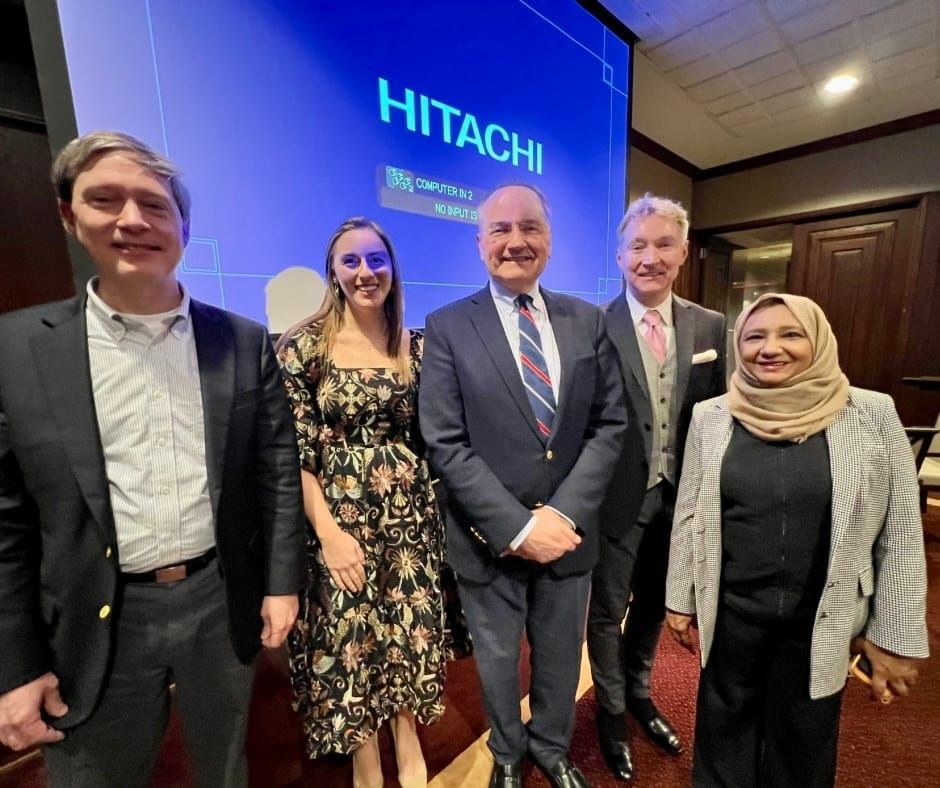
The Birmingham Committee on Foreign Relations (BCFR) and the Warsaw Freedom Institute (WFI) co-hosted BCFR’s December meeting, “All Loud on the Eastern Flank: Poland, the U.S., and the Realities of Transatlantic Relations.”
Jan Skowronski, MD opened the meeting by giving a brief history of BCFR, beginning with its inception in 1942 as part of the Council on Foreign Relations, then its separation with several other Committees from smaller Cities separating and forming the American Committees on Foreign Relations (ACFR) in 1995.
Dr. Skowronski went on to say that the current peace plan being discussed for Ukraine is “not acceptable,” setting the stage for the evening’s featured speaker, Andrew Michta, Ph.D.
Dr. Skowronski said that his native Poland has undergone an “impressive transformation in the last thirty years,” and “one of the strengths of Poland is that the people are very educated, and they are a society that gets things done.”
Poland has benefitted greatly from joining first the EU and then NATO, according to Dr. Skowronski, and historically, is the most pro-American nation in Eastern Europe. It is also now the world’s 20th-largest economy, and has one of the highest rates of military spending in NATO—because, as he said, “they have to.”
Four years ago, when Russia attacked Ukraine, Poland accepted three million refugees in a matter of weeks. Now, “the external environment is becoming less and less favorable to Poland,” and “Russia moving back into the international community scares Poland,” which is one of several potential “hot points” in Central Europe, Skowronski said.
Dr. Andrew A. Michta, a member of the WFI Council, Senior Fellow at the Atlantic Council, Professor of Strategic Studies at the University of Florida and recently retired from the Department of Defense began by saying “I do not remember a period in history that is as transformative as today. Truly, this is an inflection point.”
He gave two quotes from Vladimir Putin to set the tone of his presentation:
“The disintegration of the Soviet Union was the greatest geopolitical catastrophe of the twentieth century.”
“There is no such thing as the Ukrainian nation.”
Dr. Michta pointed out that the world currently faces a full-scale war in Eastern Europe, a simmering war in the Middle East, and potential third and fourth points of escalation on the Korean Peninsula and the Indo-Pacific region. He reminded the audience that Vladimir Putin is a Russian Imperialist, who regards Ukrainians as “Little Russians,” as opposed to the “Greater Russians” of the Russian heartland.
He described an “Axis of Dictatorships”—Russia, China, North Korea and Iraq—which are rising in power. “Russia and China have nothing in common culturally, but they are united in their desire to overthrow the international order we created and sustain.”
“We are in Phase Zero” of a conflict that involves cyber attacks, propaganda and sabotage “this is all testing us.“ After twenty years of appeasement, Russia has suffered “no consequences” for their actions. This has emboldened Putin, which directly challenges Poland’s security.
Dr. Michta described a “Northeast Corridor” of Baltic and Nordic States which stand between Russia and the rest of Europe—a Corridor in which Poland by both size and economic strength is the key.
He reminded the meeting that the U.S. is a maritime nation with isolationist tendencies, and that the U.S. commitment to Europe is “unusual,” but “we created NATO and stayed in Europe to contain the USSR.”
“Right now, that alliance is under stress and at risk of fracturing,” Michta said. “China is increasingly a European power, he said, due to their investment in European companies, and that “the Russians and Chinese are trying to lock us into our hemisphere and block us out of Europe.”
He strongly criticized the “post-Cold War delusion” that, beginning in 1991, led the U.S. to “disconnect our security from economic policy” and “gutted our manufacturing" by transferring it to China. “What were we smoking?”
“We lost our minds. We created the monster we’re facing,” in China, and the shock of 9/11 shifted our focus to “secondary things.”
Now, in Eastern Europe, “it’s all about Russia. Germany is partially responsible for the action in Ukraine because it brought Russia back into the global community,” Michta states. Russia has used the “energy weapon”—access to Russian oil and gas—as a tool to restore Russia as a Great Power, while “Europe has been AWOL, disarming themselves for thirty years.”
“Europe is wealthy but totally disarmed. It will take Europe ten years to field a division,” he stated. “Most importantly, it’s the mental attitude in Europe. There’s no strategic culture. Their defense industry is kaput.”
According to Michta, “Russia is a chronic threat. China is an existential threat with an “ideological dimension,” because the Chinese are presenting their system to developing countries as a way to advance while maintaining their current rulers without democracy—and “very few in Washington understand that.”
Poland’s dilemma is that it’s “not looking at losing sovereignty, but annihilation," and the Baltic States face the same situation. Michta called for rebuilding it only the U.S. and European militaries, but stated that “Poland should lead this military restructuring” in anticipation of the possibility of a “two-theatre war by 2027.”
“The time is short,” he concluded.
Macy Vintson Joe of the WFI brought the evening’s presentations to a close by speaking about the WFI, its mission, and how to follow them.
WFI is an Alabama-born but DC-based nonpartisan organization that works to strengthen the U.S.—Poland relationship and geopolitical alliance in support of freedom, democracy and security. They host monthly events, and both Drs. Skowronski and Michta are members of their board.
For more information on the WFI, their web page is https://www.warsawfi.org.
Like its parent organization ACFR, the BCFR brings business and professional leaders together to discuss world events. The group hosts monthly meetings featuring respected experts on foreign policy and related affairs, promoting rigorous, informal discussions outside of the DC Beltway.
For more information on the BCFR, visit https://www.acfr.org/committees/birmingham/
Dr. Jan Pawel Skowronski is a highly experienced interventional cardiologist with Baptist Health Medical Group’s Cardiovascular Associates in Birmingham. A native of Poland, he has practiced medicine in the United States for more than 25 years, bringing deep expertise in diagnosing and treating a wide range of cardiovascular conditions including coronary artery disease, acute coronary syndrome and venous obstruction. Dr. Skowronski is known for his pioneering use of radial artery access in cardiac and peripheral interventions and caring approach summed up by his philosophy of “compassionate courage.”
He completed his medical degree at Wroclaw Medical University, then pursued residency and fellowship training in internal medicine and cardiovascular disease at the University of Minnesota. Beyond the clinic, Dr. Skowronski founded Fortuna Devices to advance life-saving tools and has been actively involved in clinical research. He also leads humanitarian support efforts for hospitals and refugee centers in Ukraine. Fluent in both English and Polish, he enjoys traveling with his family and is an avid epee fencer.
Prof. Andrew A. Michta is a distinguished American political scientist and expert in international security, NATO affairs, and transatlantic relations. He serves as a Professor of Strategic Studies at the University of Florida’s Hamilton School and is a nonresident Senior Fellow in the Atlantic Council’s Scowcroft Center for Strategy and Security, where he also directs the Scowcroft Strategy Initiative. He holds a PhD in international relations from Johns Hopkins University’s School of Advanced International Studies and has previously been Dean of the College of International and Security Studies at the George C. Marshall European Center for Security Studies and a Professor at the U.S. Naval War College.
Recently, Michta joined the Warsaw Freedom Institute Council and became a strategic advisor to the Freedom Institute, strengthening ties between leading U.S. and Polish policy communities. In these roles, he deepens collaboration on democratic leadership, security issues, and transatlantic cooperation—work he has advanced through teaching, publishing in outlets like The Wall Street Journal and POLITICO, and mentoring future leaders at Freedom Institute programs.