
Celebrating November in Vietnam
Guest Opinion by Justice Will Sellers
Guest Opinion by Justice Will Sellers
Within our enlightened, Western democracies, we tend to forget that the aspirations for self-rule, freedom and liberty are ubiquitous and cross cultural. Take Vietnam for example.
Twice in Vietnamese history, November has marked the moment when the idea of independence stopped being theoretical and became existential.
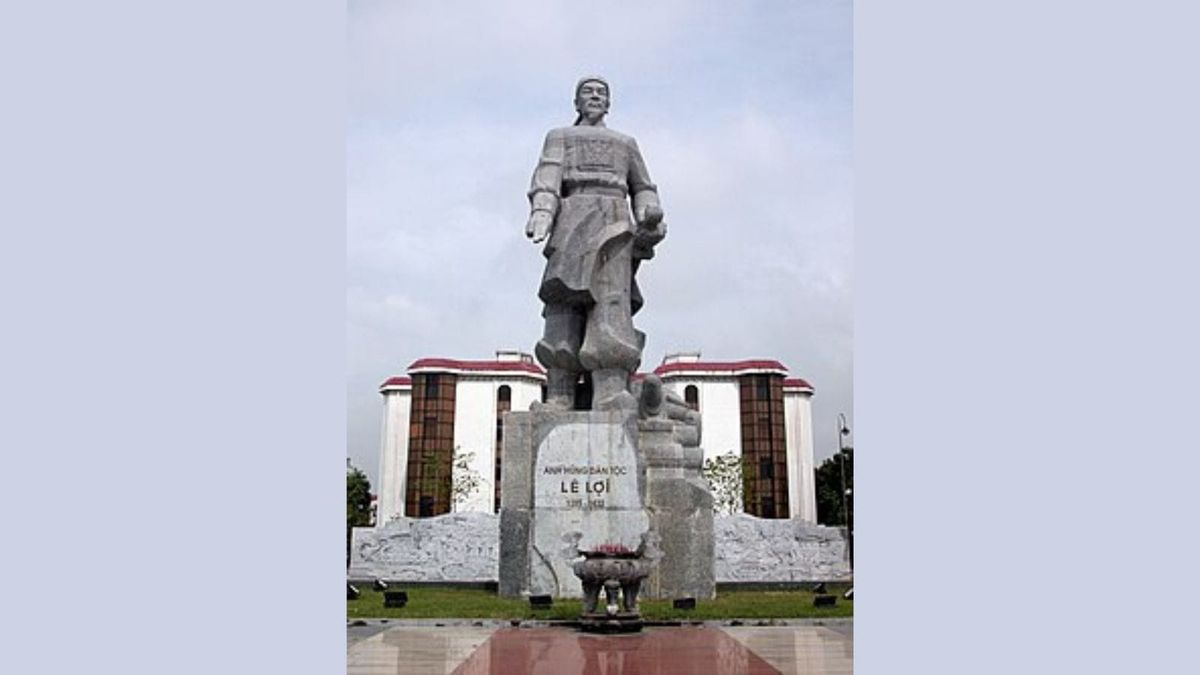
In November 1426, Le Loi's rebels ambushed a Ming Chinese army, ending two decades of occupation and opening the door for four centuries of self-governance in Vietnam.
Exactly 520 years later, in November 1946, French warships shelled the port of Haiphong, and within weeks Vietnamese nationalists, explicitly invoking the memory of Le Loi and his generation, launched the war that would eventually end French rule altogether.
These are not two unrelated events that happen to share a month. They are the two bookends of a single, continuous Vietnamese argument: that sovereignty, once tasted, does not go forgotten, no matter how long it is suppressed.
Vietnam's independence 600 years ago did not come from China's generosity; it came from decisive conflict. After two decades of occupation, Le Loi's smaller, poorer rebel army ambushed and annihilated a much larger Chinese force. The battle broke Chinese domination, convinced the Vietnamese population that the occupiers were not invincible, and allowed the rebellion to become a true war of liberation.
By 1428, Le Loi was crowned emperor, declaring that Vietnam was a distinct civilization with an inherent right to govern itself.
What followed was not uninterrupted tranquility, but uninterrupted self-rule. The Le dynasty governed strongly for its first century, then after 150 years of civil war, the country split into two sections while nominally keeping a Le emperor on the throne.
From 1428 until the mid-1800s, across unity and civil war alike, no foreign power governed Vietnam.
France's conquest in 1859 broke this pattern in a way no prior Chinese invasion had. French colonization endured for nearly a century, not because French rule was more popular, but because it was structurally different.
Rather than dispatching the emperor, France preserved him as a hollow shell: the emperor kept his throne, court, and rituals while French functionaries controlled real administration. This was co-option, a strategy of ruling through existing Vietnamese elites rather than simply over them.
This gave French rule a veneer of continuity even as it hollowed out genuine Vietnamese authority. It was precisely this co-option that pushed 20th-century Vietnamese nationalists and communists alike to look past the compromised royal court toward new movements built on different, more republican foundations.
Japan, which had occupied Vietnam since 1940, initially left French administrators nominally in charge, but in March of 1945, they changed tact, staged a coup, and interned or executed French officials and ended colonial rule outright.
Japan then installed the same emperor, Bao Dai, as head of an ostensibly independent "Empire of Vietnam," governed day to day by a Vietnamese civilian cabinet. This government existed inside Japan's wartime sphere, with real power residing in Tokyo, yet it lasted only five months before Japan's surrender swept it away too.
But its significance was less about power than about appearance because for the first time in generations, Vietnamese administrators visibly ran Vietnamese ministries, under a Vietnamese ruler, using the traditional structures of the old Vietnamese monarchy. It re-normalized the idea that Vietnam could be governed by Vietnamese hands.
When Japan's surrender created a genuine power vacuum, the Viet Minh moved in immediately, pressuring Bao Dai into an abdication that transferred his traditional legitimacy to the new order, and declaring the Democratic Republic of Vietnam.
This was not merely political theater. Ho Chi Minh's own writing and the movement's internal culture show a leadership consciously placing itself inside the lineage of resistance claimed historically by the Viet Minh as tradition, not invention.
Vietnamese who fought the French described their motivation in exactly these terms, reciting the heroes from 1426 forward that Vietnamese schoolchildren had grown up learning, emulating, and revering.
This self-asserted independence lasted barely a year before France moved to reverse it. Negotiations in 1946 produced only a fragile arrangement allowing limited French military presence alongside recognition of Vietnamese self-government.
But this arrangement collapsed in November 1946 over control of customs revenue at the port of Haiphong, becoming a proxy fight over who held sovereignty in Vietnam.
French and Vietnamese forces clashed in the city through mid-November, with French naval and aerial bombardment of Haiphong needlessly killing hundreds of Vietnamese civilians. Weeks later, Ho Chi Minh delivered his "Appeal for National Resistance," a speech which explicitly stands in a five-century-old genre of Vietnamese independence proclamations.
There is no evidence that the specific anniversary of the 1426 revolt influenced the timing of events in November 1946; the Haiphong crisis was driven by immediate disputes over customs authority and troop deployments, not a calendar date.
But the deeper truth the two Novembers reveal does not depend on calendar coincidence. It is this: Vietnamese resistance to foreign domination was never a spontaneous, one-off reaction to French colonialism.
It was a reclaiming of something Vietnam had already proven it could do: hold sovereign, self-governed territory for four centuries, interrupted by internal division but not by foreign rule, until a technologically superior European French power broke that tradition in the 19th century.
When Vietnamese nationalists fought back in 1946, they were not inventing a new idea of independence. They were restoring one with a long, documented, and still-celebrated precedent, a precedent their own leaders named explicitly, in their own proclamations, as the justification for what they were doing.
This is why the memory of 1426 is not a minor historical footnote to the Vietnam-France conflicts of the 20th century, but a load-bearing part of how Vietnam understands itself even today: as a country whose default condition, across most of its recorded history, has been self-rule.
Any period of foreign domination, however long, is understood as aberration rather than the norm.
The universal arc of history is indeed long, but it bends towards freedom. Vietnam’s history proves it.
Will Sellers is a graduate of Hillsdale College and is an Associate Justice on the Supreme Court of Alabama. He is best reached at jws@willsellers.com.
Opinions do not reflect the views and opinions of ALPolitics.com. ALPolitics.com makes no claims nor assumes any responsibility for the information and opinions expressed above.