Closed Primaries Bill Introduced Into Alabama Legislature
House Bill 541 would end open primaries, require party registration, and could shrink voter turnout
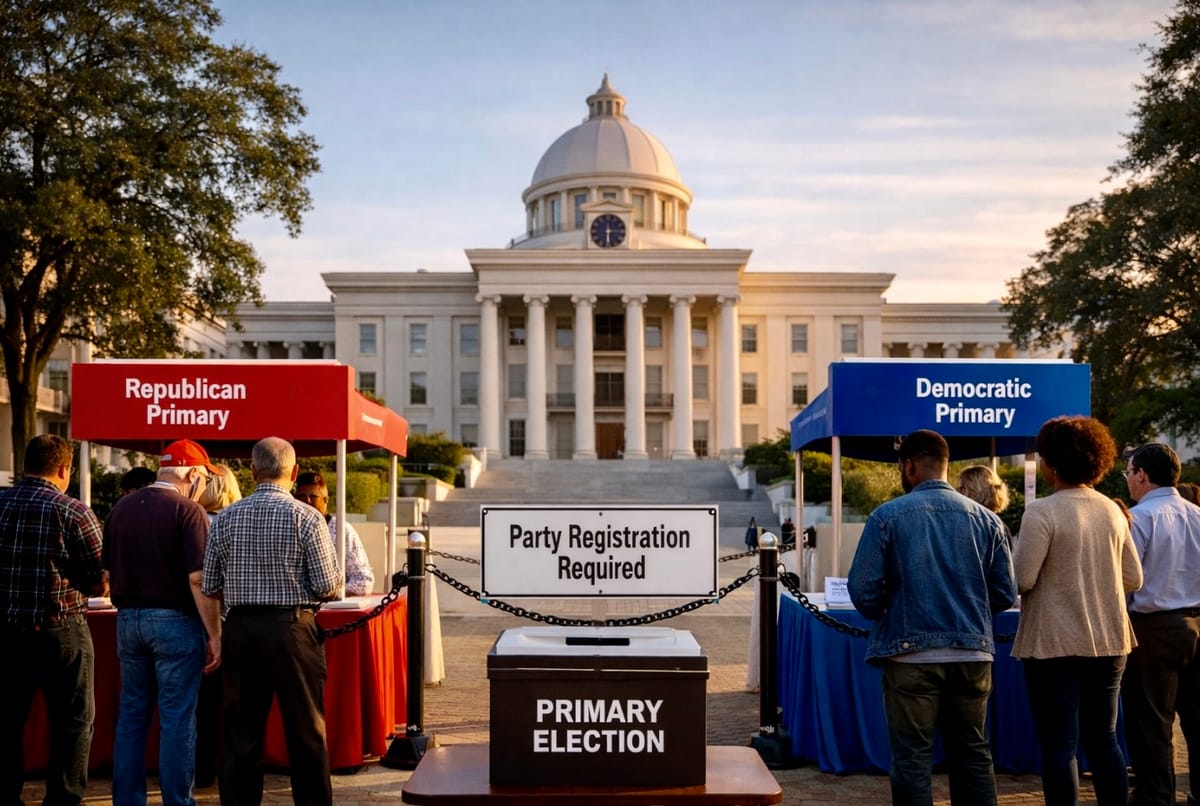
Alabama State Representative Ernie Yarborough (R-Trinity) has filed House Bill 541 (HB541), a proposal that would end the State’s long-standing system of open primaries and require voters to declare a political party in order to vote in that party’s primary election. The change would mark one of the most significant shifts in how Alabamians participate in elections in decades.
Under current Alabama law, voters do not register with a party before entering a primary. On primary day, registrants tell poll workers which ballot they want, and may cross over between parties across different election cycles. HB541 would require voters to register their party affiliation ahead of time and limit primary voting only to those registered with the matching party. HB541 would also impose a “blackout period” of 60 days before the primary, in which voters could not change their party registration.
The push for a closed primary system has been endorsed at the State party level. In August 2022, the Alabama Republican Party passed a resolution calling for party registration and closed primaries so that “only those voters who are declared Republicans should decide who the Republican nominee will be in Alabama elections.”
HB541 would bring Alabama into a group of States where party membership determines primary access. Proponents argue supporters of this reform see it as a way to keep each party’s nomination process within its own base. Critics counter that it will make the State’s already low turnout problem even worse, particularly among independent and younger voters.
Alabama has long struggled with voter participation, especially in non-general elections. In the 2024 presidential election, just 58.5 % of registered voters cast ballots, the lowest Statewide turnout for a presidential contest since 1988.
Turnout for primary elections has been even weaker. According to data compiled by the National Conference of State Legislatures, Alabama’s midterm primary turnout ranged between about 19 % and 25 % of eligible voters over the last few cycles — a chronic challenge that HB541 could worsen by narrowing access.
In at least one smaller race, turnout was shockingly low: a recent Democratic primary in Senate District 5 saw just 0.35 % participation.
Advocates of HB541 and closed primaries contend that only declared party members should choose that party’s nominees. This was a central theme of the GOP’s 2022 resolution. Supporters also say that preventing crossover — where members of one party vote in another’s primary — protects each party’s selection process. Additionally, requiring registration could lead to clearer data on party affiliation and, theoretically, bolster party identity and allegiance.
Opponents of closed primaries warn of significant downsides to closing the primaries. Research on closed versus open primaries shows that systems excluding unaffiliated voters often see lower overall turnout, because independents and casual voters do not participate in the decisive first contests. Also, data from multiple election studies suggests open or non-partisan primary systems tend to draw more voters compared with closed systems.
Currently, unaffiliated voters — a growing segment in many States — are free to choose a ballot and a party on primary day. Under HB541, they would have to declare a party to participate. Some national analyses have suggested that closed systems can give outsized influence to the most partisan voters, but this data is at best inconclusive.
These findings suggest that HB 541, by restricting participation, could deepen Alabama’s longstanding turnout gap — evident even in general elections and stark in primaries.
HB541 was referred to the House Committee on Ethics and Campaign Finance. As of this writing, that Committee is not scheduled to meet on Wednesday, March 4 or Thursday, March 5 per ALISON. With the Alabama Republican Party holding their biannual Executive Committee meeting on Saturday, March 7th, it is likely that HB541 will be a significant topic of discussion there.
If passed, HB541 would require a significant overhaul of Alabama’s voter registration process and change nearly a century of open-primary tradition.
The text of HB541 as initially filed is available HERE.