"Coming From China": Who's Really Foreign in Alabama's Data-Center Fight
Guest Opinion by Alicia Boothe Haggermaker
Guest Opinion by Alicia Boothe Haggermaker
A documented accounting of what was promised, what was built, and who is paying for it. Part 1 of a four-part series.
Assembled With Dependency — Part 1
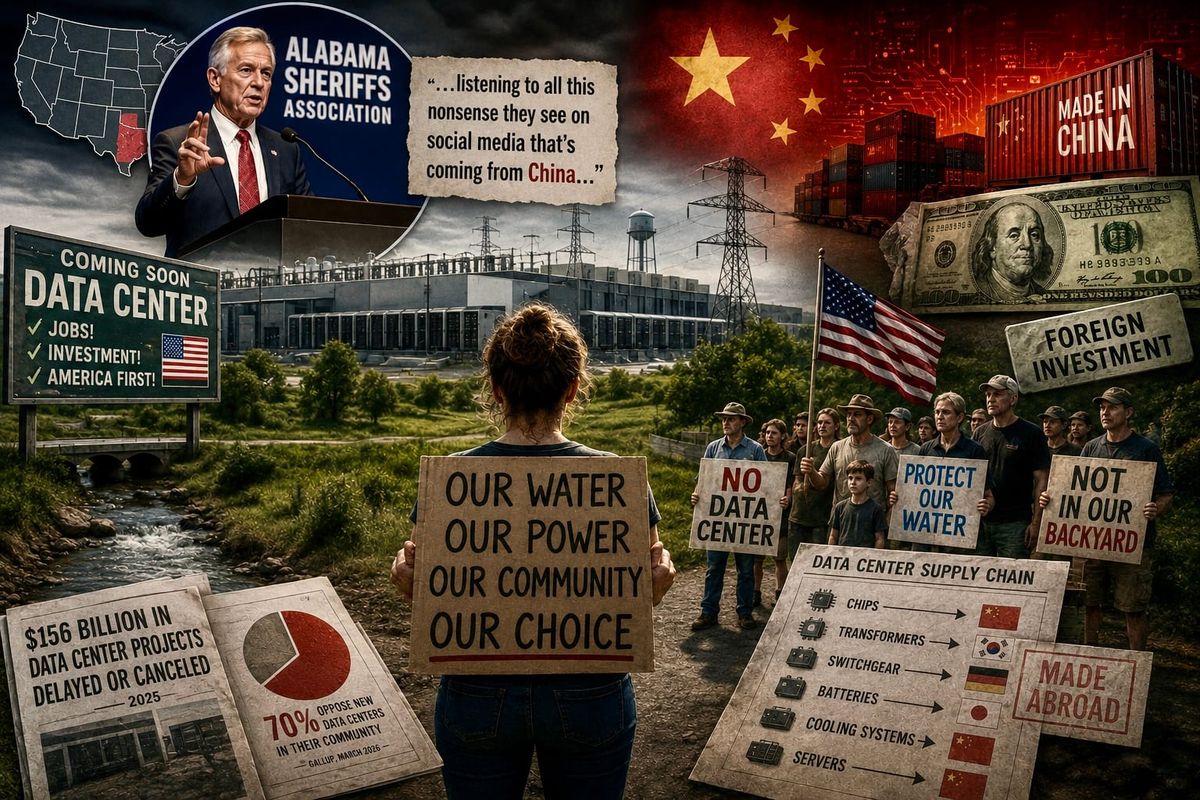
On Monday, July 14, U.S. Senator Tommy Tuberville stood before the Alabama Sheriff's Association's summer conference in Opelika and told the room why he thinks Alabamians are worried about the data centers coming to their communities.
It isn't the water. It isn't the power bills. It isn't the noise, or the strain on rural infrastructure, or the fact that many residents learned about billion-dollar projects next door only after the deals were done.
According to Tuberville — who is now running for governor — the concern is a foreign operation. He dismissed the noise and climate worries as "bull crap," and said people are "listening to all this nonsense they see on social media that's coming from China because China does not want us to grow."
His opponent in the governor's race, former U.S. Senator Doug Jones, called it one of the most ridiculous things Tuberville has ever said, and answered the substance directly: the people raising these concerns aren't foreign agents. They're Alabama families who found out about massive projects in their own communities after the decisions had already been made.
Jones has the better of this, and the documented record is not close.
The opposition is real, domestic, and enormous
Start with the size of the thing Tuberville is attributing to Beijing. A Gallup poll conducted in March 2026 found that roughly 70 percent of Americans oppose the construction of new AI data centers in their own neighborhoods. Local opposition delayed or canceled an estimated $156 billion in data-center projects across the country in 2025 alone. This is not a fringe. It is a supermajority, and it is bipartisan, and it is spread across red states and blue ones alike.
The concerns driving it are specific and physical, not ideological: water consumption, strain on the electric grid, rising residential power costs, noise, and the pattern of communities being told about projects only after the incentives are signed. Just this month, Early County, Georgia, passed an ordinance requiring water-efficient cooling, noise limits, and buffer zones around homes, schools, and churches — and residents showed up to say it still didn't go far enough. That is not a Chinese influence operation. That is a county commission responding to the people who live there.
None of these grievances are imported. They are the documented, on-the-ground effects of the facilities already running — the exact concerns this series will lay out in detail.
It isn't just Tuberville — and that's the story
Here is the part worth paying attention to: the senator did not invent this line, and he is not saying it alone.
Over the past several weeks the same claim has surfaced from a striking range of powerful people. National Public Radio reported in June that tech investors have begun asserting that China is behind the wave of local opposition to data centers — while providing little direct evidence. The Interior Secretary voiced dismay at the rise of local resistance. An investor claimed two citizen groups in Utah were operating on behalf of the Chinese government against his project. And the chairman of the House Energy and Commerce Committee sent a letter asking the FBI director and two of the President's own technology advisers to brief Congress on whether there is evidence of Chinese influence in the data-center debate.
A senator, a cabinet secretary, a committee chairman, and multiple billionaire investors, arriving at the same evidence-thin talking point within the same few weeks. Whatever one concludes about that, it is worth noticing on its own terms — because the effect of the claim, wherever it originates, is identical: it relabels ordinary constituents as foreign subversion, so that no one has to answer the question they actually asked. Tuberville calls the water and noise concerns "bull crap" and attributes them to China in the same breath. Dismiss the people; skip the substance.
Why the China theory doesn't hold
Set aside the politics and look at the incentives, because they run the wrong way for Tuberville's claim.
China profits from this buildout. It manufactures and exports the transformers, the switchgear, and the grid components that American data centers depend on — imports that have roughly doubled in five years. More American data centers means more Chinese sales. A country does not typically run a covert campaign to kill its own customers.
And here is the sharper point: if Beijing genuinely wanted to slow American AI, it would not need a secret social-media operation aimed at county commissioners. It already holds overt, documented leverage over this entire buildout — its dominance of rare-earth processing, and the export controls set to snap back later this year. A country with its hand openly on the supply valve has no reason to whisper. The theory asks you to believe China chose the weakest, most deniable, least effective tool while sitting on the most powerful one.
In fairness, foreign amplification of divisive American debates is a real and general phenomenon, and it is not impossible that some of it touches this issue as it touches many others. But "some foreign accounts amplify a real debate" and "the opposition is coming from China" are entirely different claims — and only the second is the one being made, the one that comes, as NPR noted, with little evidence behind it.
Follow the money, and the map inverts
The final irony is the one that ought to land hardest in Alabama.
If you want to find the genuine foreign entanglement in the American data-center story, it is not on the side of the people opposing these facilities. It is on the side of the people building them. The capital behind the buildout runs heavily through foreign sovereign wealth funds. The most advanced chip fabrication on American soil is owned by foreign companies. Major AI campuses are being built in partnership with state-owned firms from the Gulf. The foreign money in this story is pouring in to construct these facilities — not out to stop them.
Blaming China for the opposition doesn't just misread the public. It points the flashlight in exactly the wrong direction. The people asking where their water is going are local. The money and the ownership are not.
That is where the rest of this series goes. Alabama was promised American workers, American manufacturing, American supply chains, and American communities making their own decisions about their own infrastructure. In the parts that follow, we will trace — with the documented record — what was actually built instead, who financed it, what it draws from the towns that host it, and who is left holding the bill.
The opposition, it turns out, is the most American thing in the whole story.
Next, in Part 2 — The Promise and the Parts: the America First premise, and the documented record of what the supply chain behind the buildout is actually made of.
Alicia Haggermaker is an investigative journalist, systems analyst, and community organizer based in Huntsville, Alabama. She publishes at Unprecedented Times and is the founder of the Mycelium Network. The complete version of this series appears at unprecedentedtimes.org.
Sources (Part 1):
WBRC and 1819 News reporting on Senator Tuberville's remarks at the Alabama Sheriff's Association conference, July 14, 2026; WBRC statement from Doug Jones; WTVY reporting on the Early County, Georgia ordinance; NPR, "Tech moguls claim China funds U.S. data center opposition," June 10, 2026; Gallup polling on data-center opposition, March 2026; S&P Global and industry reporting on delayed and canceled data-center projects, 2025–2026; Coalition for a Prosperous America import data on transformers, switchgear, and batteries.
Opinions do not reflect the views and opinions of ALPolitics.com. ALPolitics.com makes no claims nor assumes any responsibility for the information and opinions expressed above.