Everybody Knew — Part IV: Prophecy Is a Warning, Not a Mission Statement
Part IV of the “Silence Becomes the System” series— Guest Opinion by Alicia Boothe Haggermaker
Guest Opinion by Alicia Boothe Haggermaker
If the Bible warns that many will be deceived, the safest place to begin is by asking whether that warning might include us.
At the end of the last piece, I asked a simple question.
If Jesus walked the earth today, would he protect the systems that demand silence — or would he flip their tables?
It’s a question many people think they already know the answer to.
But when we look honestly at how faith is often used in modern public life, the answer may not be as comfortable as we assume.
Because we live in a moment where the same Bible that warns repeatedly that many will be deceived is now being quoted by people insisting that war must happen in order to fulfill prophecy.
And almost none of them stop to ask the obvious question:
What if we are the ones being deceived?
Instead, people charge forward with absolute certainty.
No hesitation.
No reflection.
Just conviction.
But if deception truly is widespread, the most dangerous assumption any of us can make is believing it could never include us.
Prophecy Was Meant to Prevent Catastrophe
In the Bible, prophecy wasn’t originally treated as a script humanity needed to help fulfill.
It functioned more like a warning system.
Consider the story of Jonah and the city of Nineveh.
Jonah warned that Nineveh would be destroyed.
But when the people changed course, the disaster never happened.
The prophecy worked because people listened.
It wasn’t destiny carved in stone.
It was a warning about where their path was leading.
Scripture Even Explains This
The Bible itself explains that prophecy is conditional.
In Jeremiah 18:7–8:
If I announce that a nation will be uprooted and destroyed, but that nation turns from its ways, I will relent of the disaster I planned.
Prophecy describes the consequences of a path, not an unavoidable fate.
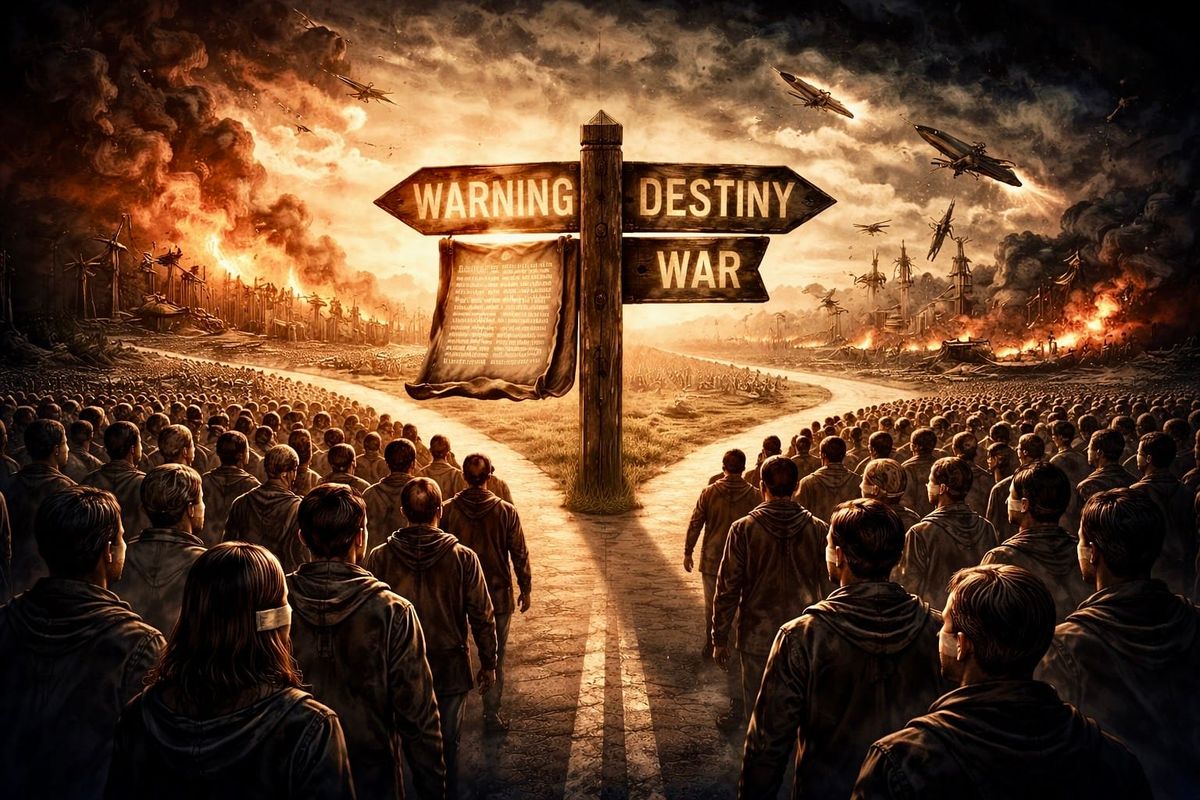
It’s a warning sign on the road ahead — not a checklist we are supposed to help bring about.
When Warnings Become Mission Statements
Somewhere along the way, something flipped.
Instead of asking how catastrophe might be avoided, many people began asking something very different.
How do we make sure prophecy happens?
Prophecy stopped being treated like a warning and started being treated like a mission statement.
Once people begin trying to force events to match prophecy, discernment disappears.
Questions disappear.
And people become very easy to manipulate.
The Sin We Rarely Talk About
There’s another uncomfortable piece of this conversation that often gets overlooked.
Blasphemy.
Most people think blasphemy simply means saying something disrespectful about God.
But biblically, blasphemy was much deeper than that.
Blasphemy meant claiming God’s authority for actions that do not reflect God’s character.
Using the name of God to justify human pride, power, or violence.
The danger isn’t disrespect.
It’s misrepresentation.
Taking God’s Name in Vain
One of the Ten Commandments in Exodus warns:
You shall not take the name of the Lord your God in vain.
Many people interpret that as avoiding profanity.
But historically, taking God’s name in vain meant using God’s authority falsely.
Claiming divine approval for things God never endorsed.
Using God as a stamp of approval for human agendas.
Pride Disguised as Faith
Throughout history, some of the worst violence has been carried out by people convinced they were acting in God’s name.
Religious certainty can easily drift into something dangerous:
pride disguised as righteousness.
Pride convinces people their interpretation cannot be wrong.
That their cause must be divine.
That questioning them is equivalent to questioning God.
But pride blinds people.
The most dangerous people in history are often the ones who are absolutely certain that God agrees with them.
When Faith Turns Into Idolatry
The Bible warns about another danger closely tied to pride.
Idolatry.
Most people imagine idols as statues.
But biblically, idolatry simply means giving ultimate loyalty to something created instead of God.
And idols can take many forms:
Money
Power
Political movements
Even nations
When Nations Become Sacred
Today many believers treat the modern state of Israel as if it carries automatic divine approval.
Support for Israel is often rooted in sincere faith.
But the Israel described in scripture and the modern political state are not identical.
Ancient Israel was a covenant community built around obedience to God’s law.
Modern Israel is a contemporary nation-state with political institutions and human leaders like any other country.
Recognizing that distinction doesn’t mean hostility toward Israel.
It simply means acknowledging that no modern government carries automatic divine endorsement.
Because when a nation becomes beyond moral questioning, faith can quietly become something else:
turning a nation into an idol and calling it faith.
A Surprisingly Recent Interpretation
Many Christians assume modern geopolitical support for Israel as prophecy has always been part of Christian belief.
Historically, it hasn’t.
The idea gained widespread popularity in the 19th century through the theology of John Nelson Darby.
Those interpretations spread through prophecy conferences, study Bibles, and modern Christian media.
For many believers today, that framework feels ancient.
But historically speaking, it is a relatively modern interpretation layered onto ancient texts.
Which makes humility about interpretation even more important.
The Other Pattern Scripture Warns About
If we ask what Jesus would do, we should also recognize the opposite pattern scripture describes.
In the Gospels, deception rarely appears as obvious evil.
It appears as truth mixed with pride.
In Matthew 4, scripture itself is quoted in an attempt to justify misuse of power.
The danger wasn’t rejecting scripture.
The danger was using scripture to justify the wrong actions.
When Violence Was Used in Jesus’ Defense
One of the most revealing moments in the Gospels occurs the night Jesus was arrested.
A disciple drew a sword to defend him.
According to Matthew 26:52, Jesus responded:
"Put your sword back in its place… for all who take the sword will perish by the sword."
The disciple believed he was defending Jesus.
But he was misunderstanding everything Jesus had been teaching.
Moments like this reveal something uncomfortable about human nature.
People often believe they are defending their faith when they are actually contradicting it.
And Christianity is not unique in this.
Across religions and throughout history, people have justified violence in the name of God, prophecy, or their messiah — convinced they were protecting the very thing they were distorting.
The pattern isn’t limited to one tradition.
It is a human one.
The Silence That Changed History
The story of Jesus itself unfolded in a moment of silence.
Religious leaders saw him as a threat.
Political leaders saw him as a problem.
Crowds that once praised him grew quiet when it became dangerous to stand beside him.
Very few people spoke when it mattered most.
The same pattern that allows systems to protect themselves today was already present two thousand years ago.
Silence.
Maybe We’re Reading It Backwards
What if prophecy was never meant to inspire humanity to run toward catastrophe?
What if it was meant to make us pause long enough to avoid it?
Real faith probably doesn’t look like cheering for war.
It looks like humility.
It looks like questioning the crowd.
It looks like resisting the urge to wrap our own certainty in God’s name.
Which leaves us with a question that may be more important now than ever:
What would Jesus actually do today?
Truth has always had a way of flipping tables.
The real question is whether we have the courage to stand when it does.
But there is another question that follows close behind it.
What actually happens when violence becomes the answer to everything we fear?
Because history suggests that war doesn’t just eliminate extremism.
In many cases, it creates the conditions that allow it to grow.
That is the pattern we turn to next.
The first part of this series may be read HERE, the second part HERE, and the third HERE.
Alicia Boothe Haggermaker is a lifelong resident of Huntsville, Alabama, and a dedicated advocate for health freedom. For more than a decade, she has worked to educate the public and policymakers on issues of medical choice and public transparency. In January 2020, she organized a delegation of physicians and health freedom advocates to Montgomery, contributing to the initial draft of legislation that became SB267.
Opinions do not reflect the views and opinions of ALPolitics.com. ALPolitics.com makes no claims nor assumes any responsibility for the information and opinions expressed above.