Everybody Knew — Part VI: The Most Dangerous Thing in the World
The conclusion to the Everybody Knew series— Guest Opinion by Alicia Boothe Haggermaker
Guest Opinion by Alicia Boothe Haggermaker
Throughout this series, we’ve examined silence from several angles.
We looked at communities that stayed quiet while warning signs accumulated around them. We examined the social pressure that punishes people who speak too early. We asked what moral courage looks like when the crowd is moving in the wrong direction. We explored how faith can be used to justify violence, and how war often creates the extremism it claims to defeat.
Each of those pieces pointed to the same pattern from different directions.
But there is a deeper thread running beneath all of them.
Silence is not the root problem.
Silence is the symptom.
The root problem is something more seductive and far more dangerous:
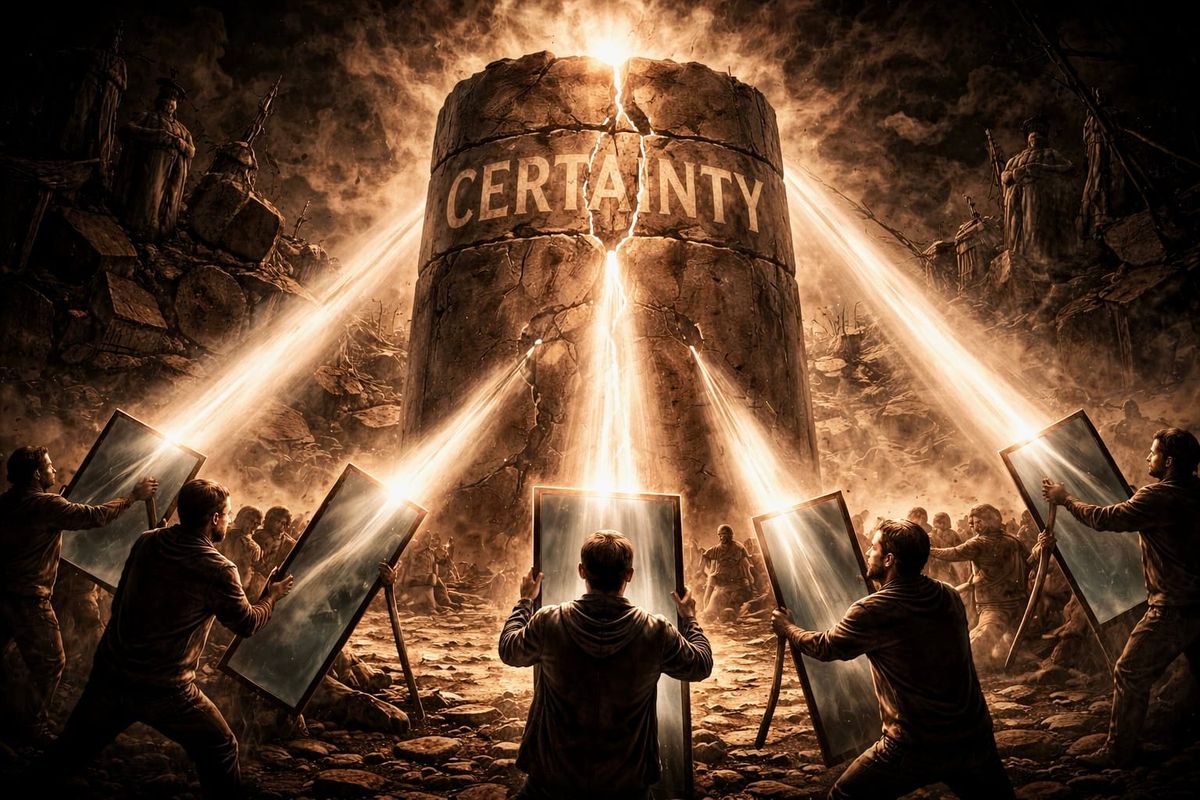
certainty without accountability.
Certainty feels powerful. It feels like clarity — the sense that you finally understand something others cannot see.
That feeling is not always wrong.
Many of the people who changed history were certain. Abolitionists were certain. The suffragists were certain. The people who hid Jewish families during the Holocaust were certain.
But they were also accountable.
Accountable to evidence. Accountable to conscience. Accountable to the lives of real people affected by their decisions.
That accountability is what separates moral conviction from something far more dangerous.
The moment certainty removes itself from accountability — the moment a person, institution, or movement decides it cannot be questioned — something shifts.
And that shift is where many of the harms we examined in this series begin.
Look across the patterns we’ve explored.
Communities that protected abusers weren’t just staying silent. They were protecting a certainty — the belief that the respected person at the center of the community couldn’t possibly be guilty.
Institutions that buried scandals weren’t just making legal calculations. They were protecting the certainty that their reputation must remain intact.
Theological movements that turned prophecy into a mission statement weren’t just misreading scripture. They were elevating their interpretation beyond question.
Governments repeating military strategies that history shows often create new extremist movements aren’t simply making strategic mistakes. They are operating from the certainty that decisive force will solve the problem.
Different stories.
Same architecture.
Certainty that has insulated itself from accountability.
And once that insulation exists, systems begin to defend themselves.
They elevate certain voices beyond questioning. They frame scrutiny as disloyalty. They reward silence and punish those who speak. They wrap their assumptions in authority — religious authority, institutional authority, political authority — until questioning the certainty feels like attacking the system itself.
But accountability is not destruction.
One of the ways systems protect unaccountable certainty is by convincing people that accountability means tearing everything down. That asking difficult questions is dangerous.
It isn’t.
Accountability simply means remaining answerable to something outside ourselves.
Answerable to evidence when it contradicts our assumptions.
Answerable to the people affected by our decisions.
Answerable to the distance between what we claim to believe and how we actually behave.
That kind of accountability requires something most systems quietly discourage:
humility.
Not weakness. Not self-erasure.
Real humility — the willingness to ask an uncomfortable question:
What if I’m wrong?
Those questions are difficult. But they are also the questions that separate certainty that protects people from certainty that harms them.
Every piece in this series has circled the same moment.
The moment when someone sees something wrong and has to decide what to do with it.
Stay quiet and protect the system.
Or speak and accept the cost.
That choice isn’t only about courage.
It’s about accountability.
The person who speaks is holding themselves accountable to what they know.
The person who stays silent is often protecting the certainty that silence is safer.
And that is the choice every society faces.
Not silence versus courage.
Accountability versus the comfort of certainty left unchallenged.
We live in a moment saturated with certainty.
Algorithms reinforce what we already believe. Institutions defend their reputations. Ideologies assume their own goodness and identify convenient enemies.
In that environment, the most radical thing a person can do is remain accountable.
Accountable to complexity.
Accountable to evidence.
Accountable to the people affected by the systems we participate in.
Because the people who changed history were not those who eliminated doubt.
They were the ones who refused to let certainty become an excuse for ignoring it.
This series began with a quiet sentence whispered after every scandal:
“Yeah… we kind of knew.”
It ends with a harder question.
Not just why no one stopped it.
But what certainties we are protecting right now that we may one day have to answer for.
Because silence protects systems.
Accountability protects people.
And history rarely asks whether people knew.
It asks what they did once they did.
The first part of this series may be read HERE, the second part HERE, the third HERE, the fourth HERE, and the fifth HERE.
Alicia Boothe Haggermaker is a lifelong resident of Huntsville, Alabama, and a dedicated advocate for health freedom. For more than a decade, she has worked to educate the public and policymakers on issues of medical choice and public transparency. In January 2020, she organized a delegation of physicians and health freedom advocates to Montgomery, contributing to the initial draft of legislation that became SB267.
Opinions do not reflect the views and opinions of ALPolitics.com. ALPolitics.com makes no claims nor assumes any responsibility for the information and opinions expressed above.