FY2026 NDAA Bolsters Alabama’s Defense and Research Role
Defense bill backs Redstone, Anniston, and Maxwell, shapes national science, AI, and nuclear policy
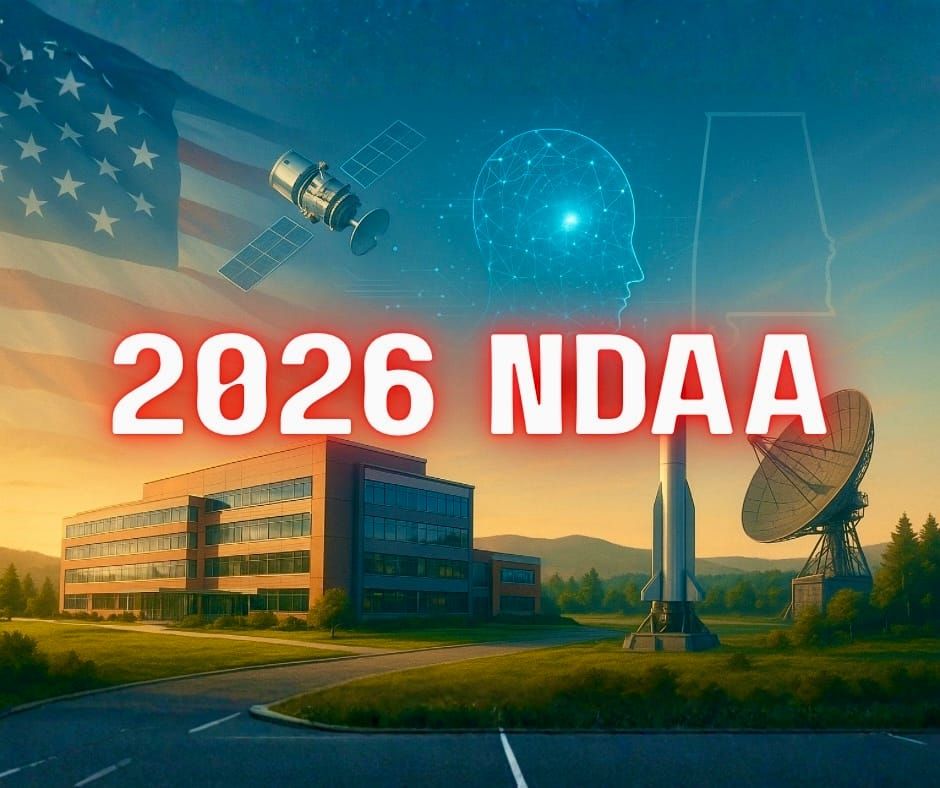
The final version of the National Defense Authorization Act (NDAA) for fiscal year 2026 sets national defense priorities while delivering direct benefits to States with deep military and research ties, including Alabama. The 3,086-page bill governs Pentagon policy, authorizes defense spending, and outlines federal rules affecting scientific research, emerging technologies, and national security.
For Alabama, the NDAA reinforces the State’s role as a cornerstone of missile defense, advanced research, and military readiness. Funding authorized in the bill supports infrastructure and modernization at key installations, most notably Redstone Arsenal in Huntsville, Anniston Army Depot, and Maxwell Air Force Base.
At Redstone Arsenal, the NDAA authorizes funding tied to advanced research facilities, including support for a physics laboratory and completion of the Propulsion Systems Building. These investments align with Redstone’s expanding mission in missile defense, space, and propulsion research and further anchor Huntsville’s reputation as a national defense technology hub.
The bill also supports construction and modernization efforts at Anniston Army Depot, a critical logistics and maintenance center, and Army Reserve facilities at Maxwell Air Force Base in Montgomery. Together, these projects sustain thousands of jobs and feed into Alabama’s broader defense economy, which contributes more than $23 billion annually Statewide.
The NDAA shapes the research environment that underpins Alabama’s defense ecosystem, beyond physical infrastructure development. The bill extends an existing policy limiting Department of Defense funding for fundamental research collaborations with institutions in China and Russia, while allowing waivers in specific cases. More sweeping research security proposals, including the SAFE Research Act, were excluded after concerns from universities and scientific groups that the language was overly broad and could hinder collaboration.
The NDAA also incorporates biosecurity and investment restrictions aimed at protecting sensitive technologies. Language drawn from the BIOSECURE Act limits federal contracts with certain biotechnology firms tied to foreign adversaries, while provisions from the Comprehensive Outbound Investment National Security Act seek to curb U.S. investment in strategic technologies in countries such as China and Russia.
For Alabama’s research universities and defense contractors, grant policy clarity was another key outcome. The bill blocks the Secretary of Defense from changing indirect cost reimbursement models unless a new approach is developed “in consultation with the extramural research community” and includes a reasonable transition period. Earlier proposals that would have expanded Pentagon-directed university partnerships in critical technology areas were ultimately removed.
Artificial intelligence remains a central focus of the NDAA, with potential downstream effects for Alabama’s defense research sector. The bill directs the Pentagon to establish one or more National Security and Defense Artificial Intelligence Institutes at Universities conducting DOD-funded research. These institutes would be supported through competitive five-year grants and focus on foundational AI science, workforce development, and public-private collaboration—areas where Alabama institutions and contractors are already active.
The NDAA also advances nuclear and missile defense policy. It establishes an Advanced Nuclear Transition Working Group and supports modernization efforts tied to nuclear deterrence and missile defense, including the Golden Dome initiative. Regular reporting requirements and funding shifts aim to accelerate development while keeping programs under direct military oversight.
In total, the FY2026 NDAA underscores Alabama’s strategic importance to U.S. defense and research policy. From Redstone’s labs to Anniston’s depots and Maxwell’s training missions, the bill positions the State to remain a central player in national security, scientific innovation, and military readiness in the years ahead.
The NDAA passed the House last week, and now awaits action by the Senate.