
Growing Old Offline in Alabama Depends on your County
Alabama's senior broadband gap runs from 11% in Shelby County to 55% in Greene, with DeKalb at 25%. A county-by-county look at the divide.
By the CompareInternet Research Team
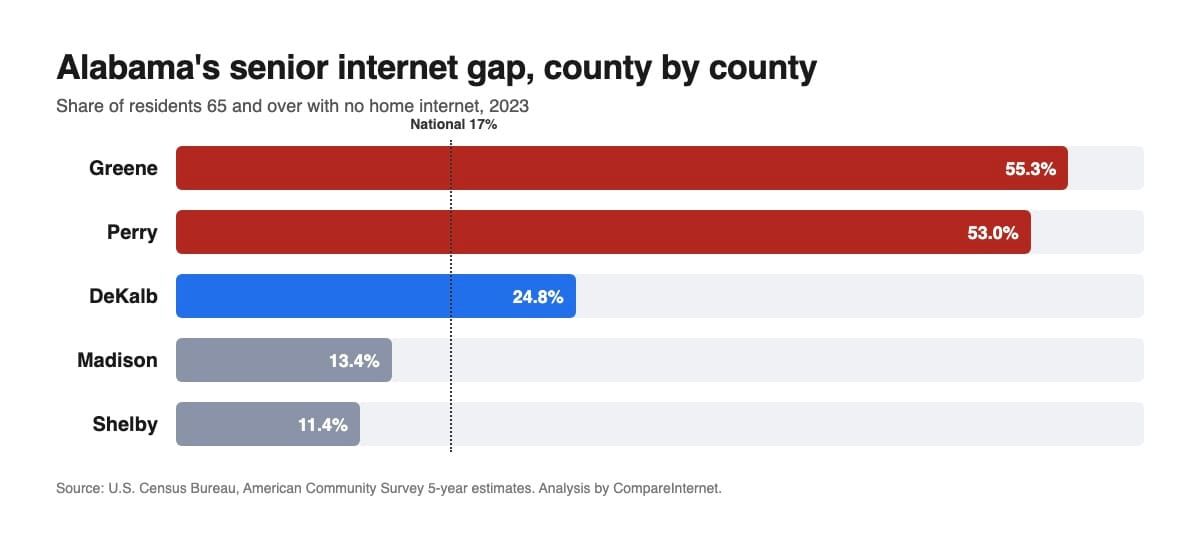
In Greene County, more than half of the residents over 65 have no internet where they live. In Shelby County, it is closer to one in nine. Same state, same year, same technology, and a gap that wide between two groups of Alabama seniors. The difference is not about age or interest. It is about where a person happens to grow old.
DeKalb County sits in between, and closer to the hard end. Our analysis of the latest Census figures at CompareInternet shows 2,970 residents over 65 in DeKalb with no internet at home, about 24.8 percent of the county's seniors. That is higher than Alabama's rate of 22.5 percent, which is itself well above the national figure of 17 percent. Another 5,221 households in the county rely on a cell phone plan with no home connection behind it.
Line the counties up and the spread is stark. At the widest end are the Black Belt counties, Greene at 55 percent and Perry at 53 percent, where a majority of seniors have no home connection at all. At the other end sit the suburbs of the state's biggest metros, Shelby near 11 percent and Madison, around Huntsville, at about 13 percent. From worst to best, that is close to a fivefold difference inside a single state.
For an older person, that gap is not an abstraction. More of later life now runs online whether anyone chose it or not. Doctors send results and messages through patient portals. Pharmacies handle refills and reminders on the web. Medicare, Social Security, and benefit programs increasingly point people to a website first and a phone line second. A senior without a home connection is left to manage all of it from a parking lot, a library, or a relative's phone, or simply to go without.
Picture a 74-year-old in one of these counties whose doctor's office has moved booking and test results entirely online. She owns no computer, or owns one thatcannot get online, so every result becomes a phone call she has to start, every refill a trip into town, every new form a favor asked of a grandchild. None of that is impossible. All of it is harder, slower, and lonelier than it needs to be, and it repeats every week.
Even the word connected hides part of the problem. In DeKalb County alone, 5,221 households get by on a cell phone plan and nothing more. A phone is fine for a call or a text. It is a poor tool for a telehealth visit, a long benefits application, or reading the fine print on an insurance form, which is exactly the work these systems now ask of older adults.
The senior numbers are the sharpest edge of a wider divide. The counties that strand their oldest residents tend to strand their students and working families too, because a household either has a real connection or it does not, no matter who lives there. Seniors just feel it first and hardest, since so much of what they depend on has moved online fastest.
None of this falls randomly. The gap tracks income, rural distance, and the long shadow of disinvestment, which is why it lands hardest in the Black Belt and lightest in the wealthier suburbs. The counties where seniors are most likely to be offline are also the ones with the fewest providers competing for their business and the least infrastructure already in the ground. The market has sorted them to the back of the line.
The distance between Greene County and Shelby County was not handed down by fate. It is the sum of decisions about where lines got built, which customers were worth chasing, and which places were left to wait. That means it can be closed the same way, on purpose, through the broadband programs, provider discounts, and local access points that already exist but rarely reach the people who need them.
The first step is refusing to treat a number like 55 percent as normal, and putting the county-by-county spread where the public and the officials who answer to them can see it.
Source: U.S. Census Bureau American Community Survey, tables B28005 (age and home internet) and B28002 (how households connect). Full study: https://www.compareinternet.com/blog/how-many-american-households-have-no-home-internet/