Gutted HB475 passes the Alabama Senate and House in One Day
Rep. Mack Butler’s reform effort was mangled in the Senate, but miraculously passed both Houses to preserve the status quo (and our sky-high rates)
House Bill 475 (HB475) did not just change in the Senate. It was eviscerated, stuffed and mounted like a fish on the wall.
What began as a serious, long-overdue effort to bring transparency and accountability to Alabama’s utility system ended as a weakened substitute — one that preserves the very structure it was meant to challenge.
The House passed the original bill unanimously. That version demanded answers. It required public rate hearings, tightened oversight of utility profits, and forced the Alabama Public Service Commission (PSC) to operate in the open.
The final version does none of that in any meaningful way.
The version of HB475 introduced by Representative Mack Butler (R-Rainbow City) took direct aim at a system that has operated for decades with limited public scrutiny.
It required formal rate cases — real hearings with sworn testimony and cross-examination. It would have forced utilities to justify their pricing in public, not behind closed doors.
It also sought to rein in profits by tying returns to regional norms, a move that could have put real pressure on electricity costs.
And it drew a clear line: ratepayers should not foot the bill for lobbying, advertising, or political activity.
This was not cosmetic reform. It was structural, and would have addressed a number of issues many Alabamians had been wanting.

As originally filed, HB475 would “require the PSC to hold public hearings on electricity rates,” a basic expectation in many other States.
For once, there was broad agreement 9n the House. The system needed sunlight — and HB475, as introduced, would have brought that light.
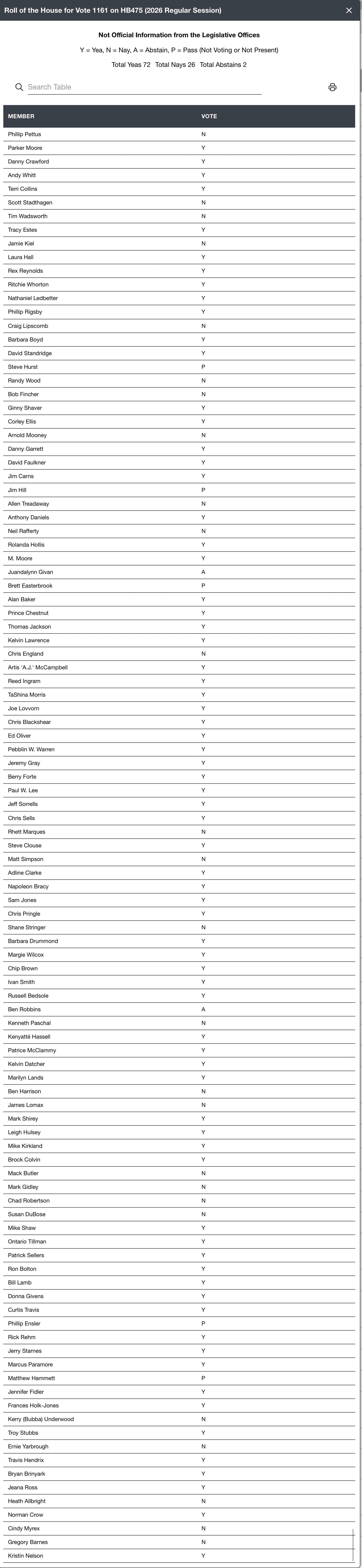
But, by the time HB475 cleared the Senate and was shoved back through the House, its backbone and guts were gone. Tellingly, Rep. Butler — who introduced it — voted against the final form of the bill on Wednesday.
The original bill required formal, courtroom-style rate cases. That provision is gone.
The final bill allows the PSC to continue operating largely as it has—without being forced to defend rate decisions in a full public setting.
The central reform was simply removed, as if it had never been.
The original bill would have tied profits to regional benchmarks and required detailed justification.
The final bill leaves the existing Rate Stabilization Equalization (RSE) system intact.
There are no meaningful new limits. No real pressure. No structural change.
The original bill clearly barred utilities from charging customers for lobbying and advertising.
The final version keeps some of that language, but in a softened form that raises real questions about enforcement.
What was once firm is now flexible. Flaccid, even.
The original bill imposed strict requirements on the PSC, with real consequences for failure — including impeachment provisions.
Those consequences are gone.
The PSC is still asked to meet and report. It is no longer compelled to answer.
In place of substantive reform, the final bill adds a new Secretary of Energy and adjusts the structure of oversight — provisions that had been a point of contention as part of another PSC bill, SB360, and were grafted onto HB475.
As now enrolled, HB475 shifts power to the Governor’s Cabinet-level Energy Czar. It does not fix the problems.
And who benefits? It’s not regular Alabamians, no matter what pretty press releases say. And it’s no great secret who gains the most from the bill.
Utilities opposed the original bill. Public hearings would have opened their books. Profit limits would have cut into margins. Real scrutiny would have changed the balance of power.
They pushed back.
Senate leadership followed with a familiar argument: stability, predictability, caution.
What that meant in practice was stripping out the parts of the bill that actually mattered.
Consumer advocates supported the original version. They lost.
One blunt assessment from Energy Alabama captured the result: “HB 475 is now a wolf in sheep’s clothing.” And, “Alabama Power won the negotiations.”
It‘s hard to argue otherwise.
HB475 is not an isolated case. This session has seen a profusion of PSC bills come up, and then die under the weight of public outrage.
This same legislative session saw movement on SB360, the so-called “Power to the People Act,” another measure many said favors utility interests over ratepayers. Like the revised HB475, it also flew through the Senate without any opposition.
I’m sure that’s purely coincidental. That, and the remarkable resemblance of some of the provisions in SB360 that made their way into HB475.
Taken together, the message is clear. Reform efforts can advance. They can even pass the House. But by the time they reach final passage, they often look very different from their initial form.
The fish in the lake and the fish on the wall are both technically fish, but….
The original HB475 was a serious attempt to force transparency into Alabama’s utility system. It would have required utilities to justify their rates in public and placed real limits on how those rates are set.
The final version does not.
It adds process. It avoids confrontation. Ultimately, it leaves the core system untouched.
This is not a compromise that preserved the best parts of the bill. It is a retreat from them — if not a complete undoing.

Alabama had a chance to demand answers from its utility system.
Instead, it will now be forced to settle for a bill that asks fewer questions — and expects even fewer answers.
To add insult to injury, HB475 passed out of the Senate committee Tuesday — reportedly without the final, very much altered bill being available to be read by the committee before the vote — then unanimously passed the Senate on Wednesday before being immediately sent to the House.
Yes, that’s right: HB475 passed both the Senate and the House on Wednesday, and now has been sent to Governor Ivey — and the calls for her to veto it have already started.
It’s doubtful she will veto it. And, when it’s signed?
That’s when things will get interesting.
Because for weeks now, the PSC has been THE topic that’s riled up the rank and file all across the political spectrum. Now, all those restless natives have just been shown, decisively, that what they want doesn’t matter.
And this is an election year. At least in the Republican Party, there are petitions that have already been circulated on another issue, and rumors are being passed around about more in the works that directly address this session’s PSC shenanigans.
Remember, the vote out of the Senate was unanimous. And below is the roll call of the House’s final vote on HB475, so you can see just how every Representative voted.
Dr. Bill Chitwood is the Managing Editor of ALPolitics.com. He is the author, under his nom de guerre Doc Contrarian, of Beyond MAGA: From Trump campaign slogan to political movement to restoring the Republic. He identifies as Conservatarian Contrarian and a staunch Constitutional Originalist. He enjoys being called a First Amendment Nazi — mainly because he is.
Opinions do not reflect the views and opinions of ALPolitics.com. ALPolitics.com makes no claims nor assumes any responsibility for the information and opinions expressed above.