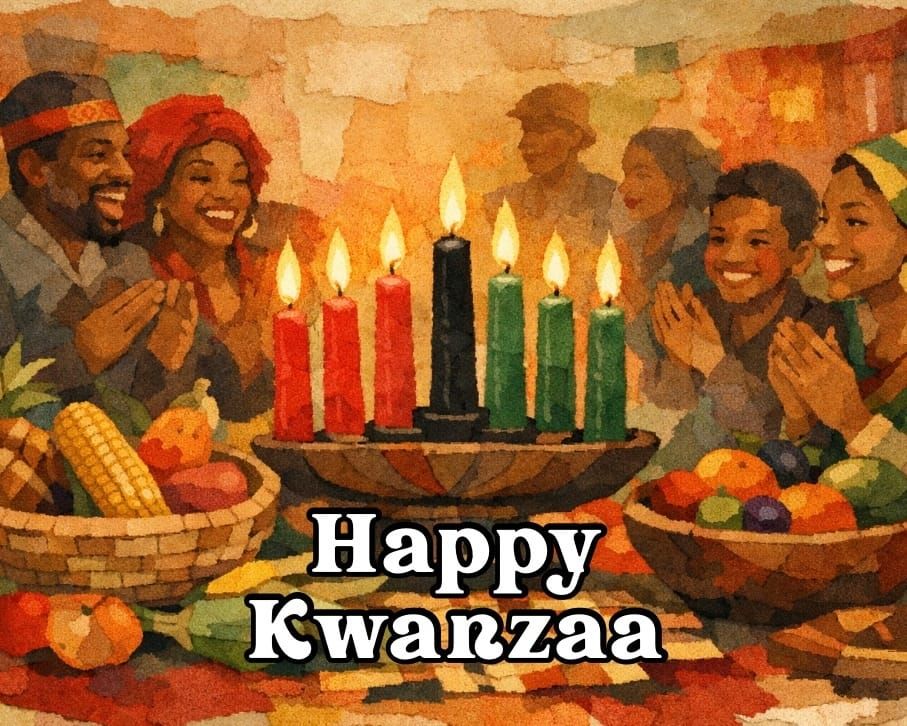
Happy Kwanzaa!
Kwanzaa begins today, a seven-day celebration of African heritage and the Nguzo Saba principles from Dec. 26 through Jan. 1, focusing on unity, purpose and community
Today marks the first day of Kwanzaa, a week-long celebration that honors African heritage, community and cultural values. The holiday runs annually from December 26 through January 1, with each day dedicated to one of seven guiding principles.
Kwanzaa was created in 1966 by Dr. Maulana Karenga, a professor of Africana studies, during the Black Freedom Movement. Karenga designed the observance as a way to help African-American families reconnect to traditions disrupted by centuries of slavery and systemic oppression. The name comes from the Swahili phrase matunda ya kwanza, meaning “first fruits,” and the extra “a” was added to allow for seven symbolic letters.
This year’s celebration begins today, Friday, Dec. 26, with the lighting of the first candle on the kinara, a seven-branched candleholder. Families and communities gather in homes, cultural centers and public events to reflect on the principles, share meals and enjoy music, storytelling and other traditions.
Each of the seven days of Kwanzaa highlights a core value in the Nguzo Saba (Seven Principles):
- Dec. 26 — Umoja (Unity): Strive for and maintain unity in family, community, nation and race.
- Dec. 27 — Kujichagulia (Self-Determination): Define and name ourselves, create for ourselves and speak for ourselves.
- Dec. 28 — Ujima (Collective Work and Responsibility): Build and maintain community together and solve problems jointly.
- Dec. 29 — Ujamaa (Cooperative Economics): Support and sustain our own businesses and economic well-being.
- Dec. 30 — Nia (Purpose): Make collective work and community building a central goal.
- Dec. 31 — Kuumba (Creativity): Do what we can to make community life more beautiful and beneficial than inherited.
- Jan. 1 — Imani (Faith): Believe with all our hearts in our people, leaders and the righteousness of the struggle.
Traditions often include lighting one candle each night, sharing stories, giving gifts that reflect thought and learning, and gathering for a communal feast, called the karamu. Families also display symbolic items such as ears of corn for children, fruit representing the harvest and a unity cup.
While Kwanzaa is not a federal holiday, it has grown in recognition and practice over decades. It is observed by many alongside other winter holidays, and its values are embraced by people of diverse backgrounds interested in cultural heritage and community building.
If you’d prefer a slightly different take on Kwanzaa—that it “is a fake holiday invented in 1966 by black radical/FBI stooge Ron Karenga—aka Dr. Maulana Karenga, founder of United Slaves, the violent nationalist rival to the Black Panthers” who went around gunning down Panthers in the street—and celebrated almost exclusively by DEI-besotted white liberals, Ann Coulter’s classic 2019 essay on Kwanzaa may be found HERE. An earlier version, circa 2008, can be read at THIS LINK.