House Passes SB71 After Sharp Debate on Environmental Standards
Alabama House OKs SB71, barring State rules stricter than federal ones; supporters cite certainty, critics warn of weakened pollution safeguards
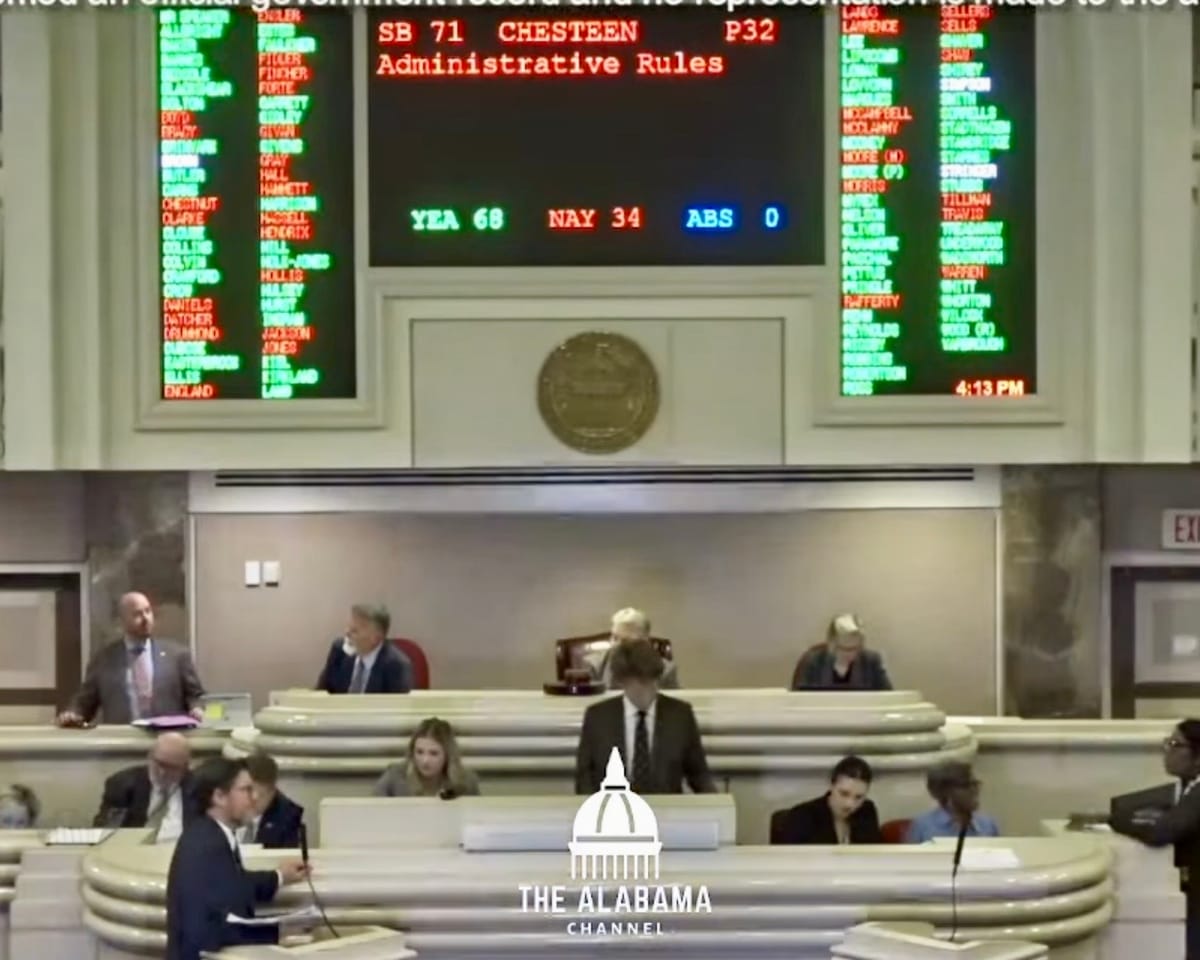
After a heated debate that reflected deep policy differences over environmental protection and regulatory authority, the Alabama House of Representatives voted to pass Senate Bill 71 (SB71) on Tuesday. The measure now moves to the Governor’s desk following a 68-34 vote on the chamber floor.
Representative Troy Stubbs (R-Wetumpka), who carried the bill in the House, introduced the bill by saying, “SB71 is a bill related to regulatory rules, and specifically provides a framework by which the State of Alabama can operate to provide stability for our businesses, our farmers and others throughout the State.”
“This bill provides a way in which the State of Alabama can pass its own regulations related to the environment, in the event that the federal government does not address those particular matters,” Stubbs continued. “We will, in those cases, use generally accepted scientific practices and sound science rules to do that. This bill is a limited government bill. It maintains the authority with the State of Alabama to ensure that we are protecting the people of Alabama and the industries and farmers that support our State.”
The legislation, sponsored by Sen. Donnie Chesteen (R-Geneva), would stop State agencies from adopting environmental rules that are more stringent or expansive than existing federal standards. Under SB71, if a federal rule is in place on a given issue — from water quality to hazardous waste handling — Alabama’s agencies may not go beyond that baseline. In areas where no federal rule exists, State regulators could act only if limits are backed by what the bill calls “best available science” and the “weight of scientific evidence.”
Supporters of the bill argued that the measure brings clarity and fairness to the regulatory process. They said it prevents unelected agencies from imposing costly, unpredictable rules that exceed what Washington requires, helping businesses and families by limiting red tape. This line of defense reflects broader conservative concerns about regulatory overreach and economic burden.
Critics inside and outside the Legislature warned that the bill could weaken Alabama’s ability to protect public health and the environment. Opponents of SB71 and its House companion, HB162, said the measure effectively locks Alabama into federal standards — some of which they argue are too lax or don’t exist at all for many toxic substances such as arsenic, cyanide, and PFAS “forever chemicals.”
In late January, Eagle Forum of Alabama urged health professionals to oppose the bill, saying that “State agencies with limited resources would be required to show a ‘direct causal link’ to harm” and would be barred from setting rules based on increased risk of disease — an approach they argue is “out of step with public health science.”
Environmental advocates, including the Southern Environmental Law Center, issued warnings that SB71 and HB 162 could strip State authority over water and air pollution protections and force reliance on federal standards that may not address local risks or science. They maintained that federal rules should be viewed as minimum safeguards, not the ceiling.
The final House vote largely split along party lines: most Republicans supported the bill, while Democrats opposed it, arguing that Alabama should retain the ability to respond to specific threats and protect vulnerable communities.
Supporters say the bill will deliver regulatory certainty and economic predictability. Detractors counter that it could delay or block State action on pollutants until harm is clearly shown in humans — a threshold many scientists say is rarely met before harm occurs.
If signed by Gov. Ivey, SB71 will take effect immediately.
Tuesday’s House session, including the debate on SB71, may be viewed on The Alabama Channel on YouTube At THIS LINK.