Marijuana “Rescheduling” Isn’t Progress
It’s a Corporate Funnel Disguised as Reform—Guest Opinion by Alicia Boothe Haggermaker
Guest Opinion by Alicia Boothe Haggermaker
After years of political stalling, Alabama suddenly “moves forward” on medical cannabis licenses—just days after Congress secured a federal budget deal by taking food stamps and insurance hostage.
And now the White House wants credit for “modernizing marijuana policy” by shifting cannabis from Schedule I to Schedule III.
Let’s be clear:
This is not the reform people think it is.
And if anything, the timing should set off alarms.
The Big Lie: “Rescheduling = Legalization”
Many people think Schedule III means:
- cannabis becomes accessible
- dispensaries become normal
- people go to jail less
- medical marijuana becomes cheaper
- we move closer to real legalization
Not even close.
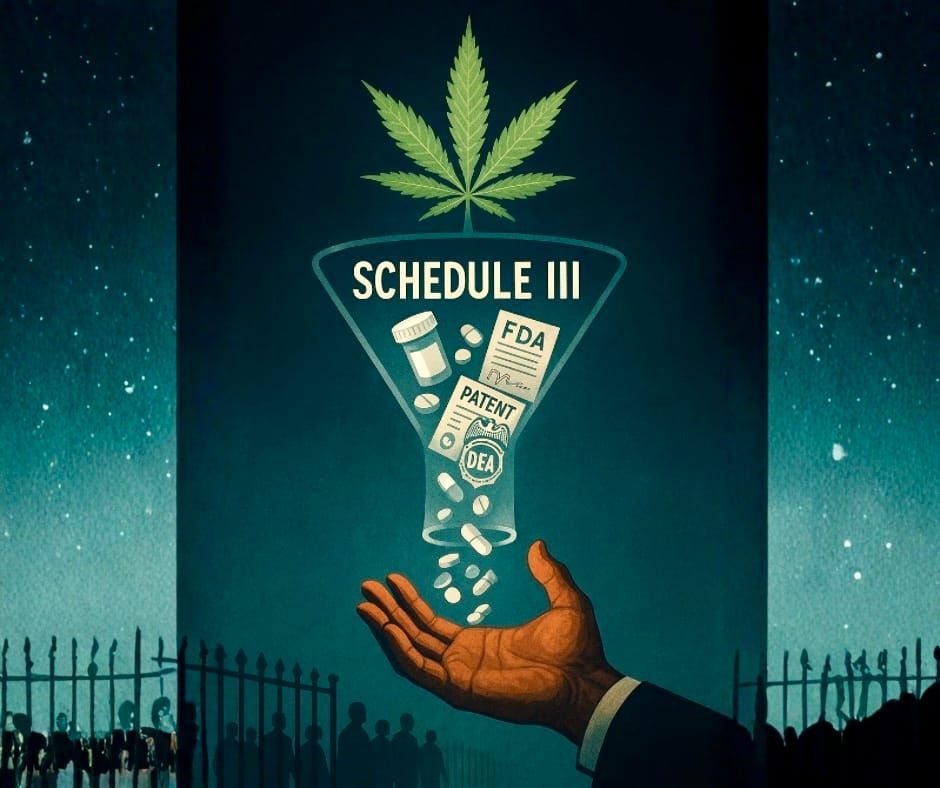
Here’s what Schedule III actually does:
It turns cannabis into a pharmaceutical product, not a liberated plant
Schedule III means:
- DEA oversight
- mandatory FDA pathways
- prescription-only status
- clinical trials
- insurance coding
- manufacturer control
You know who wins under that system?
Pharmaceutical companies—not patients, not small growers, not communities.
This isn’t legalization.
It’s corporatization disguised as compassion.
States like Alabama suddenly look “behind,” triggering a rush to build a framework that already favors big money.
For years, lawmakers dragged their feet.
Now—AFTER a federal deal that weaponized benefits—Alabama finally awards cannabis licenses.
But the costs and rules are so restrictive that only wealthy entities can participate.
That timing isn’t coincidental.
When corporate entry becomes inevitable, states rush to create red tape that only corporations can afford to comply with.
Schedule III does NOT protect people from arrest
This part needs to be said loudly:
- Schedule III does not legalize state programs.
- Schedule III does not decriminalize possession.
- Schedule III does not expunge records.
Cannabis will still be illegal outside of “approved products.”
Meaning:
- flower? ambiguous
- home grow? still illegal
- concentrates? FDA-dependent
- minor possession? still chargeable
We’re creating a two-tier system:
Corporate cannabis: legal.
Natural cannabis: criminalized.
Prices will go UP, not down
If you thought $40 eighths were bad, wait until cannabis goes through:
- DEA registration
- FDA approval
- clinical trial costs
- manufacturer markup
- pharmacy overhead
- insurance gatekeeping
Once it’s in the pharmaceutical pipeline, cannabis becomes:
a drug code, not a plant.
And here is the most important and least discussed consequence: AI will now decide whether you get access
Here’s the part the public isn’t being told:
Schedule III funnels cannabis into the same system currently being run by AI-driven prior authorization models—including Medicare’s new WISeR pilot.
That system already:
- denies medically necessary treatments
- forces appeals
- delays care
- overrides physician judgment
Now imagine cannabis inside that structure.
Under Schedule III, cannabis becomes:
- a prescription
- processed through Medicare/Medicaid algorithms
- screened by Pharmacy Benefit Managers
- subject to “medical necessity” reviews
- filtered through automated denial systems
Your doctor may say you need cannabis…
…but the AI may decide you don’t.
This is the real future brought by Schedule III:
“Your cannabis prescription has been denied. Try a covered synthetic alternative.”
“Exceeded monthly allowance — appeal pending 14–45 days.”
“Strain not on formulary. Request a substitution.”
Once cannabis enters the pharmaceutical grid, your access stops being a doctor–patient decision. It becomes:
Doctor → AI → Insurance → AI → Pharmacy → AI → You
That is not reform.
That is automated gatekeeping.
The “reform” was never about patients. It was about positioning
Alabama is branding itself as a biotech hub.
Huntsville is being groomed for pharmaceutical expansion.
Eli Lilly just arrived.
Federal partnerships are shifting.
When cannabis becomes Schedule III, the beneficiaries are obvious:
- major pharmaceutical manufacturers
- research institutions
- corporate dispensary networks
- states aligned with biotech expansion
This isn’t legalization.
It’s privatization.
And That’s Why People Are Angry—Not Confused
Alabamians are watching the same pattern repeat:
- public resources funneled into private profit
- state rules structured to exclude ordinary people
- everything gets more expensive
- everything becomes more controlled
- corporations take the wheel
Cannabis is just the newest example.
People don’t hate growth.
They hate being billed for it and bullied by it.
The Real Reform Would Be Simple
If the government wanted actual progress, they would:
- decriminalize possession
- expunge records
- allow home grow
- approve small-business licenses
- regulate like agriculture, not pharmaceuticals
- protect local growers
Instead, we’re watching a power grab wrapped in a press release.
THE PATTERN — AND THE RECEIPTS
(This section restores everything you noted.)
If all of this feels familiar, it’s because we have seen this pattern before—and many of us tried to warn our leaders long before the consequences arrived.
2020: The First Warning Ignored
In early 2020, before mandates hit Alabama, I emailed the Alabama Department of Public Health and state officials with medical data, oxygen studies, and concerns about mask safety for children.
- The links later vanished.
- The warnings were ignored.
- The mandates came anyway.
But the receipts still exist.
2021: The Montgomery Meeting — The Day SB267 Was Born
In early 2021 — before Alabama had a statewide mask mandate — a group of us went to Montgomery:
- Dr. Bill Chitwood (MD)
- Dr. Misty Browning (DC)
- Sherrie Saunders (Army medic)
- myself
- another parent with documentation
- and Stephanie Durnin, who brought a model bill from another state
Legislators present:
- Ritchie Whorton
- Tommy Haynes
- Bob Fincher
Dr. Browning and I also met briefly with Sen. Arthur Orr to discuss vaccine concerns.
Those meetings are what ultimately became Orr's SB267, which protected citizens from having to have a vaccine passport to exist in public. We tried to protect medical workers, but were unsuccessful by the time they got done adjusting the bill.
These meetings were the spark that later became Health Freedom Alabama, and Stephanie Durnin and Kaycee Cavender later carried the movement forward.
The 5G Warning — Another Shrug at the Exact Wrong Time
During that same meeting, we warned Rep. Whorton that a rapid 5G rollout was coming and that it carried health implications that were being dismissed publicly.
He didn’t deny it. He didn’t challenge it.
He shrugged and said:
“There’s nothing that can be done about it.”
And now?
Those exact towers are being fast-tracked under new federal rules that strip local control over placement — just like we said would happen.
Warnings Dismissed → Every Prediction Realized
Mask concerns ignored → mandates arrived → studies now reveal harms.
Vaccine coercion dismissed → now mainstream headlines admit severe injury categories exist.
5G concerns shrugged off → now preemption laws remove public say in tower placement via HR 2289.
“Hemp loopholes” dismissed → now closed right as Eli Lilly arrives in Huntsville. The entire national effort led by Alabama.
Cannabis dragged for years → suddenly moved forward right as federal rescheduling positions corporations to take over.
- None of this is coincidence.
- None of this is accidental.
- And none of this is new.
This is the choreography.
This is the pattern Alabama keeps pretending not to see.
Conclusion: Don’t Let the Marketing Fool You
Moving cannabis to Schedule III is not liberation.
It is:
- a funnel
- a filter
- a gate
- and a corporate capture disguised as reform.
Alabama is being swept into a national shift that will determine who owns the future of cannabis:
the people who fought for access,
OR the corporations waiting for rescheduling to hand them the industry.
If voters don’t understand this distinction now, they will later—when the plant becomes a product, the product becomes a prescription, and the prescription becomes something only a corporation can control.
Because once cannabis becomes a pharma commodity?
You don’t get the plant back.
Not without a fight.
Alicia Boothe Haggermaker is a lifelong resident of Huntsville, Alabama, and a dedicated advocate for health freedom. For more than a decade, she has worked to educate the public and policymakers on issues of medical choice and public transparency. In January 2020, she organized a delegation of physicians and health freedom advocates to Montgomery, contributing to the initial draft of legislation that became SB267.
Opinions do not reflect the views and opinions of ALPolitics.com. ALPolitics.com makes no claims nor assumes any responsibility for the information and opinions expressed above.
References and further reading:
https://www.cnbc.com/2025/12/12/cannabis-stocks-trump-regulations.html