Marshall, Robertson Speak Out in Defense of Women’s Sports
Arguing before SCOTUS, States say laws must protect fairness in female athletics
Alabama Attorney General Steve Marshall issued a statement after the U.S. Supreme Court heard oral arguments in Little v. Hecox and West Virginia v. B.P.J., two high-profile cases testing whether States can enforce sports rules that limit participation in girls’ teams to students who are biological females.
Marshall, who spearheaded amicus briefs from a coalition of States, urged the justices to uphold States authority to set and enforce these laws. “States have the authority and the responsibility to protect fairness and equal opportunity in girls’ sports, and that authority must be upheld,” he said. “Title IX was designed to eliminate competitive disadvantages for female athletes, not to force them back into unequal playing fields.”
He added, “This is not about exclusion. It is about defending the integrity of female athletics and the opportunities they provide. The law, the science, and the American public are on our side, and we are confident the Court will be as well.”
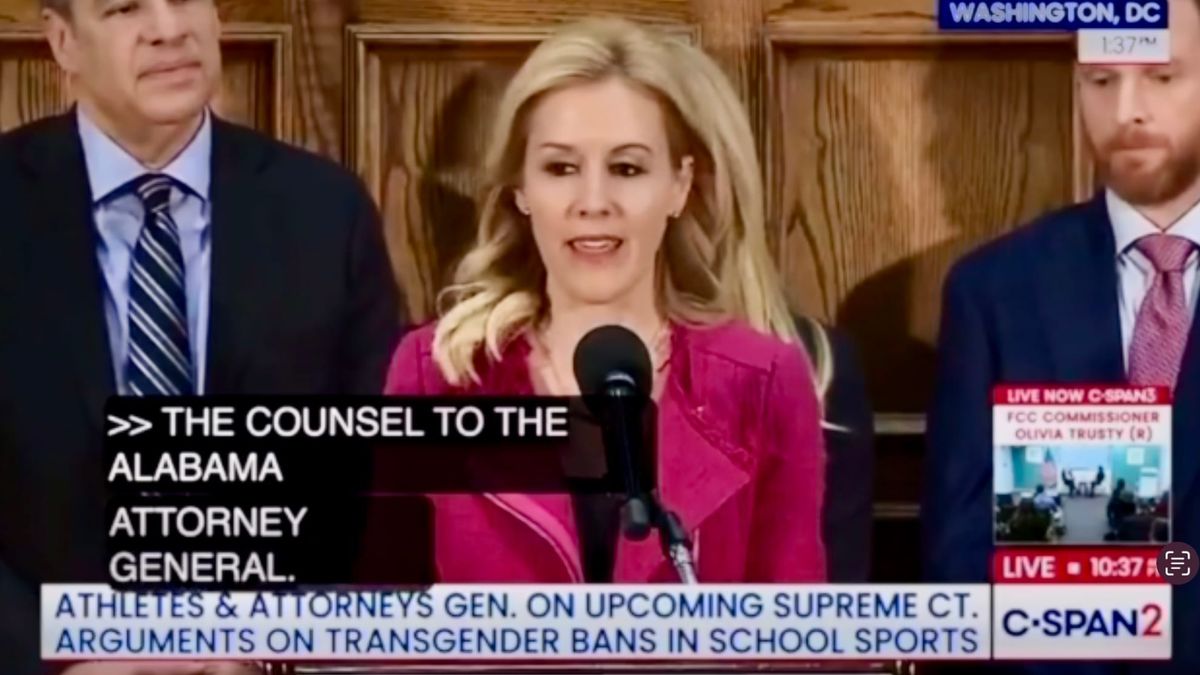
Marshall’s Chief Council, Katherine Robertson, spoke at a press conference in Washington, D.C. in support of the amicus briefs, saying, “when we debated our law on this topic, we were told it was a solution in need of a problem…Alabama is proud of the role we’ e played. We’re so grateful to partner with States like West Virginia and Idaho and others. We believe we’re going to win that case and put this issue to rest for a while.”
Source: @KGRob27KK
The Supreme Court’s session focused on two State’s laws that restrict girls’ and women’s teams to those classified female at birth. In Little v. Hecox, the Court reviewed Idaho’s “Fairness in Women’s Sports Act,” a statute that limits participation on women’s teams to students the law defines as biologically female. In West Virginia v. B.P.J., the Court weighed a similar challenge to West Virginia’s “Save Women’s Sports Act.”
Those opposing the laws argue they discriminate against transgender girls and violate both the Equal Protection Clause of the Fourteenth Amendment and Title IX’s ban on sex discrimination in education. Attorneys for the transgender athletes contend that many individuals barred by the laws do not have physiological advantages tied to male puberty, and so blanket bans unfairly exclude them from school sports.
The Court’s conservative majority appeared receptive to arguments favoring the States during the three-hour hearing, with Justices noting the longstanding tradition of separating sports by biological sex and questioning whether the challengers’ claims fit within Title IX’s protections.
Alabama’s Legislature passed a similar law in 2023 that uses biological sex, not gender identity, to sort sports teams in public schools and higher education. Marshall’s office also supported a multi-States brief last year opposing a proposed expansion of Title IX rules under the Biden administration that would have allowed gender identity to play a role in determining access to female-only spaces, including sports facilities.
The Supreme Court is expected to issue its decision by mid-2026. A ruling in favor of the States could affirm broad authority for lawmakers to set sports eligibility rules. A decision for the challengers could limit or invalidate such laws nationwide.