
Moon Mission Meets Its Match: The Space Toilet
Artemis II pushes deep into space—but its $23M toilet proves even NASA can’t escape plumbing problems
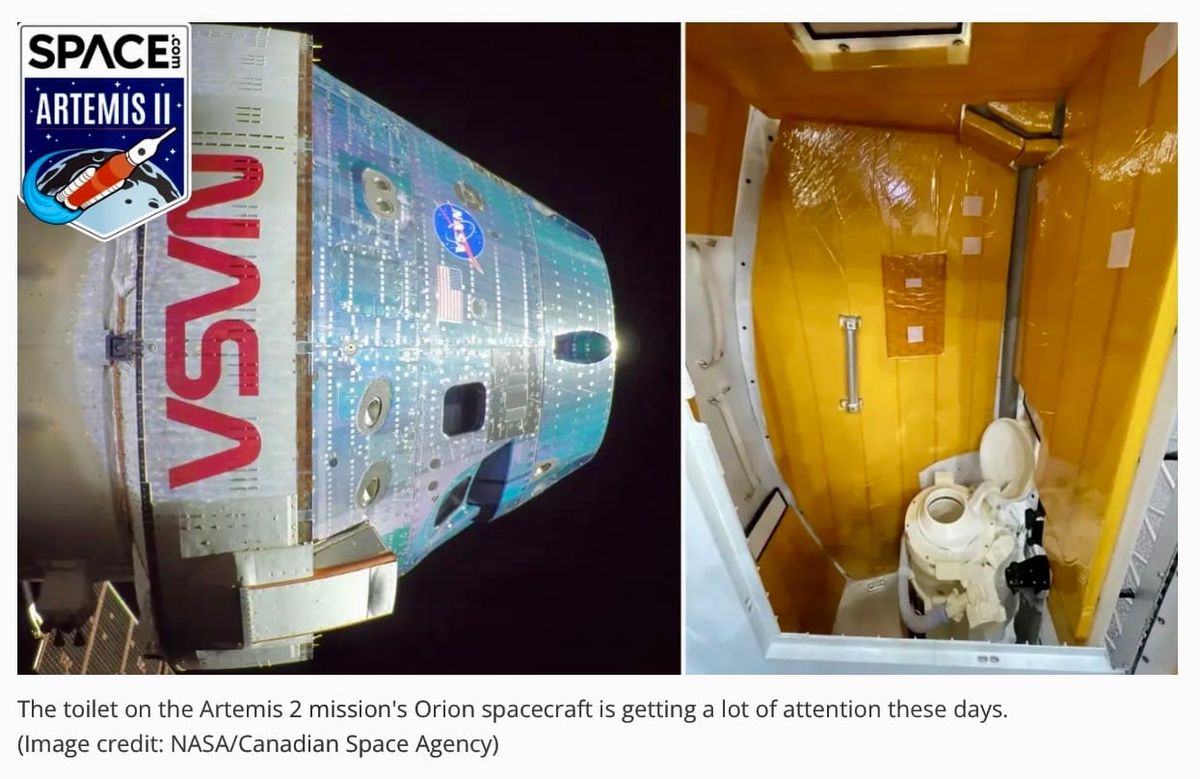
For all its historic ambition, NASA’s Artemis II mission has found itself grounded—at least briefly—by a problem as old as plumbing itself.
Somewhere between Earth and the Moon, the most advanced spacecraft of its kind has been wrestling with a decidedly low-tech adversary: the onboard toilet.
The issue first surfaced shortly after launch, when the Orion capsule’s $23 million Universal Waste Management System—NASA’s upgraded answer to Apollo-era “bag-and-hope” methods—began acting up. Engineers traced an early malfunction to a waste system fault, forcing astronauts to rely on backup collection bags while Mission Control worked through a fix.
Then came the smell.
“Regarding the smell, I just wanted to make sure you all were tracking the EGS notes of the kind of burning heater smell that was coming from the toilet several times,” astronaut Christina Koch radioed to Mission Control.
The odor, described elsewhere as similar to an old heater warming up, was never definitively pinned down. NASA suggested insulation near the toilet bay door as a likely source and assured the crew there was no safety risk.
Which is comforting—up to a point.

Because the toilet’s troubles did not stop at an odd smell. Behind the scenes, engineers have also been dealing with a more stubborn issue: getting the system to do what every Earth-bound user expects without thinking—flush properly.
“The challenge that we're working through is evacuating the tank,” NASA officials said as the mission progressed.
In plain terms, the spacecraft has struggled to vent stored urine into space, with early indications pointing to possible ice buildup in the line.
That left the Artemis crew — four astronauts on humanity’s first lunar mission in over 50 years — juggling contingency plans, including limiting certain uses of the system and, at times, reverting to backup methods that would be familiar, if not fondly remembered, by Apollo veterans.
It is, in its own way, a reminder that spaceflight remains an exercise in humility.
The Orion toilet, after all, represents a leap forward: a private compartment, airflow-based waste collection, and a system designed for longer missions beyond Earth orbit. Apollo astronauts, by contrast, relied on adhesive bags—an arrangement that was functional (more or less, the odd leak notwithstanding), if not dignified.
Yet even with decades of progress, the fundamentals remain stubborn. In microgravity, nothing falls. Nothing drains. And nothing, it seems, works quite like it does back home.
To NASA’s credit, none of the issues have posed a serious threat to the crew or mission. Artemis II continues on schedule, its astronauts preparing for a lunar flyby that will carry them farther from Earth than any humans in more than half a century.
Still, for a mission meant to showcase the future of deep-space travel, the most persistent storyline has been a familiar one.
Rockets may defy gravity. Computers may guide the way. But in the end, even the most advanced mission in a generation can be brought back down to Earth by a problem in the bathroom.
As the saying goes: “Feces Happens.”
And yes, there WAS an episode of “The Bug Bang Theory” about just this topic: