Moore, Palmer Back SAVE Act as Senate Pressure Mounts
Alabama Reps. Barry Moore and Gary Palmer backed the SAVE America Act to tighten election rules, while GOP leaders press the Senate to act
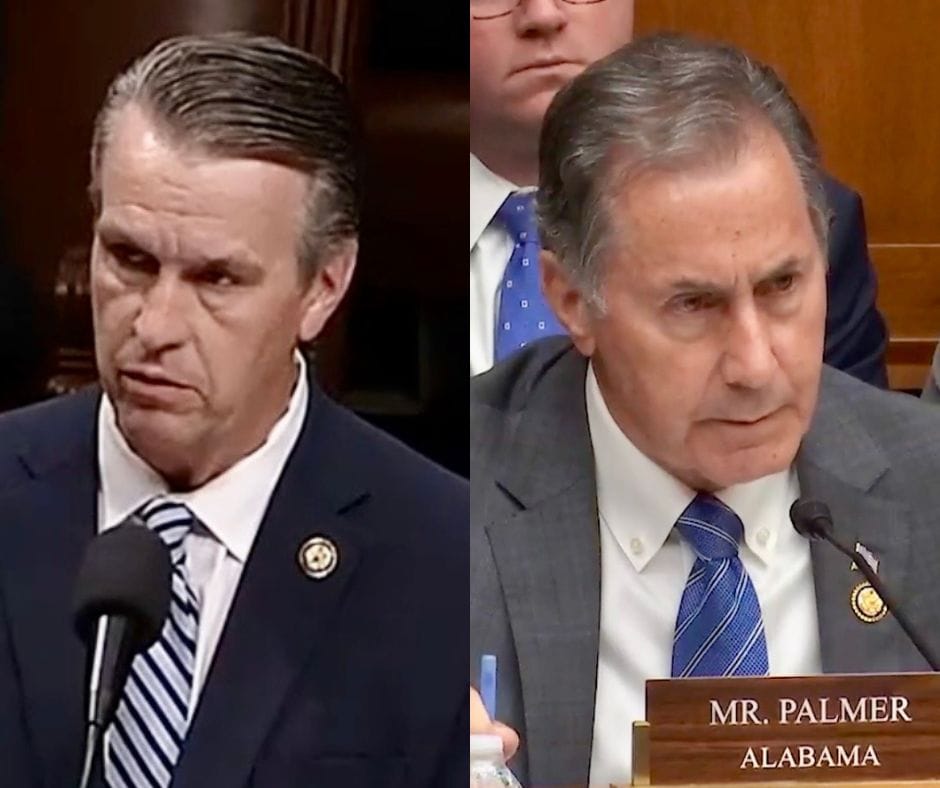
U.S. Representatives Barry Moore (R-AL-01) and Gary Palmer (R-AL-06) are among the Alabama House Republicans to publicly throw their support behind the Safeguard American Voter Eligibility (SAVE) America Act. The SAVE Act, which tightens federal election rules to require proof of citizenship and photo identification for voter registration and voting in federal elections, recently passed the House by a vote of 281-213.
“American elections should only be decided by American citizens,” Moore said in a statement supporting the measure. “After years of record illegal immigration and weak enforcement under the Biden Administration, the SAVE America Act would enact common-sense safeguards like proof of citizenship and photo ID. This bill protects American voters, strengthens confidence in our elections, and ensures every legal vote counts. Securing the ballot box is essential to preserving self-government, and Congress has a responsibility to act. I’m proud to stand with President Trump and my colleagues to defend election integrity.”
“Providing a valid photo I.D. to vote is common sense, not voter suppression,” said Palmer. “Providing proof of citizenship when registering to vote and presenting a photo I.D. at the ballot box is an easy solution to ensuring only American citizens are voting in American elections. I was proud to vote for this bill on the House floor, and I hope my colleagues in the Senate will pass this legislation so we can put it on President Trump’s desk.”
All five of Alabama’s House Republicans — Moore, Palmer, Mike Rogers (AL-03), Robert Aderholt (AL-04) and Dale Strong (AL-05) voted Yea on the SAVE Act. Alabama Democrats Shomari Figures (AL-2) and Terri Sewell (AL-07) voted Nay.
The SAVE America Act, formally reintroduced in Congress this session by Republican Chip Roy of Texas, would amend existing federal voter registration law to require individuals to provide documentary proof of U.S. citizenship when signing up to vote in federal elections. It also would require voters to present an eligible photo identification document before casting a ballot. States would have to remove non-citizens from their voter rolls and establish procedures to verify citizenship status. The bill further includes provisions allowing citizens to bring civil action against election officials who fail to uphold proof-of-citizenship requirements.
Supporters like Moore, Palmer and other Republican lawmakers say these steps are necessary to protect election integrity and public confidence in federal elections. Critics argue that the bill could place new burdens on eligible voters and complicate registration processes already in place under current law.
The House of Representatives approved the SAVE America Act in a narrow party-line vote, sending it to the Senate for further consideration. With current strict rules on the filibuster requiring 60 votes to advance most legislation in the upper chamber, supporters are stepping up efforts to build momentum. Some Senate Republicans, including Maine Sen. Susan Collins, have expressed conditional support for the bill and emphasized the need for election security measures, even as they resist eliminating procedural protections like the filibuster.
Senate Democratic leaders have vowed to block the bill, describing its measures as restrictive and warning that it could suppress voter participation. Opponents contend that existing federal law already bars non-citizens from voting, and that widespread fraud has not been documented.
With the vast majority of Americans supporting voter IDs, pressure is mounting on the Senate to end the talking filibuster rule and pass the SAVE Act quickly — a bill President Trump will almost certainly sign.
As debate continues and pressure on the Senate grows, lawmakers like Representative Moore and Palmer insist that the SAVE America Act represents a necessary step to secure the integrity of U.S. elections ahead of the 2026 midterm cycle.