Paschal Reintroduces Child Custody Reform Bill
Rep. Kenneth Paschal’s “Best Interest of the Child Protection Act” seeks clearer shared parenting standards in Alabama custody decisions

A bipartisan effort to update Alabama’s child custody laws returned to the State Capitol this week as Representative Kenneth Paschal (R-Pelham) reintroduced the Best Interest of the Child Protection Act for the 2026 Regular Session.
The measure, HB147, is intended to modernize custody standards that lawmakers and advocates say have been unchanged for more than four decades. The National Parents Organization (NPO), a national child custody reform group, has publicly backed Paschal’s bill, pointing to reforms in Kentucky that have reduced courtroom conflict and increased parental involvement.
“National Parents Organization supports Rep. Paschal’s leadership in advancing evidence-based custody reform,” an NPO spokesperson said in a statement. “Kentucky’s experience shows that shared parenting laws, when paired with strong safeguards, benefit children, families, and courts alike. Alabama children deserve the same opportunity.”
Under current Alabama law, judges must consider joint physical custody — defined only as “frequent and substantial contact” with both parents — but no clear standard exists for what that means. Courts also are not required to explain why they award or deny joint custody.
Paschal said the proposed bill would set shared parenting as the starting point in custody decisions while still allowing judges to protect a child’s safety and well-being.
“Alabama’s custody laws are more than 40 years old and no longer reflect what research or experience shows children need,” Paschal said. “This bill focuses on children’s well-being, not parents’ preferences.”
HB147 would update custody law in several key ways:
- Define joint physical custody as equal or approximately equal parenting time
- Create uniform Statewide custody and visitation guidelines
- Establish a rebuttable presumption that shared custody is in a child’s best interest
- Require parenting plans in all custody cases
- Mandate written findings when a court departs from shared parenting
“These reforms promote transparency and consistency,” Paschal said. “Families deserve to understand how decisions affecting their children are made.”
Backers also cite polling showing strong public support for shared parenting as a baseline in custody disputes, with more than 80 percent of Alabamians favoring it in a 2023 survey commissioned by NPO.
The bill explicitly preserves judicial authority to limit or deny shared custody when evidence shows abuse, neglect, substance abuse, or other factors that could harm a child.
“This applies only when both parents are willing and able,” Paschal said. “Children should not lose meaningful relationships with a parent without a clear, written reason.”
Supporters estimate that roughly 40,000 children in the State are placed on limited visitation schedules each year, often with little explanation of why shared parenting was rejected.
If enacted, Alabama would join Kentucky, Arkansas, Florida, Missouri, and West Virginia in adopting shared-parenting reforms modeled on evidence-based research. Madison County is the only Alabama judicial circuit currently using shared parenting as the default starting point.
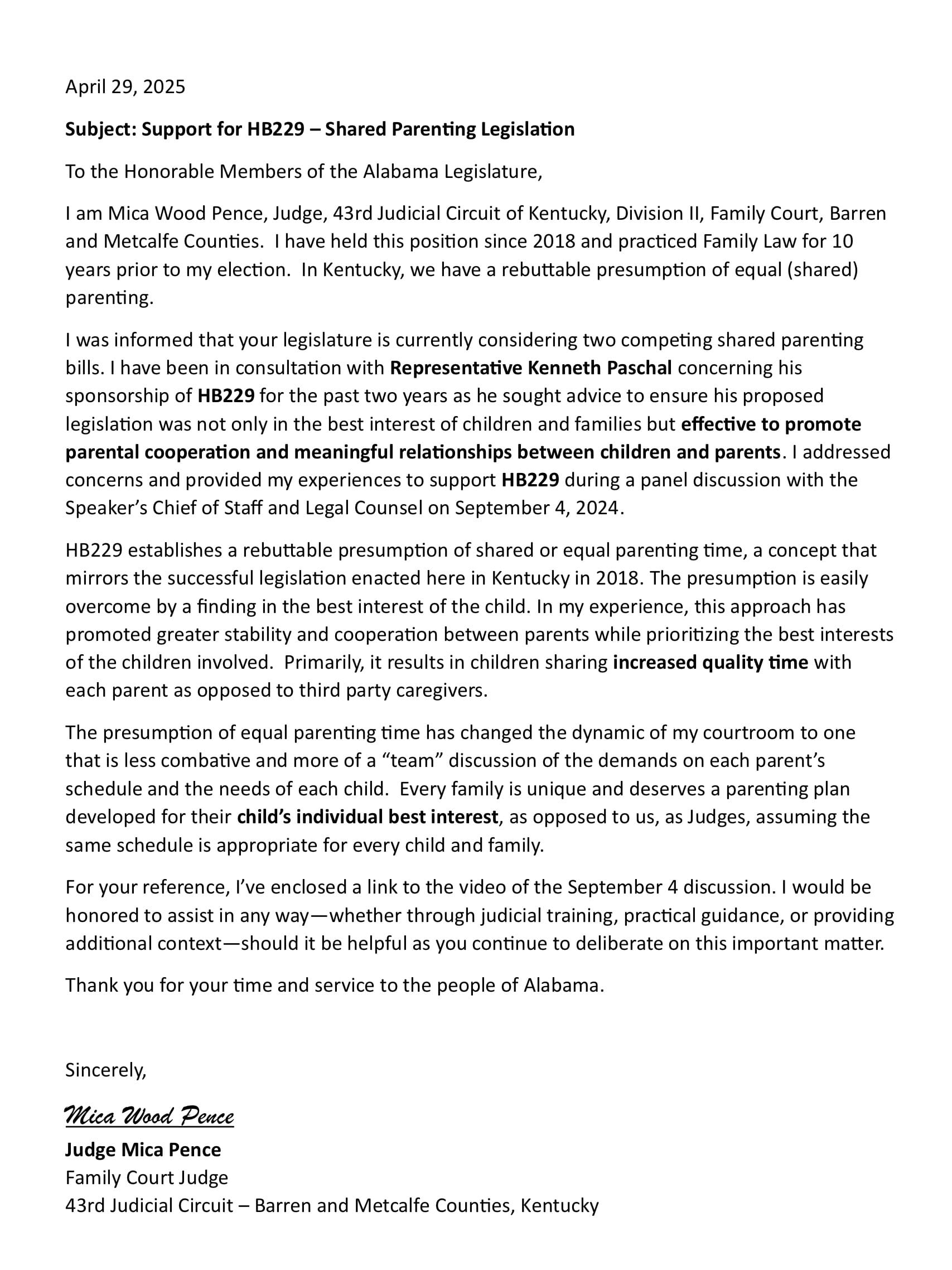
In a 2025 letter to Alabama legislators (below), written for a previous version of this bill in the last session, Kentucky Family Court Judge Mica Wood Pence praised her State’s law for establishing “a rebuttable presumption of shared or equal parenting time,” noting positive results since its enactment.
“This is not a partisan issue,” Paschal said. “It’s about children and families.
The full text of HB147 is available HERE.