President Trump Put the Rivals in One Room and Got Them to Sign
Guest Opinion by Perry Hooper Jr.
Guest Opinion by Perry Hooper Jr.
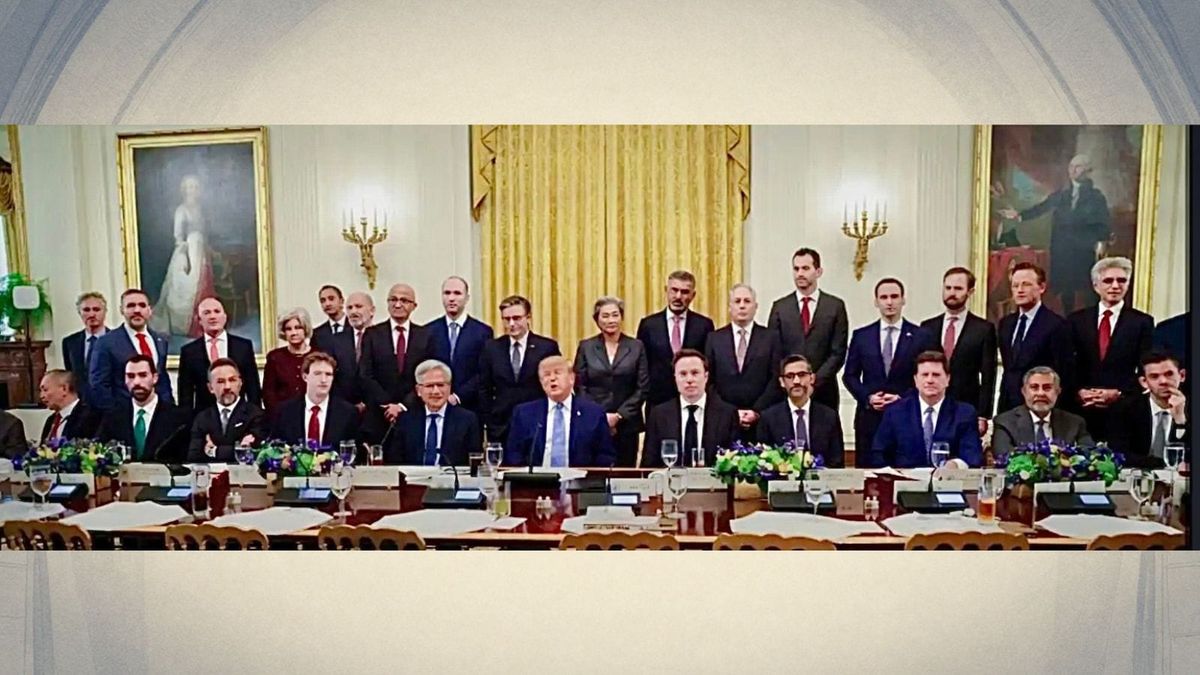
Washington is famous for summits where everyone agrees before they arrive, the talking points are prewritten and the photograph matters more than the result. President Donald Trump’s September 29 Super Intelligence summit was something very different. He put some of the most powerful and fiercely competitive technology leaders in the world in one room—executives from OpenAI, Nvidia, Google, Meta, Anthropic and other companies racing one another for customers, engineers, computing power and leadership of the next technological era—and by the end of the meeting they had signed a voluntary safety accord Trump called “morally binding.” Reuters reported that the agreement included internal controls, independent review and corporate oversight of increasingly powerful systems.
That room is the story. Greg Brockman, Jensen Huang, Sundar Pichai, Mark Zuckerberg and Dario Amodei do not run branches of the same company. They are competitors with billions of dollars at stake and sharply different views about how fast this technology should advance and how it should be governed. Trump’s method was recognizable: get the people who actually possess the technology, capital and decision-making authority around the same table, make them deal with one another directly and push for an agreement rather than another Washington white paper.
The contrast with the Biden White House is hard to miss. On August 5, 2021, President Joe Biden staged a major electric-vehicle event with General Motors, Ford, Stellantis and the United Auto Workers. Tesla—the top U.S. seller of electric vehicles at the time—was not invited. Elon Musk responded that it “seems odd that Tesla wasn’t invited.” When White House Press Secretary Jen Psaki was asked whether Tesla’s nonunion status explained the omission, she noted that the invited companies were the three largest employers of the UAW and told reporters to “draw your own conclusion.” Biden’s event was built around legacy automakers and organized labor even though the country’s most prominent pure-electric automaker was outside the gate.
There is another part of that Tesla story that is too often ignored. Tesla said in a 2018 investor filing that all employees were provided equity awards. Musk later said Tesla stock grants had made many line workers millionaires. The exact number was his claim and was not independently established, but the compensation structure itself is documented: stock ownership was not reserved only for the executive suite. Workers on the factory floor could participate directly in the company’s rise. At the 2021 White House event, the union leadership and legacy-auto executives had the invitation. Tesla’s workforce had something Washington seldom talks about when it lectures businesses about workers: a direct ownership stake in the company they were helping build.
The September 29 summit reflected a very different instinct. Rather than deciding which corporate players fit the administration’s preferred political coalition, Trump assembled companies that compete with one another and asked them to confront a national problem together. The result was more than a photo opportunity. The companies agreed to safeguards, Trump backed continued expansion of the data centers and energy infrastructure required to support advanced computing, and the administration placed the competition with China squarely at the center of the discussion.
Trump also signed an executive order directing executive-branch agencies to use the term “Super Intelligence,” or SI, in place of artificial intelligence in nonstatutory communications and ordered his science and technology adviser to develop a proposed federal definition. People can argue over the terminology, but there is no serious argument about the scale of the transformation underway. Advanced computing is rapidly touching defense, medicine, manufacturing, finance, transportation, education, agriculture and energy. The nation that controls the chips, power, data centers, research talent and capital behind those systems will hold enormous economic and strategic advantages.
That is why the summit mattered. This was not a discussion about another consumer gadget. It was about whether the United States intends to lead the next industrial and national-security revolution or surrender ground to China while Washington debates itself into paralysis. Trump’s answer was to bring the people building the future directly into the White House and demand that they address innovation, safety and American leadership at the same table.
The photograph from that room will be remembered because of who was in it and because of how unusual the gathering was. These companies compete relentlessly. Their executives have different interests, different corporate cultures and different ideas about the future. Most important many don’t agree with the President’s political agenda. Trump puts America First. All of our political leaders must take this to heart if not I hate to think of the consequences.
Perry O. Hooper Jr. is a longtime Alabama Republican figure, former Alabama Legislator and Montgomery businessman. He served as Co-Chair of “Alabama Trump Victory” in 2016, and served as an at-large delegate to the Republican National Convention. He is a noted civic leader in Montgomery with deep family roots in Alabama’s legal and political history.
Opinions do not reflect the views and opinions of ALPolitics.com. ALPolitics.com makes no claims nor assumes any responsibility for the information and opinions expressed above.