PSC Bill Passes Alabama House Committee
HB392 received a favorable report from the Committee despite significant opposition, now goes to House floor
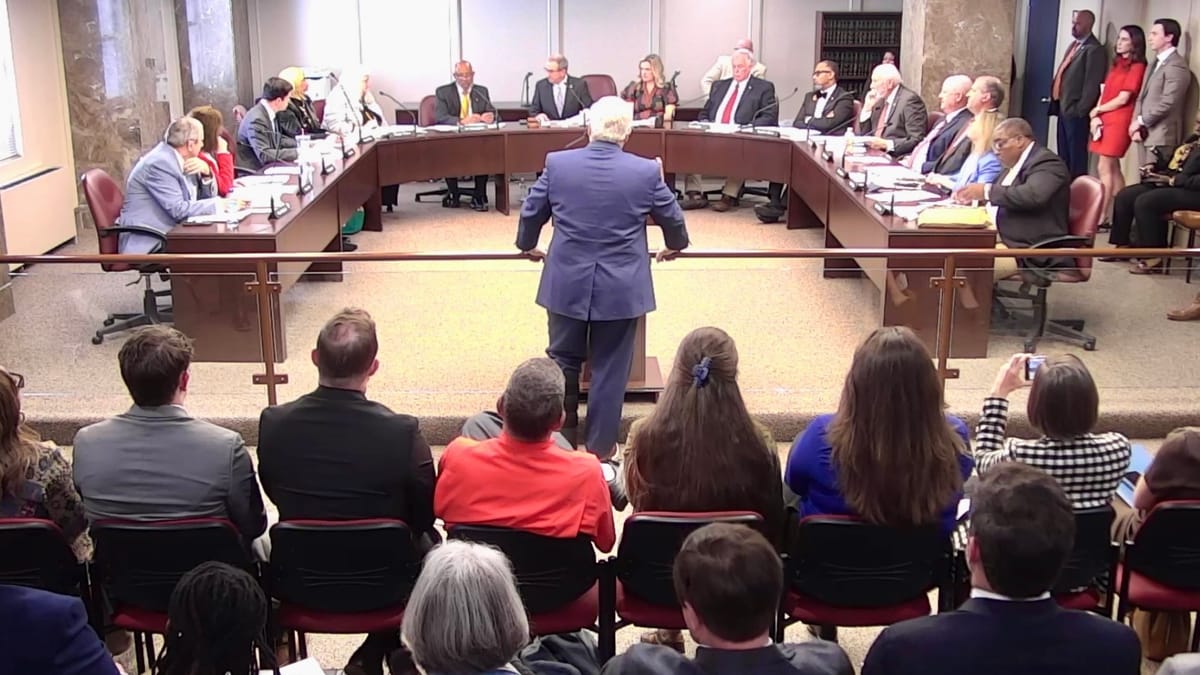
HB392, one of a pair of twin bills to fundamentally alter the selection of members of Alabama’s Public Service Commission (PSC) received a favorable report from the House Transportation, Utilities and Infrastructure Committee.
Tuesday’s Committee meeting and public hearing on the bill took place before a capacity crowd in the meeting room, with several passionate speakers both supporting and opposing the bill.
Chairman Steve Clouse (R-Ozark) opened the public hearing by calling on Representative Chip Brown (R-Mobile), the main sponsor of HB392, to introduce the bill.
Rep. Brown began by pointing out that Alabama is only one of ten States that elects our utility regulators.
“All other regulatory boards in Alabama are appointed, including item oversight, ethics, soil and water conservation, banking, Port Authority, insurance,” Brown said. “In fact, all three current Commissioners serving on the Public Service Commission were appointed, one by Governor Bentley and then two by Governor Ivey. (Editor’s note: Commissioner Jeremy Oden was appointed by Gov. Bentley in 2012, and has since been elected to his position in 2014, 2018 and 2022.)
“This legislation will provide accountability,” Brown continued. “It requires each utility to have a public hearing once a year, something we don't have now. This also takes politics out of the Public Service Commission and potential conflicts of interest. There'll be no out of State interest influence in the public service Commission the governor and us in the legislature will be in will be accountable for the Public Service Commission have stronger ethics. This bill contains requirements that the Commissioner and their families do not work for or receive any financial gain from regulated companies, but also companies that are indirectly involved with regulated utilities, they also cannot own stock. Utilities will be banned from passing on lobbying and political cost to customers. I feel this bill provides accountability, stronger ethics reform and transparency.”
Rep. Brett Easterbrook (R-Fruitdale) opened the questioning by having Rep. Brown confirm that “there's three appointed Commissioners right now, correct?” When Brien said that was correct, Easterbrook pointed out that “we're at the highest utility rates in the southeast. And, they just approved keeping them there for two years…So, with them agreeing to lock these high rates in for for two years with an appointed Commission, I don't think it's time we switched to a fully appointed Commission.”
Rep. Artis “AJ” McCampbell (D-Linden), the ranking minority member, commented, “How many other regulatory agencies, organizations. Have people ever had the opportunity to vote on? None. Okay, and do you believe people have the right to vote? They should have that right,” to which Brown agreed.
Brown then replied that “one of the problems I see is that you run the risk of outside influences, whether that be from in State or out of State, if you're having to run for office, but then you're expected to regulate those individuals, I think you have a possibility of undue influence. So this, by taking it out of having elections, then we have the ability to have individuals that their sole focus is on regulating our utilities.”
Rep. Rolanda Hollis (D-Birmingham) asked “Why are we taking the vote from the people? That's one. Two is, will this seat have a turn limit? That's two, and three? How would the rates be regulated?” Brown replied that one of his concerns with the present system was the influence of outside money on the PSC elections.
Rep. Margie Wilcox (R-Mobile) pointed out that “I'll speak from experience. I may be the only one here that was regulated by the Public Service Commission for 30 years, and I'll also speak to a conversation I had with one of my constituents over the 30 years, there were some public service Commissioners that knew a lot more about their job than others…So on page six, line 141, section five, kind of outlines in your bill that they got to have some qualifications. So, I appreciate in particular that section of your bill that I do think that is needed, and I applaud you for putting that in there. And I want to hold those appointing authorities to that. Thank you.”
Chairman Clouse opened the public hearing section of the meeting, emphasizing that each speaker would be allowed two minutes.
First to speak was Daniel Tate, the Executive Director of Energy Alabama. “Today I'm speaking on behalf of more than 30,000 Alabamians who have joined our effort to hold Alabama Power accountable,” Tate said. First, I'd like to address a fundamental political misunderstanding that we've heard Republicans are arguing that appointments are needed to keep the Commission safe from Democrats, and some Democrats have argued that we need appointments to guarantee a democratic seat. But, common sense tells us that these two things cannot be true, but here's what actually is true under current law, utilities like Alabama Power are explicitly prohibited from donating to or endorsing candidates for the PSC. That prohibition exists for a reason, because the regulated should not be choosing their regulators, but this bill creates a loophole in that very protection. Alabama Power can donate practically unlimited sums to all of you, the speaker, the Senate, pro tem and the governor, the very people who would now control the entire appointment process. If this bill becomes law, by passing this legislation, you are essentially legalizing bribery. Finally, there's a deeply troubling provision buried in this bill that does the exact opposite of what his supporters claim. On page seven lines 182, through 194 this bill opens the door for Commissioners to accept gifts and benefits, not just from utilities, but from their trade associations, like the Business Council of Alabama or the Energy Institute of Alabama. This is a complete gutting of ethics protections. Some Alabama laws define a person as inclusive of a corporation, but this bill does not, so I have to ask you, where is this transparency that you talk about? Where exactly is the accountability, where anywhere in this bill is affordability and lower bills actually addressed? There's nothing about lower bills, nothing about lower profits, and Alabamians are not stupid. This bill is about locking in corporate power and profits before voters can demand change. I ask you to vote no on House Bill 392, thank you.”
Robyn Hyden, Executive Director of Alabama Arise described her group as “a nonprofit coalition of faith based civic and community groups working across our State to alleviate poverty. I'm here today representing our 155 member organizations as well as 2000 individual members. We were actually founded in the late 80s by a group of concerned citizens who came together over utility rate regulation, the lack of oversight of our public utilities with monopoly power in Alabama and over the years, we have supported numerous efforts for more transparency and accountability. This year, our members asked us once again to revisit the issue and what can be done about Alabamians paying the highest rates for their power in the south. We believe this bill is a major step backwards in our efforts towards greater transparency and accountability. We know how unpopular this bill is with the general public, and I'm not just speculating. In 2019 the legislature voted to support a constitutional amendment to make the Board of Education and appointed, not an elected body. In March of 2020 the voters of the State overwhelmingly voted to oppose this amendment, choosing to retain our right to vote and not to delegate that power. So we reject the notion that people do not know who represents them, which was Stated. The purpose of public elections like those we're facing this year is that those elected Commissioners come to us the public to be accountable every four years to answer for regulatory issues, including the rate setting process and affordability. I would also mention that I to reject the idea that this bill would address outside influence. We do agree that utility rates utility companies will have unlimited power to donate and elect those who are going to be regulating them. If this bill is enacted, I urge you to vote no and to call for a roll call vote. Thank you.”
Bill Cook, a farmer from Montgomery, rose to say “I'm here today on behalf of farmers and rural families who depend on affordable, reliable power every day. That's why I'm here in support of House Bill 392. I spent much of my life in the greenhouse business, and electricity was among the largest operational cost. My farmer friends who raised poultry and catfish, as well as those who have irrigation systems also rely heavily on affordable power. I'm concerned about the growing influence of out of State money in Alabama, and what that could mean for decisions made by the Public Service Commission for agriculture. Energy costs aren't theoretical. Power bills have a direct impact on our ability to stay in business. Farmers work every day to be as lean as possible and keep input cost at a minimum. Radical policies fueled by activists could undermine our hope for profitability and Alabama's economic growth. Alabama is one of only 10 States that still elects its utility regulators. Most States appoint and confirm their PSC members, and because utility regulation is technical work that should be based on expertise and not campaign fundraising, the PSC has created was created by the legislature to serve Alabama residents. Over the years, its role has changed to meet the State's change in needs. This bill is simply the next step in the State's regulatory evolution to ensure the PSC serves the people of Alabama and not out of State interest.”
Ashton Kennedy, who described herself as “just a working class citizen, a rural one that farms and lives on a dirt road that the State refuses to pave,” said that “people are telling me that their power bill increased by $290 just these past two months. People are robbing Peter to pay Paul. We're taking out credit cards to pay power bills, and I know a lot of the committee members sitting here have accepted at least $5,000 from Alabama Power. Now, what we do know is there was a meeting held this weekend. This bill came up out of nowhere, and now we're talking about it today…So seeing this speed is just inspiring. This is a power grab. (It’s) Taking away our right to vote.
Tabitha Isner next rose to say “You know, there are not a lot of bills in the legislature that you can pass that would put money in people's pockets every single month. Like that would affect every single Alabamian and make their lives demonstrably better. But bringing down, bringing down rates would affect every single Alabamian and would put money in their pockets every single month without spending taxpayer dollars. That is why voters are so hyped up, so interested, so passionate about the Public Service Commission is because it is occurring to voters that they have something they can vote for that will actually put money in their pocket. When they vote for you, they are voting for a representative one among many. But when they vote for a public service Commission, they're voting for one of three, and somebody who is focused on one issue only, when they vote for you, they've got a balance where you stand on all these different issues, but when they vote for a Public Service Commissioner, they are voting for one thing only, and that is powerful. When we take away the people's right to vote on a specific issue you've already taken away. Alabama already does not have the ability for voters to initiate ballot initiatives, but this is one issue where a voter doesn't have to be partisan. They don't have to select a candidate who represents a whole slew of positions. They can represent a candidate with just one position. Take that power away from the voters, and if you're going to do it, we need to hear a better reason why we need to hear a lot better reason why. Please take your time. Put this off for a while. Vote no for now.”
Paige Hutto, President of the Chamber of Commerce Association of Alabama said, “Our association represents Chambers and communities across the State, and we care deeply about ensuring that Alabama maintains a strong climate for growing jobs and businesses. I'm speaking today in support of House Bill 392 for Chamber members in all four corners of our State. Having stable, reliable and affordable energy is important in all their businesses. It also greatly impacts the ability of our local Chambers and economic developers to help recruit new businesses to their communities and for all businesses to remain competitive and prosperous. We acknowledge the importance of elections and fostering trust and accountability. However, for a role this critical to our business climate, the benefits of a qualification based appointment process outweigh those concerns. This structure reduces political pressure and allows appointing individuals to focus solely on selecting the most capable and highly qualified individuals to serve. Thank you for your time today. On behalf of our chambers, thank you for your service.
Brent Woodall rose next, saying, “Full disclosure, I am currently a candidate for Public Service Commission Place 2, but I am here today to speak as a private citizen. I looked this morning at the mission of the Public Service Commission, and it says “to ensure a regulatory balance between regulated companies and consumers in order to provide consumers with safe, adequate and reliable services at rates that are equitable and economical.” This bill goes directly toward that balance between the regulated companies and the consumers. I ask you to kill this bill.”
Woodall continued: “For over three years, I was the Chief of Staff for a member of the Public Service Commission. Guess how many times we saw lobbyists from the regulated companies or representatives directly from the companies? We saw them all the time. now, guess how many times we saw a lobbyist come in to reg to advocate on behalf of consumers at the Public Service Commission never the only tool that the consumers have in this State when it comes to those issues before the Public Service Commission is the right to vote on their representatives at the Public Service Commission. Someone said earlier that this was going to take the influence out of the equation. No, it's not. It just takes out the ability of the average citizen in this State to have a say about who is regulating at the PSC and who is providing that balance. Again, I ask you to vote ‘No.’
Sabri McLean, who grew up in Talladega County, told the Committee that “I am incredibly mad about this. I grew up on a working cattle farm, hundreds of acres. I was my FFA President. My degree is in Animal and Dairy Sciences, agriculture, economics from Mississippi State, Go Dogs. I spent my early adult years in Alabama. I then went to Washington State. One of those reasons why I came home is to help my mom. Her bill is over $500! She could not pay that bill by herself. I came back here to help her…My average power bill in Washington was $33, because we had public utilities, where, at a local level, we had Commissioners, we voted in allowing that. So please vote no.”
Two amendments were offered and accepted. The first, by Rep. Danny Crawford (R-Athens), Chair of the Ag & Forestry Committee, added agriculture to the list of qualifications. A second amendment by Rep. McCampbell added requirements that the Minority Leaders of both chambers be involved in the appointment process.
Rep. McCampbell then asked for clarification on the addition of confirmation by the Senate to the bill, to which Rep. Brown replied that it brought the bill into alignment with other appointments such as those to the Board of Pardons and Paroles.
Rep. Wilcox then asked for, and received permission from, the Chair to question the speakers. Wilcox asked for confirmation that Sabrina McLean was from Alabama, and was told that she was from Alabama, had been away for ten years but returned. She said that she recognized Tabitha Isner and Brent Woodall as being from Alabama, before asking Ashton Kennedy “are you (from) Colorado or Alabama? What part of Alabama?’ Kennedy answered “Montgomery.”
Wilcox went on to say that she knew that (Alabama) Arise had “advocated on several things” in the State, and she also acknowledged Paige Hutto of the the Chamber of Commerce Association. Bill Cook told her, on questioning, that he was from Montgomery.
Wilcox then turned her attention to Daniel Tate of Energy Alabama, initially asking for confirmation that he lived in Huntsville and steady “I’m not familiar with your organization. You've kind of popped up on the scene and no offense, but you seem very well rehearsed. So I just have never seen one of our speakers…some of the other speakers seemed not as rehearsed.”
Tate answered that he had been running Energy Alabama since 2014, when he founded the group.
Wilcox continued questioning Tate, saying, “Now there's been a lot of controversy about your, or a lot of questions about your organization, your funding.”
Tate thanked Wilcox for the question, then answered, “Contrary to what you may have heard in Yellowhammer (News), which I would note, is a major recipient of advertising funds from the Energy Institute of Alabama, of which Alabama Power is a member?
Wilcox interrupted, saying, “No commentary. Just answer the question.” Tate then continued, saying “yeah, we do not receive funding from George Soros or any of these kinds of crazy groups that you're talking about. You know, everything you see on Yellowhammer is, I mean, they're just making stuff up because they want to attack us, because…
Wilcox interrupted once more, saying, “alright, can you just…where is your funding from? Let's don't talk about what other people. I just want to have a dialog between you and I.”
Tate answered, saying, “Okay, well, our funding comes from our members, and we have regular people all across Alabama, who…”
Wilcox jumped in, asking, “how many members?” Tate answered, “Well, right now, we have about 35,000 people, as I mentioned, that have joined to hold energy Alabama, I mean, to hold Alabama Power accountable.”
Wilcox continued to press Tate on what a membership consisted of, and about one of Energy Alabama Board members, Mr. Richard Williams, who is from Arkansas.
Tate answered that Energy Alabama has paid memberships for as little as $1 per year, and has many people who have joined them. “We're advocates for affordable energy,” Tate said, before continuing, “and this is all a distraction, because people don't want to talk about Alabama Power’s profits. They'd rather talk about us. That's not what we're here to talk about. I've been born and raised in Alabama my entire life. Don’t paint me as some out-of-state liberal, when our Board of our organization is made up of Republicans and Democrats.”
Wilcox continued to press Tate, who acknowledged that Williams is from Arkansas, and is on their board for his expertise. The remainder of their Board is from Alabama. When Wilcox demanded Tate list them, to which Tate referred her to the Energy Alabama website. “We make this all public,” Tate said. “We list our financials, we file with the IRS. This is, again, it's just a circus…
“No, it’s not a circus. This is a committee meeting, I'm asking questions,” Wilcox interjected.
Tate then asked Wilcox, “Can I ask you where you got those questions to ask me?”
Wilcox said, “As a legislator I get them from my committees. I get them from fellow committee members. I get them from reading different articles. So yes, sir, I've read Yellowhammer. I know I have discussed this bill, because this is a big change. I happen to be somebody that's been before the Public Service Commission for 30 years.”
Tate went on: “This is not new to Energy Alabama. I mean, we have, again, been around since 2014 and, you know, we've been doing a lot of work, not just here for the Alabama Power area and the Public Service Commission. I think we've been able to make some really great things happen with TVA and local utilities in North Alabama, who are taking very stringent steps to improve rates and affordability for their customers. And we want to see that for everybody, TVA's rates are 40% lower than Alabama powers, that's in the same State,” he finished.
Wilcox having finished at that point, Rep. Donna Givens (R-Loxley) then began questioning Tate.
“So just some clarity here, to help me understand,” Givens said. “In May of 2025 you called Governor Ivey's appointment of Cynthia Allman to the PSC an ‘inflection point’ and a ‘pivotal point’ for Alabama’s energy future. When Tate replied in the affirmative, Givens continued, “So, in July of 25 you called the appointee ‘sharp’ and you were happy that there was someone there that was going to listen.” Again, Tate agreed. “So now you're here telling us that the gubernatorial appointment of the PSC is not the way to go. It's not the thing to do. It's not how we should…So why? What's the difference? What changed?”
“In my opinion, those two things are not mutually exclusive,” Tate said. We are very excited about Cynthia Almond, who is an extraordinarily sharp and smart woman who, I think, is going to be extraordinarily fair. And you heard about the regulatory balance earlier from another speaker. I can't think of anybody better, who could, you know, hold that balance than Cynthia Allman. So, I think that was a great appointment. That was the existing law in Alabama. That is the existing law that when there is an opening, that opening is appointed, and that person fills the term, and then that person would then sit for re-election. Our stance is that when there is an appointment ability, because someone has left or passed, or whatever, in that seat, we want to see the most qualified, excellent candidates, of which Cynthia Almond is clearly the best one to do that. However, when it is time for election, when her seat would come up under the current law in 2028, we believe that she should face the voters and determine whether or not she has fulfilled her duties to the voters. That is their decision, not the legislature or the Governor again. And in fact, Jeremy Odin, who was appointed by Governor Bentley, has done that. He was appointed and then has consecutively won elections. That's fair. He did what he was supposed to do, he went into the Commission, and he did what he was supposed to do, and he faced voters. Okay?”
Givens went on to ask, “So, your Board member, Ted Thomas, the one that's from Arkansas. Seven years as a Governor-appointed Arkansas PSC Chairman. He joined the Regulatory Assistance Projects Council of Commissioners, which launched in November of 2025. That Council is composed entirely of former appointed utility Commissioners, not a single elected Commissioner among them.”
“Ma'am, I can't speak for the other organizations that he works with. I don't know anything about that,” Tate answered. “I can tell you that I regularly go to…the Associations for Regulated Utility Commissioners, both for the South and nationally. That's where all Commissioners, both regulated and appointed, routinely get together as their trade association to talk about best practices and things of this nature. And you routinely see both appointed and elected Commissioners there, and including from Alabama.”
Givens asked, “So why do you have someone from Arkansas on your board in Alabama?”
“Because we feel like he is an excellent addition that knows the energy world in a regulatory landscape,” Tate answered.
“So your Board member built his career on gubernatorial appointment, joined an exclusive club of former appointed Commissioners, bankrolled coastal foundations, and now sits on your Board of your organization, which tells Alabama voters that the appointment model is regulatory capture,” Givens stated. “Does anyone in your organization actually believe what you're telling this Committee, or is it your opposition to appointments? Just opposition to appointments for you to control?”
Tate replied, “We don't control anything. Ma'am. Y'all would be the ones that would control the appointments, or the voters would if people vote. We are advocates for clean and affordable energy, that's it. We try to make our case. And if voters put people in these positions who do things that are good, that we believe, for clean and affordable energy, that's great. Sometimes they don't. And in fact, that's been most of the time for the Alabama Public Service Commission. We have the highest rates in the Southeast. We don't have the cleanest mix. That's, I mean, that's not like I've been magically winning lots of arguments with the current Public Service Commission. In fact, I lose most of them. So I guess I don't really understand the question entirely.”
Givens then remarked, “Well, it's just to me, that you're wanting it to be the people vote on it, but yet, you have a board member that's never been voted on and takes contributions from all these outside organizations.”
“I don't know about the other organizations, but I think that's completely irrelevant to the matter at hand,’ Tate said, “Again, this is a questioning of Daniel Tate and energy Alabama, mainly because Alabama Power wants that to be the case, right? They want y'all to talk about measly old Energy Alabama and measly old Daniel Tate. What's the real issue here? The issue is that our rates are out of control, that bills are out of control. That's the issue.”
Givens immediately replied, “And these are the rates that have been set by those that have been elected, is what you're saying.”
“That is correct, but the voters have the decision to make whether that continues or not,’ Tate said.
Givens continued, “Exactly, but the rates are so high, by the Public Service Commission that have been elected to fill those seats.”
“Ma'am, I don't think you're suggesting that the current Public Service Commission is failing on its job, are you? Tate asked Givens, to general laughter from the audience.
“No, I'm questioning you,” Givens said. “You're…you're saying two things here, you think…”
Tate immediately answered, “I think they're not mutually exclusive. Do I agree that the Commission to this point has done their job? Absolutely not. I have been very vocal and clear that this Commission has not held its responsibility of regulatory balance between the needs of Alabama Power and the needs of customers in check. It has very much not, and almost any regular Alabamian would tell you that that does not mean that I also think it is worthwhile to strip people of their right to vote for that very dynamic. I may disagree with people's votes, or I may not get what I want, but I will never, and Energy Alabama will never, stand forward and advocate for anything that takes away the right to vote.”
Givens concluded her questioning by confirming that Energy Alabama had been in existence since 2014, but “My career was 40 plus years with a rural electric cooperative, and I've never heard of you. I've only been in Montgomery, this is my fourth year, and I've never heard of you until just recently.” Tate replied that Energy Alabama had done significant work with the Tennessee Valley Authority, and that they were “not a flashy organization.”
Rep. Rhett Marquis (R-Enterprise) asked Tate, “You talked about affordability a couple times. How is killing this bill or stopping this going to a PSC, elected, I mean, appointed, board. How's that going to make it more affordable in the current system?”
Tate answered, “Our position is that that's the right of the voters. The voters are the ones who…”
“So you're happy with the system that we have,” Marquis broke in.
“No, sir, in fact, just the opposite. I'm not happy with the current system,” Tate answered, “But that doesn't mean just because I'm unhappy, that I believe that we should take away the right to vote. If that means that people continue to vote for a system that gives unchecked profits to Alabama Power, as much as that pains my heart, I hope it doesn't happen. If that's what the voters decide to do, that's not my right to tell them otherwise.”
Rep. Napolean Bracy (D-Pritchard) commented that “I don't know the gentleman either, but I've never been in a committee meeting or public hearing where we’ve had more questions for a speaker than for the actual bill sponsor,” before being asked to refrain by the Chair. Bracy then went on, “I know that one of the things that's great about here is you're going to have people for and against every issue that we vote on. We have people that have people that are on their boards and their bankrole, and they have all of these situations, and they come in and they advocate for what they want, and that's simply what this gentleman is doing. Now I'm not saying if I'm for or against, but I'm not going to grill you because of your two minutes that you came to talk to us, or whatever that I've heard in the background, or anybody else that comes up here. And I just don't think it's fair to do that, and I just want to state my piece on that,” to which Tate replied, “I appreciate that.’
House bill 392, as amended, received a favorable vote from the Committee. It now goes to the House floor for consideration, which could occur as early as this Thursday.
The version of the bill reported out of Committee is available at: https://alison.legislature.state.al.us/files/pdf/SearchableInstruments/2026RS/G3IFICC-1.pdf
Tuesday’s Committee hearing may be seen on The Alabama Channel’s YouTube page at THIS LINK or below: