Results, Not Applause
Trump Tells the World Economic Forum the Truth It Didn’t Want to Hear—Guest Opinion by Perry O. Hooper Jr.
Guest Opinion by Perry O. Hooper, Jr.
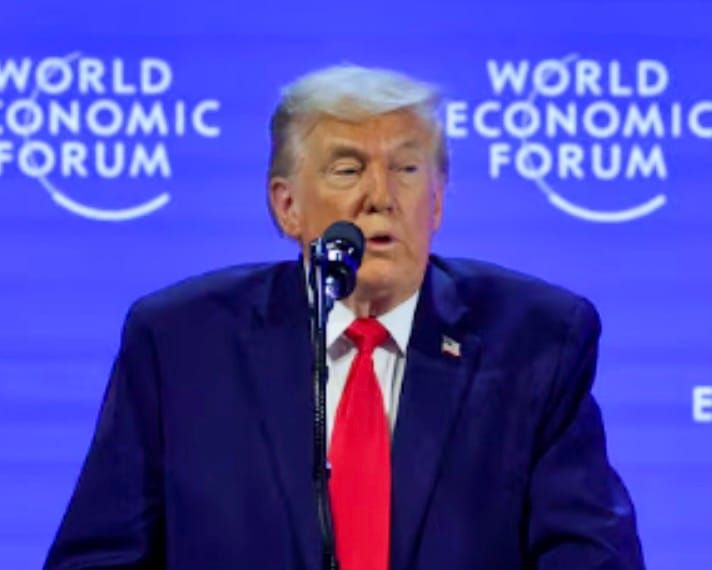
For more than thirty years, American presidents went to the Annual World Economic Forum in Davos Switzerland looking for approval. From Bill Clinton through Barack Obama and Joe Biden, the ritual was the same: reassure the global elite, affirm their economic orthodoxy, and return home to explain why American workers had to “adjust.” Davos was not a debate. It was a blessing ceremony. Donald Trump ended that era. He didn’t go to Switzerland seeking approval. He went to tell them the era of deference is over—and that Europe, not America, is now the cautionary tale.
“Europe is not heading in the right direction,” Trump told the Davos audience bluntly. “The United States is.” The contrast could not be clearer. The United States is growing faster. Energy is cheaper. Capital is flowing in, not out. Jobs are being created across industries instead of subsidized on paper. These are not slogans. They are outcomes. America chose deregulation, tax relief, and energy abundance. Europe chose regulatory excess, energy scarcity, and bureaucratic comfort. The scoreboard reflects those choices.
Europe’s leaders prefer to describe their stagnation as bad luck or unavoidable transition. Trump rejected that fiction outright. “This didn’t happen by accident,” he said. “It happened because of decisions.” Europe made itself dependent on hostile energy suppliers like Germany shutting down nuclear in favor of Russian natural gas, then acted surprised when power costs spiked and factories shut down. It layered regulation on top of regulation, then wondered why investment slowed. It underinvested in defense for decades, then complained when American leverage followed. This did not happen to Europe. Europe chose it.
Trump framed America First not as isolation, but as proof that growth still works. “America First does not mean America alone,” he said. “It means America strong.” That strength, he argued, is built on policies that reward production instead of punishing it. Lower taxes. Fewer rules. Reliable energy. When governments stop suffocating their own economies, people build, hire, and innovate. Europe was not being scolded. It was being shown the results.
The Greenland issue made many in the room visibly uncomfortable, but Trump did not retreat. “We need Greenland,” he said flatly. “We need it for international security.” He tied the issue directly to the Arctic’s growing importance as Russia and China expand their presence. Greenland is not theater. It is strategy. Shipping lanes, rare earths, missile defense, and the future balance of power are all at stake. Ignoring the Arctic does not make it irrelevant. It makes it dangerous.
Then came the predictable outrage over tariffs. Trump did not mince words. “If we’re treated unfairly, we’re going to use tariffs,” he said. “We have to protect our workers.” This isn’t complicated. This isn’t cruel. This is math. Tariffs are leverage. They are not mandatory. They are not permanent. They are avoidable. They exist to enforce reciprocity. Europe cannot demand open access to the American consumer while shielding its own markets, subsidizing favored industries, and free-riding on U.S. defense commitments. If Europe wants free trade, it can practice it. If it prefers protection, America will protect its workers. That is not extremism. That is governance.
Trump also addressed what Davos prefers to discuss only in abstractions: affordability. “People want to afford a home,” he said. “They want lower costs. And energy is a big part of that.” He connected high housing costs, inflation, and stagnant wages directly to energy scarcity and regulatory excess. Affordability begins with energy abundance. Cheap, reliable energy lowers construction costs, stabilizes interest rates, reduces manufacturing expenses, and raises real wages. That is how prices come down in the real world, not through panels and press releases.
On foreign policy, Trump previewed a new concept he called a “Board of Peace,” intended to replace what he described as a failed, performative, U.N.-centered approach to conflict resolution. The premise was simple: results over resolutions, enforcement over symbolism, accountability over endless process. Trump pointed to his record of de-escalating conflicts not through speeches, but through leverage.
He cited Venezuela as one example, noting the collapse of the Maduro regime after sustained pressure and isolation, and contrasted that outcome with decades of diplomatic indulgence that produced nothing. “We ended wars,” Trump said. “We didn’t start them.” He noted—only half-jokingly—that such outcomes never earned him a Nobel Peace Prize, a reminder that global institutions tend to reward compliance rather than achievement.
What unsettled the Davos audience most was not any single policy. It was Trump’s refusal to ask permission. “We’re done apologizing,” he said. He did not soften his language. He did not chase applause. He did not pretend the post-war European model is still delivering when it clearly is not. He stated plainly that America will no longer subsidize stagnation, defend it by default, or imitate it out of habit.
Europe still has a choice. It can reform, compete, and grow, or it can continue managing decline with better talking points. That decision belongs to Europe. America’s decision is already made.
Trump did not go to Davos to charm the room. He went to draw a line. And for once, the people who claim to run the global economy were forced to listen to a leader who measures success not by invitations or applause, but by outcomes.
As Trump reminded them, “Results matter.” And results do not need consensus.
Perry O. Hooper Jr. is a longtime Alabama Republican figure, former Alabama Legislator and Montgomery businessman. He served as Co-Chair of “Alabama Trump Victory” in 2016, and served as an at-large delegate to the Republican National Convention. He is a noted civic leader in Montgomery with deep family roots in Alabama’s legal and political history.
Opinions do not reflect the views and opinions of ALPolitics.com. ALPolitics.com makes no claims nor assumes any responsibility for the information and opinions expressed above.