Supreme Court Hands Trump 8-1 Win on Border Wall
Justices rule 8-1 to let border wall construction resume in West Texas, with Ketanji Brown Jackson casting the lone dissent
TL;DR: The U.S. Supreme Court ruled 8-1 Monday to allow President Donald Trump's administration to resume border wall construction in Texas's Big Bend region. The justices found that a federal judge likely lacked the power to block the project under a 1996 immigration law. Justice Ketanji Brown Jackson was the only dissenter. The ruling allows construction to resume while the legal fight continues.
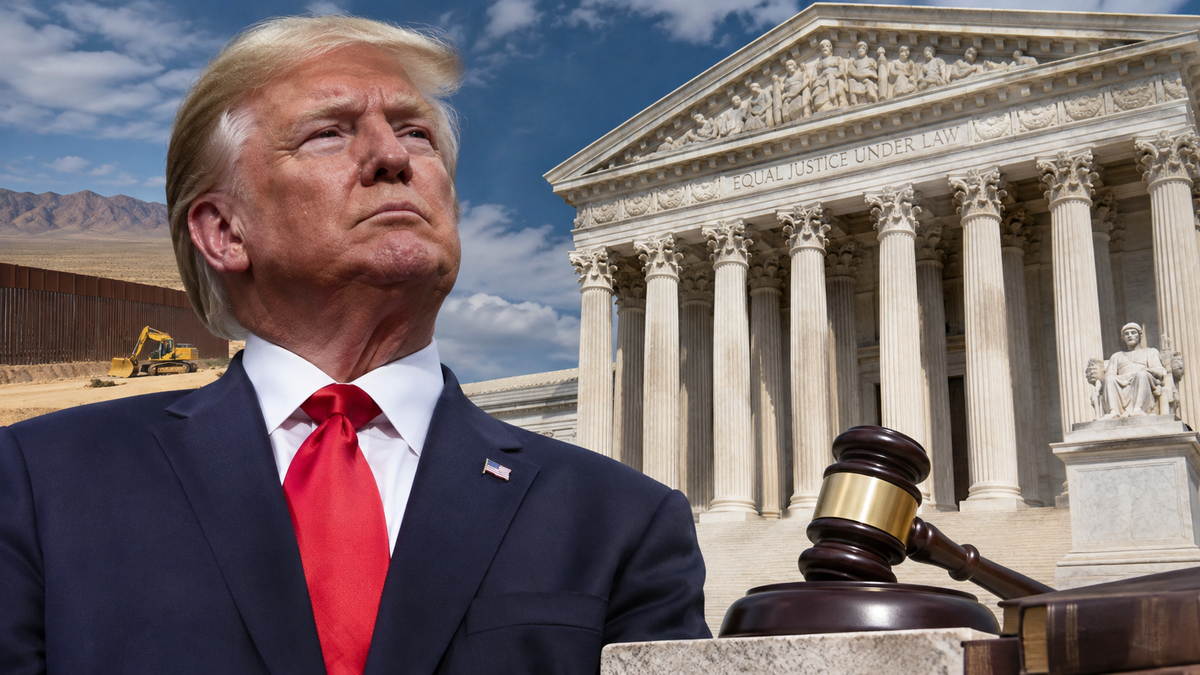
President Donald Trump won a major legal victory Monday when the U.S. Supreme Court ruled 8-1 to allow his administration to resume border wall construction in the Big Bend region of West Texas.
Justice Ketanji Brown Jackson was the lone dissenter. The other eight justices, including liberal Justices Sonia Sotomayor and Elena Kagan, agreed to lift a lower court order that had stopped construction.
The decision clears the way for the Department of Homeland Security (DHS) to resume building barriers, roads and other border security facilities along a remote stretch of the U.S.-Mexico border.
Significantly, the case goes well beyond one small portion of the wall itself. At its core is a dispute over how much power Congress has given the President to bypass federal laws when securing the border — and how much authority federal judges have to intervene.
The dispute began when DHS invoked a federal law allowing the government to waive certain legal rules to speed construction of border barriers.
The project covers parts of the Big Bend Sector, a 517-mile stretch of West Texas known for its rugged desert, mountains and the Rio Grande.
The administration declared the sector an area of high illegal entry and waived several federal environmental and conservation laws.
That decision drew a lawsuit from the Center for Biological Diversity, a local river guide and a nonprofit that works to preserve a historic church in Ruidosa, Texas.
The plaintiffs argued that DHS had exceeded its legal authority. They also warned that construction could harm the region's wildlife, natural beauty and public access.
On October 2, U.S. District Judge Kathleen Cardone issued a preliminary injunction blocking the waivers and halting construction. Her written findings followed on October 14.
The administration then asked the Supreme Court to intervene.
The Supreme Court's decision rested largely on a law signed by President Bill Clinton three decades ago.
Section 102 of the Illegal Immigration Reform and Immigrant Responsibility Act of 1996 gives the Homeland Security Secretary broad powers to build barriers and roads along the southern border.
It also allows the Secretary to waive legal requirements that might delay construction. More importantly, the law places strict limits on the power of federal courts to review those waivers.
Under the statute, federal judges generally may hear claims alleging violations of the U.S. Constitution. Claims that the administration merely exceeded its powers under federal law are largely barred.
The plaintiffs tried to overcome that limit by invoking the major questions doctrine, a legal rule that requires clear authority from Congress before federal agencies can exercise certain sweeping powers.
The Supreme Court rejected that argument.
In its five-page ruling in Mullin v. Friends of the Ruidosa Church, the court wrote:
There is no such thing as a “constitutional” major-questions claim.
The justices found that the plaintiffs' claim was based on federal law, not a direct violation of the Constitution.
As a result, the majority concluded that the administration was highly likely to prevail on its argument that the district court lacked jurisdiction to hear the claim.
The justices also considered the cost of delaying construction.
According to a declaration from a U.S. Customs and Border Protection official, the injunction was costing the federal government nearly $500,000 per day.
The government argued that those losses could not be recovered even if it ultimately won the lawsuit.
The court agreed that the financial losses, along with the government's border security interests, weighed in favor of allowing construction to resume.
The majority also acknowledged concerns about the region's scenery, recreation and environment.
However, the justices concluded that Congress had already weighed those interests when it passed a law permitting the government to waive environmental rules for border construction.
The court stated:
The Government’s interest therefore outweighs any aesthetic, recreational, and environmental harm alleged by respondents.
The 8-1 vote was notable because the majority included justices from both the court's conservative and liberal wings.
Jackson, appointed by former President Joe Biden, was the only justice to publicly oppose granting the administration's request.
She did not issue a written dissent explaining her position.
Instead, the order ended with a single sentence:
JUSTICE JACKSON would deny the application for stay.
Her specific objections to the majority's reasoning remain unclear.
Despite the administration's victory, the Supreme Court did not issue a final ruling on every legal issue surrounding the Big Bend project.
The order suspends the lower court's injunction while the administration seeks further Supreme Court review.
According to The Texas Tribune, the project has drawn opposition from environmental groups, local residents and some Texas Republicans.
Critics argue that Big Bend's harsh terrain and historically low rate of illegal crossings make extensive barriers unnecessary. They also warn of lasting damage to the region's parks and tourism economy.
The administration counters that gaps in border defenses could attract smugglers, drug traffickers and illegal crossings.
As of this writing, those disputes remain unresolved.
For now, the Supreme Court's ruling removes a major legal barrier to construction and gives the Trump administration an important victory in its effort to expand border security.
It also reinforces a broader legal principle: When Congress expressly limits judicial review, federal judges cannot simply set those limits aside because they disagree with how an agency uses its powers.
The full ruling in Mullin v. Friends of the Ruidosa Church may be found at THIS LINK.