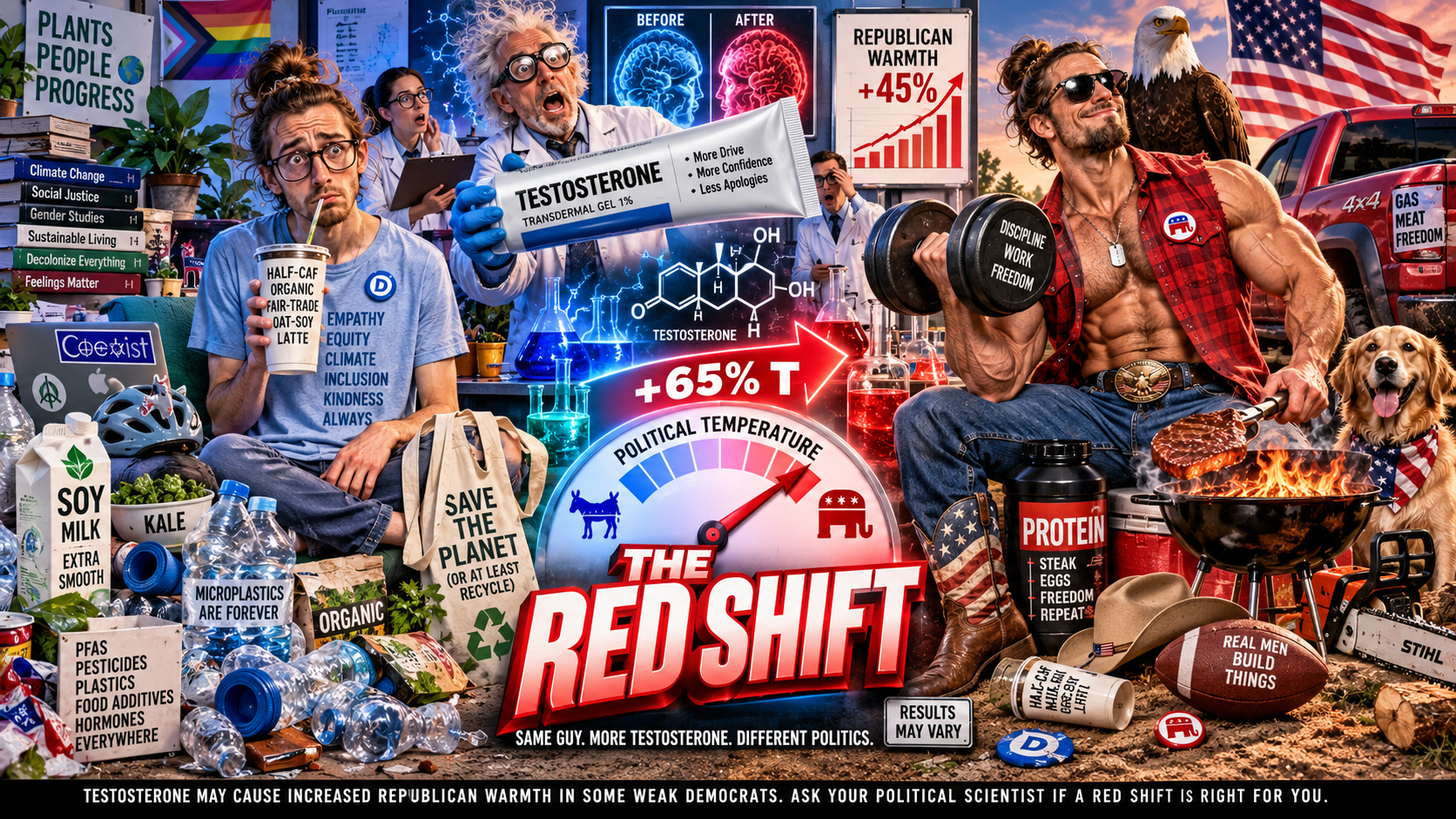
Testosterone treatment gives weak Democrats a ‘red shift’
A new study found testosterone weakened Democratic sentiments and boosted warmth toward Republicans among weakly aligned men
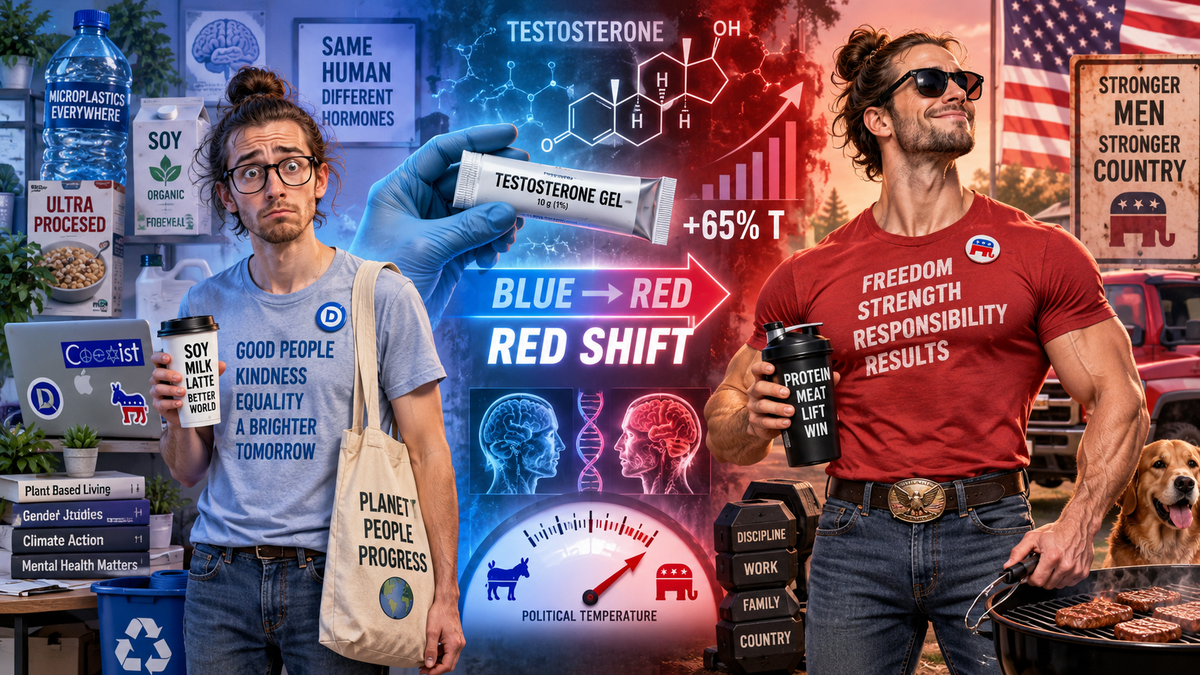
TL;DR: A peer-reviewed Brain and Behavior study found that testosterone produced a measurable “red shift” among weakly affiliated male Democrats. After testosterone treatment, their Democratic Party attachment fell about 12.5%, while their warmth toward Republican candidates increased 45%. Strong Democrats and Republicans did not significantly change. Even before treatment, weak Democrats had 19% higher basal testosterone than strong Democrats and all Republicans.
The finding fits a broader body of research suggesting political orientation is influenced partly by biology. Genetic studies suggest inherited factors can account for a substantial share of variation in political attitudes, while a large 2024 MRI study replicated a small association between conservatism and larger amygdala volume. Evolutionary psychology also offers models connecting life-history strategies with political preferences, although the simplistic r/K mapping of liberalism and conservatism remains controversial.
Meanwhile, testosterone levels among American males have declined over recent decades, while widespread exposure to endocrine-disrupting compounds — including phthalates, BPA, PFAS, pesticides and chemicals associated with plastics — has raised legitimate scientific concern about effects on male hormones.
Does that mean microplastics and estrogenic chemicals caused the rise of the political Left? No evidence currently establishes that causal link. But after a study literally found that giving weak Democrats testosterone moved them to the right, the hypothesis makes for considerably better cocktail-party speculation than it did a few years ago.
A dose of testosterone may not turn a Democrat into a Republican, but according to a peer-reviewed study, it can apparently give some Democrats a rather noticeable push toward Team Red.
Researchers writing in the journal Brain and Behavior found that testosterone treatment weakened Democratic Party attachment and sharply increased favorable views of Republican candidates among men who described themselves as weakly affiliated Democrats.
The effect was not exactly subtle.
Among weak Democrats given testosterone, the strength of their Democratic affiliation fell by 12.5%. Their warmth toward Republican political figures jumped by 45%. Strong Democrats did not move, and neither did Republicans.
The researchers themselves called it a “red shift.”
There is, however, another finding buried in the study is even more interesting: before researchers administered anything, “weakly affiliated Democrats had basal T levels 19% higher than strong Democrats and all Republicans.”
In other words, the Democrats who were already least committed to being Democrats also happened to have the most testosterone.
As I said — interesting.
The study, led by researchers affiliated with Claremont Graduate University and Loma Linda University Medical Center, involved 136 healthy men with an average age of 22.3.
The experiment was actually conducted from March through November 2011, during the run-up to the 2012 presidential election, though the results were not published until July 2025. Democrats made up about 44% of the sample, Independents 29%, and Republicans just over 8%.
Participants were randomly given either an inert placebo or 10 grams of AndroGel (a form of topical testosterone that is readily absorbed through the skin) in a double-blind protocol. The testosterone treatment raised average testosterone levels by about 65%.
Researchers then measured party attachment and used a 0-to-100 “feeling thermometer” to gauge attitudes toward leading political figures.
The Democratic slate included Barack Obama, Joe Biden, Bill Clinton, Nancy Pelosi and Harry Reid. Republicans included Mitt Romney, Newt Gingrich, Sarah Palin, Mike Huckabee and Rand Paul. They did this in 2011, remember?
The results depended heavily on the strength of partisan attachment.
Testosterone did essentially nothing politically to strongly affiliated Democrats. It also did not significantly move Republicans.
But among weak Democrats, average Democratic Party identification fell from 65.25 to 57.12 after treatment — a 12.5% decline. Those same men became 45% warmer toward Republican candidates.
The authors summarized their findings this way: weak Democrats started with unusually high testosterone, became less Democratic when given more testosterone and became substantially more favorable toward Republicans.
Their conclusion was straightforward: additional testosterone caused a measurable rightward movement among this subgroup.
The researchers even offered a description that requires almost no editorial assistance, suggesting weak Democratic males might be “wolves in sheeps' clothing.”
There are, of course, limits to what we can conclude from this. The men did not actually change their voter registration. They did not cast ballots or make campaign donations. The study also involved a small, young sample with very few Republicans.
The authors explicitly warned that their findings do not show that Republicans generally have higher testosterone than Democrats.
Still, when researchers give a Democrat testosterone and his affection for Republicans rises 45%, the phrase “red shift” seems unusually appropriate.
The study raises a larger and more serious question: How much of political belief is really the product of conscious thought, and how much might have a biologic underpinning?
Perhaps less thought and more biology than most people imagine.
The authors note that “One's genes appear to explain up to 50% of party affiliation, leaving an opportunity for life experiences to alter political preferences,” citing work by political scientist Peter Hatemi and colleagues.
Hatemi's research using twins and extended families found substantial genetic influence on political and social attitudes, although genes do not dictate which box someone checks on Election Day. Genetic effects appear to act through personality, temperament and other traits that help make some political ideas more appealing than others.
That distinction matters. No one has found a Republican gene tucked neatly next to the genes for eye color.
But the broader evidence increasingly suggests that political orientation is not simply downloaded from CNN, Fox News, college professors or one's parents.
Part of it may be baked into the machinery.
The testosterone paper also notes that “The brains of conservatives and liberals may even be different,” while properly warning that the evidence has been mixed.
That claim has since received some interesting support.
An influential 2011 brain-imaging study reported that political conservatism was associated with greater gray-matter volume in the right amygdala, while liberalism was associated with greater volume in the anterior cingulate cortex.
More importantly, researchers recently attempted a much larger preregistered replication.
A 2024 study, published in iScience, examined MRI scans from 928 people. Researchers successfully replicated a small positive association between conservatism and amygdala volume. They did not, however, reliably replicate the earlier finding involving the anterior cingulate cortex. They also found weak links between conservatism and portions of the fusiform gyrus.
The authors stressed that the effect sizes were quite small.
So, no; a neurologist cannot slide your MRI into a scanner and announce, “Bad news, I’m afraid. Your amygdala says you're voting Democratic Socialist.”
But political differences do appear to have at least some detectable biological correlates.
That brings us to an even more provocative theory.
Political differences may, in part, reflect behavioral strategies shaped by evolution.
One version of that argument has been promoted by the author writing under the name “Anonymous Conservative” in The Evolutionary Psychology Behind Politics.
His model applies the older biological concept of r/K selection theory to modern politics. In simplified form, r-selected strategies favor rapid reproduction and exploitation of abundant resources, while K-selected strategies place more emphasis on competition, investment in fewer offspring and survival when resources are constrained.
Anonymous Conservative argues that many liberal preferences resemble an r-oriented behavioral strategy, while conservative preferences resemble a K-oriented one — particularly on competition, family formation, sexual behavior, resource use and individual versus collective responsibility.
It is an interesting framework. It is also important not to oversell it. And, following his blog and daily news brief will undoubtedly get you on a numbers of lists. You have been warned.
Classic r/K selection fell out of favor among evolutionary biologists decades ago as a general model of life-history evolution. A major review in Ecology noted that by the early 1980s the framework was increasingly viewed as too crude and had largely been displaced by more detailed demographic and life-history models. However, the underlying structure persists in modern Life-History Theory, and has recently been applied to the observed behaviors of migrants.
Using simple r/K categories to explain individual human political beliefs is therefore not established evolutionary science — but it does seem to have a certain degree of utility in select situations.
Meanwhile, the broader idea behind it — that political behavior might reflect evolved life-history strategies — has not disappeared. Quite the opposite, in fact.
A 2025 review in Evolutionary Psychological Science examined evolutionary explanations of political belief and identified life-history strategy, pathogen avoidance, sexual strategies, kin selection and coalition defense among the major proposed biological pathways influencing political preferences.
An earlier study in Evolution and Human Behavior also found relationships among childhood stress, attachment style and later political values, although it did not find support for every prediction drawn from life-history theory.
A recent Cambridge review likewise treats evolutionary explanations of ideology as a legitimate research field, connecting political orientation with such traits as threat sensitivity, physical strength, pathogen avoidance, cooperation and group conformity.
Thus, “r equals liberal and K equals conservative” is far too neat and tidy to be treated as settled fact.
But, the deeper proposition — that some political differences may emerge from evolved behavioral tendencies — is no longer particularly exotic.
Now we come to the part where correlation, speculation and political mischief can have a few drinks together — or at least a round of shots.
American males appear to have experienced a long-term decline in testosterone.
A population study published in the Journal of Clinical Endocrinology & Metabolism found age-adjusted testosterone levels declining over time among American men, independent of aging alone.
A later analysis of 4,045 adolescent and young adult males using NHANES data found mean testosterone concentrations were significantly lower during 2011-2016 than during 1999-2000. The decline persisted even among normal-weight men, although obesity and other factors clearly play a role.
The exact causes (because, naturally, there isn’t just one) remains a subject of debate. However, environmental endocrine-disrupting chemicals are among the chief suspects.
The Endocrine Society defines an endocrine-disrupting chemical as an outside chemical or mixture capable of interfering with hormone action. The category includes pesticides, chemicals used in plastics, food-contact materials, cosmetics and other common exposures.
Research has linked several major classes of these compounds with altered male reproductive hormones.
Phthalates, commonly associated with plastics and consumer products, have been linked in some human studies with lower testosterone. An NHANES analysis, for example, found certain phthalate metabolites associated with lower total, free or bioavailable testosterone in some age groups.
BPA can display estrogen-like activity and interact with androgen and estrogen signaling. PFAS — the so-called “forever chemicals” — have also drawn scrutiny for endocrine effects, though the human evidence varies considerably by compound and outcome. A 2023 review found comparatively strong human evidence for adverse male reproductive associations with phthalates and pesticides, while evidence regarding phenols and PFAS was more mixed.
Microplastics have now entered the conversation as well. A 2026 review reported experimental evidence that microplastics can interfere with testosterone production through oxidative stress, Leydig-cell damage, altered steroid production and disruption of hormone receptors. The authors emphasized, however, that direct human evidence remains limited.
And yes, there really are estrogenic compounds in drinking water.
A 2024 systematic review of 45 studies identified 16 estrogenic compounds in drinking-water samples around the world, including hormones, plasticizers, pesticides, surfactants and pharmaceutical residues. Importantly, however, the estimated estrogenic activity risk was negligible for most compounds at observed concentrations, with DEHP presenting a low estrogenic-activity risk.
That last sentence is worth noting because “chemical detected” is not the same thing as “chemical present at a dose proven to feminize humans.” Also, there has been very little attention paid to the possible cumulative — additive? synergistic? — effects of these compounds when found together.
Pesticides are another large category. The EPA specifically screens pesticides and environmental contaminants for estrogen, androgen and thyroid activity through its Endocrine Disruptor Screening Program.
Even the food supply offers possibilities. Reviews have identified compounds associated with processed foods and food packaging — including BPA, phthalates and some preservatives — as potential endocrine disruptors. Parabens, used in some foods, medicines and personal-care products, can display weak estrogenic activity, although their potency is vastly lower than natural estrogen and the health significance of ordinary human exposure remains disputed.
So America has declining male testosterone, widespread exposure to endocrine-active chemicals, and now an experiment showing that adding testosterone to weak Democrats makes them less Democratic.
You can probably see where this is going. Sooooo…
Scientifically?
No study cited here shows that BPA makes a man vote for Alexandria Ocasio-Cortez, that PFAS increases support for Medicare for All, or that microplastics cause an irresistible desire to put a “Coexist” sticker on a Subaru or wear a man bun.
Likewise, researchers have not demonstrated that declining testosterone has caused the growth of political liberalism.
Those would be enormous causal leaps — almost as large as believing we can actually vote our way out of this mess.
Still, the ingredients for an interesting hypothesis are all right there, staring us in the face.
We know that male testosterone has declined over time.
We know modern humans are widely exposed to substances capable of disrupting sex-hormone pathways.
We know biological traits, genes and even some aspects of brain structure correlate with political orientation.
And now we know that experimentally increasing testosterone caused a specific group of Democratic men to move measurably toward Republicans.
That doesn't prove environmental estrogenic compounds created the modern Left.
But it does make one wonder whether the nation's political consultants have been wasting billions of dollars on television ads when somebody should have been checking the water supply.
There is a certain brutal elegance to the hypothesis.
Perhaps the answer to polarization isn't another 4,000-word New York Times essay.
Perhaps some swing voters just need to stop microwaving lunch in plastic containers.
That's a joke, not a clinical recommendation. (Editor’s note: it’s totally a clinical recommendation. Borosilicate glass FTW!)
Strip away the fun, though, and the study challenges a comforting assumption about politics.
People like to imagine that they arrive at political beliefs through calm, rational examination of tax rates, foreign policy, constitutional law and competing economic models.
Yeah. Uh huh. Shuuuuure they do.
Increasingly, research suggests that this picture is incomplete.
Genes matter.
Personality matters.
Childhood conditions matter.
Threat perception matters.
Brain structure may matter.
Hormones apparently matter, too.
And the effects may be strongest precisely among voters without deeply anchored partisan identities.
The testosterone study's authors themselves proposed dopamine and risk-taking as one possible mechanism. Testosterone may make weak Democrats more willing to acknowledge political preferences they already held but were reluctant to express. They also observed that competition can raise testosterone and suggested that social conditions could therefore produce political effects without anyone applying prescription gel.
That possibility may ultimately prove far more important than the partisan joke.
Politics may not merely change how people feel.
How people feel — in the most literal biochemical sense — may help change their politics.
And, for at least one group of young male Democrats, the experimental evidence points in only one direction: Right.