The $28 Christmas Lesson Huntsville Wasn’t Expecting
“People aren’t angry about Christmas lights. They’re angry because the math doesn’t math and the priorities don’t prioritize.”— Alicia Boothe Haggermaker
Guest Opinion by Alicia Boothe Haggermaker
Huntsville, we need to talk about the math.
Not calculus.
Not quantum engineering.
Just basic, elementary-school math — the kind that still applies even when you wrap it in Christmas lights.
Let’s start with the headline everyone keeps dancing around:
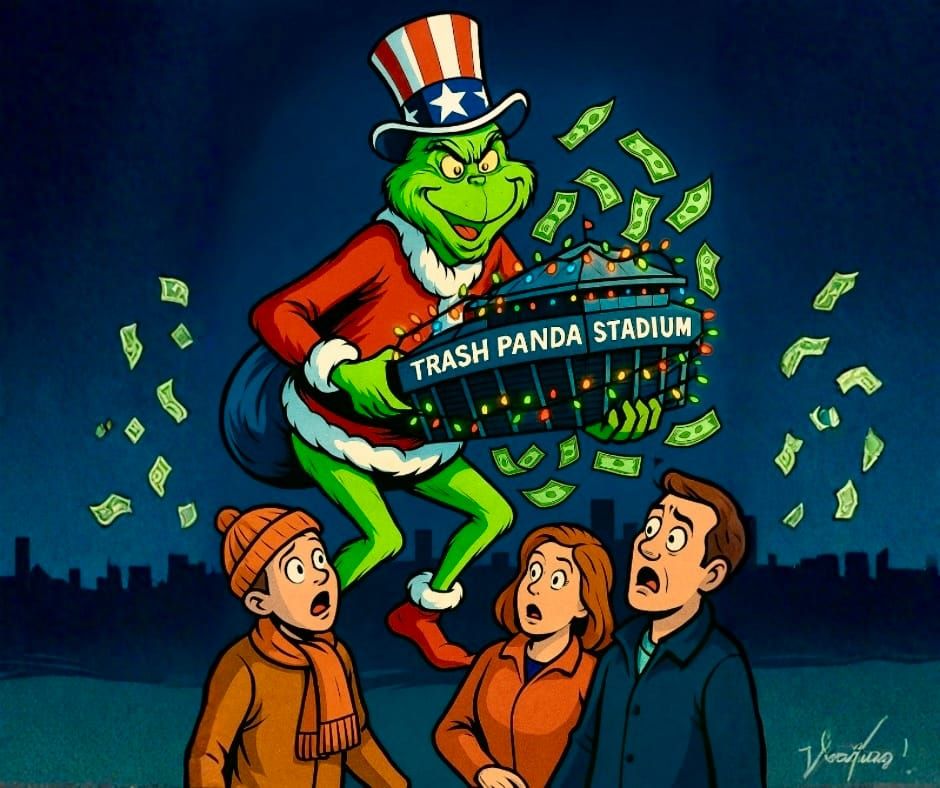
It’s $28 per person to walk through Christmas lights at Toyota Field.
Not per car.
Not per family.
Per. Person.
Yes, kids 12 and under are free. Wonderful.
But by the time two adults and a couple of kids get in, buy the snacks, grab the “festive” cocoa, and inevitably get talked into one glowing, blinking, spinning light-up object…
You’re already in for $60–$80 before the evening has even begun.
And that’s before dinner.
At this rate, feeding your kids McDonald’s pink-slime nuggets beforehand isn’t even a budgeting hack — it’s a survival strategy.
But here’s the real kicker:
People aren’t angry about Christmas lights.
They’re angry because the math doesn’t math and the priorities don’t prioritize.
When families say “this is too expensive,” they aren’t attacking the holidays.
They’re saying what everyone feels:
- Stadium events cost more every year
- Community access feels smaller
- Cashless policies and add-on fees multiply like gremlins
- Taxpayers are subsidizing developments they can’t afford to enjoy
And somehow there’s never money for the things that actually matter
Huntsville doesn’t hate growth. Huntsville hates being billed for it and bullied by it.
Because while regular families are doing grocery-store math in their heads, our leadership is proudly taking victory laps around:
- multi-million-dollar stadium deals
- annexations with no public explanation
- cashless venues with mandatory card fees
- and “public-private partnerships” that privatize profits and socialize costs
Meanwhile, volunteer fire departments can’t replace equipment.
Teachers buy classroom supplies out of their own pockets.
Roads crumble.
Water bills skyrocket.
And now families are told that $28 per person to see lights is just “the cost of fun.”
It isn’t the lights that shocked people — it’s the realization that affordability has quietly vanished from the equation.
Community spaces feel less like gathering places
and more like upper-class event barns
with a few children's activities sprinkled in for branding.
I’ve run fundraisers for years — Trash Pandas, Havoc hockey, Girl Scouts, homeschool groups, rec leagues. I’ve seen how our community actually behaves when something is accessible, local, and rooted in reciprocity:
- People show up.
- People donate.
- People participate.
- People support each other.
If you build something for the community, the community sustains it.
But when you build something from the community’s pocket without returning real value?
People notice.
And this year… they noticed loudly.
So let’s just say the quiet part out loud — or wheel the elephant right out onto the field (Roll Tide): Editor’s Note: War Eagle
The issue isn’t the cost of lights.
The issue is the cost of living inside a system where residents pay more and receive less.
If leaders want trust, they can’t keep asking families to absorb price hikes while publicly subsidized venues operate like private luxury destinations.
This isn’t about Christmas spirit.
This is about civic math.
And right now, the equation is upside down.
Until that changes, you can expect the public to stay vocal — and rightfully so.
Because nobody begrudges a holiday outing.
But everybody knows when something that should feel joyful starts feeling like a shakedown.
And Huntsville families?
They’re tired of being shaken.
Alicia Boothe Haggermaker is a lifelong resident of Huntsville, Alabama, and a dedicated advocate for health freedom. For more than a decade, she has worked to educate the public and policymakers on issues of medical choice and public transparency. In January 2020, she organized a delegation of physicians and health freedom advocates to Montgomery, contributing to the initial draft of legislation that became SB267.
Opinions do not reflect the views and opinions of ALPolitics.com. ALPolitics.com makes no claims nor assumes any responsibility for the information and opinions expressed above.