The Golden Fleet: Trump Battleship Plan Stirs Debate
President Trump unveils USS Defiant and “Golden Fleet” battleships; Navy adds new FF(X) frigate as critics question cost, tech and cruiser roles
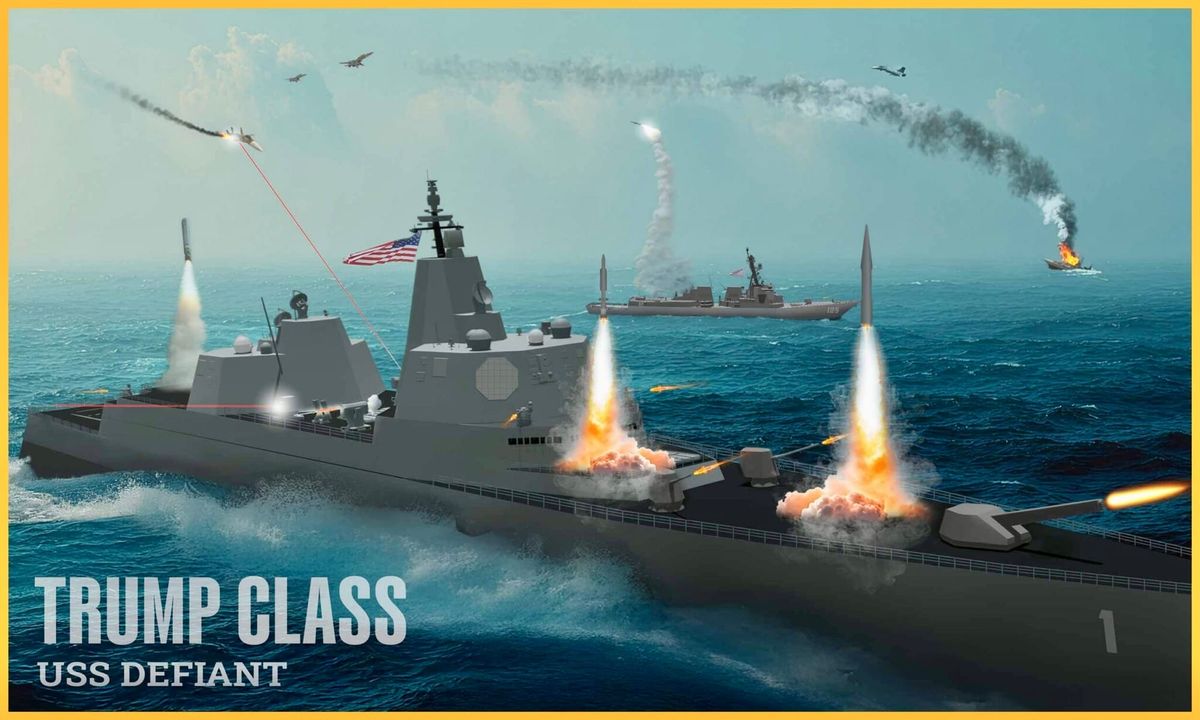
President Donald Trump formally announced a bold naval buildup that would reintroduce large warships into the U.S. fleet and reshape surface warfare strategy on December 22. Speaking at his Mar-a-Lago estate, Trump unveiled plans for a new class of large “Trump-class” battleships—beginning with the USS Defiant—as part of a broader “Golden Fleet” initiative.
Under the proposal, the Navy would build an initial pair of Trump-class vessels with the potential to expand to a fleet of 20–25 ships. The vessels are projected at roughly 30,000–35,000 tons—making them the largest U.S. surface combatants since World War II—and would carry an array of advanced weapons including hypersonic missiles, railguns, high-energy lasers and nuclear-armed sea-launched cruise missiles. Trump claimed the new ships would be “100 times more powerful than any battleship ever built.”
Navy Secretary John Phelan supported the plan, suggesting the program would help reverse decades of declining ship counts and restore maritime dominance.
Preceding the battleship announcement, on December 19 the Navy also unveiled its FF(X) frigate program—a separate initiative to deliver a new class of smaller surface combatants. The frigate will be based on the U.S. Coast Guard’s Legend-class National Security Cutter design and is intended to fill the gap left by the recently scaled-back Constellation-class frigate program.
Secretary Phelan emphasized that FF(X) vessels will be “highly adaptable,” carrying modular payloads and supporting unmanned systems, with the first hull expected in the water by 2028.
The Navy’s surface fleet has been under pressure as the Cold War-era Ticonderoga-class guided-missile cruisers age and are phased out. These cruisers have for decades provided Aegis-based air and missile defense and often served as command and control platforms within carrier strike groups.
A government watchdog found that efforts to modernize several Ticonderoga cruisers cost billions but yielded limited additional service life, underscoring the challenges of keeping these older hulls viable.
Some advocates of the Trump-class battleships see them as potential platforms to assume at least some of the command, control and long-range strike roles once held by the Ticonderogas—potentially helping bridge capability gaps as the fleet modernizes.
Defense analysts, however, have been quick to question the feasibility of the Trump-class concept. Critics note that many of the advanced weapons featured in the proposed design—such as large railguns—have been shelved or are still years from operational maturity, and that large, heavily armed surface ships may not suit the dispersed threat environment of the Indo-Pacific.
Others point out that funding such a program could strain a defense budget already stretched by newer carriers, submarines, destroyers and the new frigates—and that priorities like unmanned systems might deliver more value for the dollar.
Bernard Loo, Senior Fellow at Singapore’s S. Rajaratnam School of International Studies, described the proposal as “a prestige project more than anything else,” going so far as to call the ship a “bomb magnet.”
Notably, many of the same arguments can be applied to carriers, which in the era of hypersonic missiles, unmanned underwater vehicles (UUVs), unmanned aerial vehicles (UAVs), “carrier killer” missile barrages and nuclear weapons are often derided as “floating coffins” and “big fat targets.” The difficulties the U.S.S. Truman recently faced in the Red Sea—including one $60+ million F/A-18F fighter jet lost over the side during a maneuver the carrier made to dodge a Houthi missile—highlight the significant threat these ships face in a modern combat environment.
The Golden Fleet initiative marks an unusual pivot for the U.S. Navy. Battleships were retired in the 1990s as carriers and missile cruisers became dominant. Now, Trump’s plan seeks to blend that heritage with cutting-edge technology while also investing in more traditional combatants like the FF(X) frigate.
Whether the battleships will advance beyond concept into contracts and keel-layings remains to be seen. But the announcement has stirred fresh debate in Washington and naval circles about strategy, cost and the future of U.S. sea power—assuming, of course, that the Navy can even get them built at all.