The Religious Dumpster Fire: When Being Right Becomes More Important Than Doing Right
Guest Opinion by Alicia Boothe Haggermaker
Guest Opinion by Alicia Boothe Haggermaker
Well, I managed to start another religious dumpster fire on Facebook.
I can't say I was particularly surprised. I've repeatedly told people that we're on a search for truth, and that search is going to get uncomfortable. Apparently, some people thought the discomfort would be reserved for everyone else's beliefs.
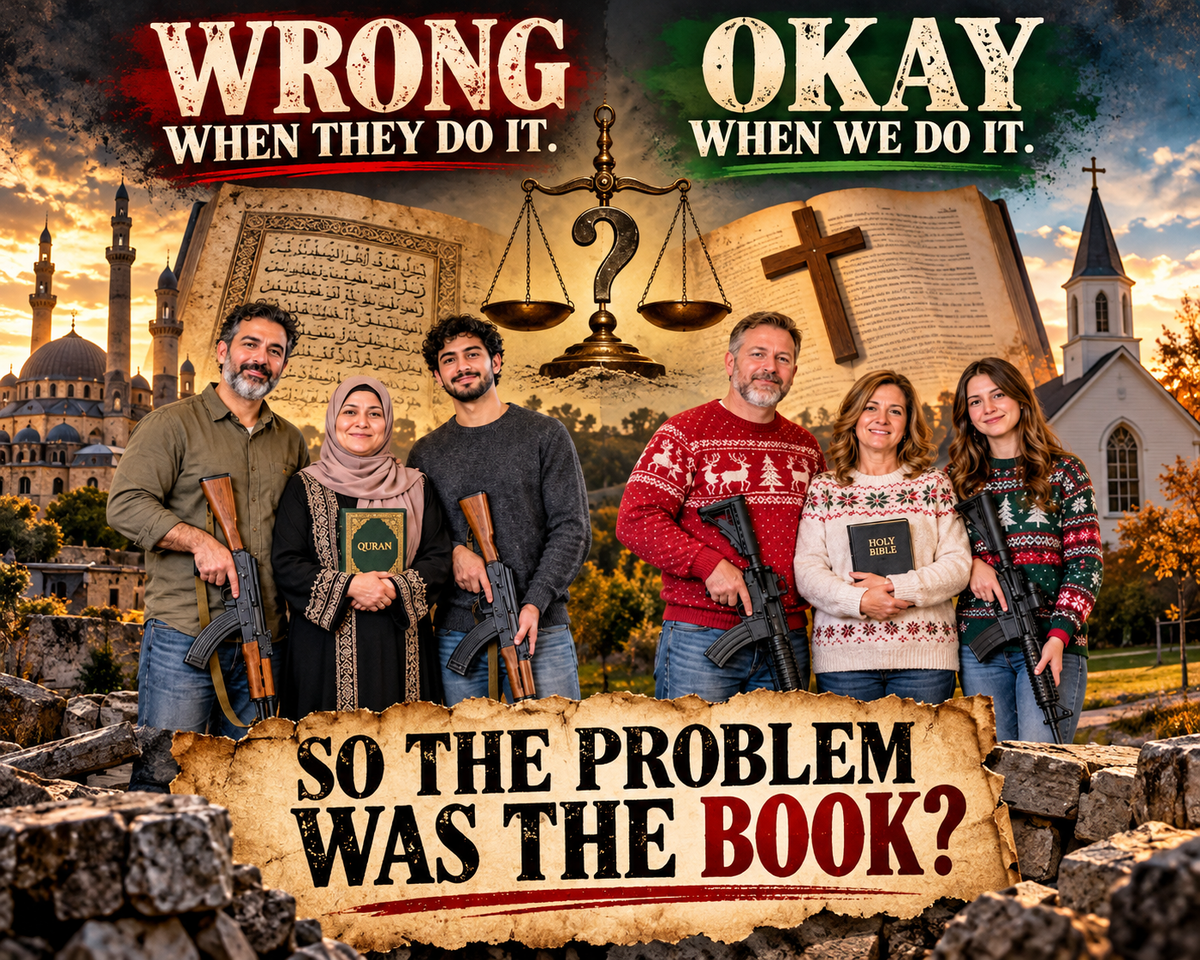
The whole thing started with a meme showing two families. One Muslim, one Christian. Both holding their respective religious texts, with family members holding firearms.
Above the Muslim family: “Wrong when they do it.”
Above the Christian family: “Okay when we do it.”
And underneath both:
“So the problem was the book?”
Now, I didn't post that expecting everyone to come into the comments, congratulate me, shake my hand, and tell me what a wonderful job I was doing.
I posted it because I thought the question was worth examining.
And boy, did we examine some things. 🤣
The Question Was About Doctrine
Let's establish something important before we go any further.
The meme wasn't claiming Christianity and Islam are identical. It wasn't declaring that all Muslims are peaceful or all Christians are hypocrites. And it certainly wasn't an endorsement of religious extremism.
It was asking whether we apply consistent standards when evaluating religious doctrine and the behavior of people who claim to follow it.
That is why I started quoting passages from both the Bible and the Quran.
Both contain teachings about compassion, mercy, generosity, and justice.
Both also contain passages involving violence, punishment, warfare, and gender relations that deserve careful examination.
Those passages don't necessarily mean the same thing, arise from the same circumstances, or carry the same authority within their respective traditions. Historical context, translation, interpretation, and the relationship between religious texts and later teachings all matter.
But here's my question:
If a passage troubles us when we encounter it in the Quran, are we equally willing to examine a comparable passage in the Bible?
And if we condemn a behavior when a Muslim engages in it, do we apply the same standard when a Christian engages in it?
Equal scrutiny doesn't require identical conclusions.
It requires consistent standards.
Somehow, that distinction became extraordinarily difficult to maintain in the comments.
I Didn't Discover Christianity Yesterday
Before anybody gets too carried away questioning my understanding of Christianity, perhaps a little personal context is appropriate.
I was raised Christian. My family's roots run deep in the Church of Christ.
Earlytown Church of Christ in Kinston, Alabama, sits in a community bearing my family name. Three family homes were built within a quarter mile of that church. My uncle and cousin preached there. My mother, aunt, grandparents, and other relatives are buried in its cemetery.
Christianity isn't some unfamiliar belief system I've recently encountered on the internet.
It's woven through my family history.
And some of the most painful treatment I've experienced in my life came from people who identified as Christian.
But here's what I don't do.
I don't attribute their behavior to every Christian on the planet.
Why?
Because I've also known Christians who were loving, generous, compassionate, and honorable.
I understand that people who share a religious label can differ enormously in character, interpretation, and conduct.
So why would I abandon that understanding when discussing Muslims?
If I refuse to hold every Christian responsible for the conduct of the worst Christians I've encountered, why would I hold every Muslim responsible for the conduct of an extremist?
That's not defending Islam.
That's applying the same principle to everyone.
Religion Is Not a Monolith
We readily acknowledge that Christianity has changed across centuries and developed differently across countries, cultures, and denominations.
Catholics, Protestants, Orthodox Christians, Pentecostals, and members of the Ethiopian Orthodox tradition do not agree on everything.
They don't all use identical biblical canons. They don't interpret every passage the same way. They disagree about religious authority, gender roles, salvation, political involvement, and the relationship between faith and government.
Even two Christians living in the same Alabama community can disagree about what Christianity requires.
Yet some people discuss Islam as though every Muslim in every country, across every century, has understood and practiced the religion identically.
That makes no sense.
Muslims also differ in their interpretations, traditions, cultures, political beliefs, and relationships with religious authority.
And Islam isn't an ethnicity.
There are Arab Christians and European Muslims. There are Muslims whose families have lived in the Balkans for generations. The world's Muslim population extends far beyond the Middle East.
None of this places Islam beyond criticism.
It means criticism should be accurate enough to account for the people and practices we're actually discussing.
If we recognize diversity within our own religious tradition, intellectual consistency requires us to recognize its existence in others.
When Religious Identity Becomes a Claim to Superiority
As the conversation continued, I found myself thinking about something deeper than religious differences.
Unhealthy narcissistic tendencies.
Not because I'm interested in diagnosing strangers from Facebook comments. I'm not.
I'm interested in patterns of behavior that can appear across religious, political, and cultural boundaries.
Grandiosity. Entitlement. Superiority. Defensiveness. Selective accountability. The need to protect an identity from criticism.
Psychologists also study collective narcissism, which involves an exaggerated belief in a group's greatness accompanied by sensitivity to perceived threats or insufficient recognition.
Religious identity can become entangled with those tendencies.
So can national identity.
So can political identity.
Hello, Democrats and Republicans. You're not getting out of this conversation either. 🤣
There's a difference between believing your religion teaches truth and believing that your religious identity makes you inherently superior to other human beings.
There's a difference between living according to your convictions and believing those convictions entitle you to control everyone else's life.
And there's a difference between defending your faith and defending your own perceived righteousness.
Jesus addressed that distinction.
In Luke 18:9–14, he tells the parable of the Pharisee and the tax collector. The Pharisee trusts in his own righteousness and looks down on others. The tax collector acknowledges his shortcomings.
Jesus doesn't praise the man who considers himself morally superior.
He challenges him.
Matthew 7 also warns against examining the speck in someone else's eye while ignoring the beam in our own.
These aren't obscure teachings.
They're central warnings against hypocrisy and self-righteousness.
Which raises a rather uncomfortable question:
At what point does someone's devotion to God become devotion to their own perceived righteousness?
And how willing are we to recognize that possibility within ourselves?
Extremism Isn't Confined to One Label
Another thing that emerged from the conversation is how often we discuss extremism as though it belongs to particular populations rather than examining the human behaviors involved.
Two extremists from different religions might disagree completely about theology while sharing remarkably similar attitudes toward authority, dissent, punishment, and the treatment of outsiders.
Meanwhile, two members of the same religion might disagree about virtually all those things.
The same applies to politics.
Two people on opposite ends of the political spectrum can both become convinced that their opponents are dangerous, dissent is betrayal, and their own side deserves exemptions from standards imposed on everyone else.
Strong convictions aren't automatically extremism.
But convictions can become increasingly rigid, intolerant, and dangerous.
And I think we make a mistake when we examine those developments without considering the environments in which people live.
Human beings have nervous systems. We have histories, predispositions, experiences, vulnerabilities, and different capacities for coping with stress.
Economic instability, violence, humiliation, propaganda, fear, and perceived threats can influence how people interpret the world.
Not everyone responds to those conditions the same way.
Some become more fearful or hostile. Others become more compassionate, cooperative, or determined to resist extremism.
Individual differences matter.
But so do the environments that reinforce particular responses.
A person can begin by wanting to protect their family and gradually become convinced that harming another population is necessary to accomplish that goal.
At every stage, they may believe they're acting defensively.
That's one reason I've spent so much time writing about reactivity and the cycles that develop when people interpret one another's defensive behavior as aggression.
Understanding those mechanisms doesn't excuse harmful conduct.
It helps us ask how to prevent it.
If we're serious about addressing extremism, shouldn't we examine the conditions that help cultivate it instead of simply arguing about which population deserves the blame?
Experience Matters. So Does Context.
Personal experiences can profoundly influence how we interpret other people.
Someone who has survived religious abuse may understandably associate certain religious practices or institutions with danger.
Someone raised in a loving religious community may associate those same practices with safety and belonging.
Both experiences deserve consideration.
But neither experience automatically establishes what every other person within that religion believes or does.
I've been exploring this principle in my Watch the Water series.
People don't encounter events as blank slates.
We interpret what happens through our histories, expectations, beliefs, and perceptions of safety.
Sometimes two people aren't even disagreeing about the same reality. They're reacting to different experiences while using the same words to describe them.
That's why understanding context is so important.
And it's why recognizing someone's suffering doesn't require accepting every generalization they might draw from it.
We can acknowledge that someone was harmed by religious extremists without assigning responsibility to millions of people who had nothing to do with that harm.
We can condemn abuse within a religious institution without declaring every member abusive.
We can criticize doctrines, governments, and religious authorities without pretending every individual associated with them shares identical beliefs.
Accountability becomes more meaningful when we identify who actually did what.
The Four C's
There's another pattern I've noticed in online conversations.
Someone encounters a post, identifies an inaccurate claim or an AI-generated image, and immediately announces:
“HAVE YOU EVEN RESEARCHED THIS?! IT'S FAKE!”
Congratulations, Detective. 🤣
Identifying misinformation is useful. Correcting it is important.
But recognizing that one detail is false doesn't necessarily mean you've understood the broader subject being discussed.
Even misinformation and disinformation can be valuable subjects of investigation.
Why was something created? Why do people believe it? What assumptions does it expose? What legitimate questions might be buried underneath an inaccurate claim?
That doesn't make false information true, and it certainly doesn't justify knowingly presenting fiction as evidence.
It means the investigation doesn't necessarily end with identifying the falsehood.
So I've developed a framework.
The Four C's: Content, Context, Conversation, and Critical Consideration.
Content: What are we actually examining? A factual claim, a religious passage, satire, an illustration, or someone's personal experience?
Context: What history, circumstances, interpretations, and missing information might change our understanding?
Conversation: What can we learn by asking questions, comparing perspectives, and examining disagreement?
Critical Consideration: Have we evaluated the evidence fairly, challenged our assumptions, and allowed for the possibility that our initial interpretation was wrong?
That fourth one applies to everybody.
Including me.
And no, you don't have to read everything I've ever written before commenting on one Facebook post.
But if you're going to make sweeping declarations about my beliefs, intentions, faith, or character, it would probably help to establish that you actually understand what I've said.
You might have wandered into Part 47 of a conversation that started months ago.
Read, people. 🤣
The Irony of the Dumpster Fire
What fascinates me most about the original discussion is how quickly a question about religious doctrine and moral consistency became a debate about my own religious identity.
I asked whether we were judging behavior and doctrine consistently.
Some people responded by questioning my understanding of God, my Christianity, and even my spiritual standing.
Think about that.
The original question was whether religious labels were influencing our judgments.
And before long, my religious label had become part of the argument.
I'm not suggesting every person who disagreed with me was acting in bad faith. Some raised legitimate questions. Some brought personal experiences that deserved consideration. Some simply interpreted the meme differently.
That's what conversation is for.
But disagreement is not proof of moral failure.
Questioning a religious interpretation is not automatically an attack on God.
And refusing to condemn an entire population is not the same thing as defending extremists within it.
I've written before about how reactivity becomes incentivized, how certainty can protect dysfunctional systems, and how fear and defensive behavior can perpetuate conflict.
This conversation brought several of those themes together.
And it reminded me why the willingness to question our own assumptions matters so much.
When Being Right Becomes More Important Than Doing Right
I don't expect everyone to agree with me about religion.
I don't even expect everyone who identifies as Christian to understand Christianity the way I do.
That's part of the point.
I do expect us to distinguish individual behavior from collective identity, examine claims with consistent standards, and recognize that our personal experiences don't necessarily describe everyone else's reality.
If we condemn coercion, we should condemn it regardless of who practices it.
If we oppose religious authoritarianism, we should oppose it even when the authorities claim to represent our own faith.
If we believe children deserve protection, that principle should not depend on the religion of the perpetrator.
If we value freedom of conscience, we should be willing to defend it for people whose consciences lead them somewhere different from ours.
And if we claim to value truth, we should be willing to discover that something we believed was incomplete, distorted, or wrong.
Because a principle that only applies when we like the people involved isn't much of a principle.
It's a preference.
Perhaps the most revealing question we can ask someone isn't simply what religion they follow.
It's this:
What do you believe your religion gives you the right to do to other people?
And perhaps the most important question we can ask ourselves is whether we're more interested in demonstrating our righteousness or actually practicing it.
I didn't promise anyone a comfortable search for truth.
I promised an investigation.
And that investigation includes the possibility that all of us—including me—have something left to learn.
Content. Context. Conversation. Critical Consideration.
Because being convinced you're right is not the same thing as doing right.
And if our beliefs make us unwilling to examine our own behavior, perhaps our beliefs aren't the only things that need examining.
Alicia Boothe Haggermaker is an investigative journalist, systems analyst, and community organizer based in Huntsville, Alabama. She publishes at Unprecedented Times (unprecedentedtimes.org) and is the founder of the Mycelium Network — a sovereign community coordination platform built as an alternative to the infrastructure this series documents.
unprecedentedtimes.org | mycelium.unprecedentedtimes.org
Opinions do not reflect the views and opinions of ALPolitics.com. ALPolitics.com makes no claims nor assumes any responsibility for the information and opinions expressed above.