
Three Hundred Years of Gulliver’s Travels
Guest Opinion by Justice Will Sellers
Guest Opinion by Justice Will Sellers
Three centuries in print is a landmark achieved by few books in human history. Even the bestsellers of their day, flicker briefly in the cultural consciousness before vanishing quietly into dusty library archives.
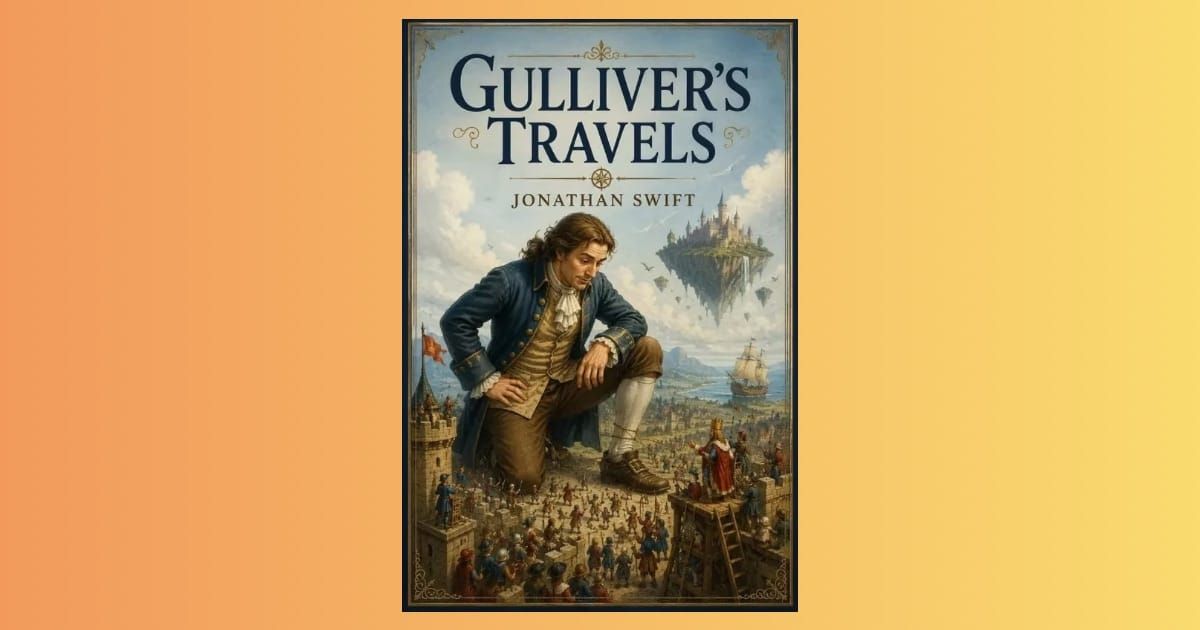
This month marks the 300th anniversary of Gulliver’s Travels by Jonathan Swift. It continues to sell thousands of physical copies every year, logs millions of digital downloads across the globe, and occupies a permanent place in English literature classes.
The Travels has also been adapted into at least 18 feature-length motion pictures and dozens of animated cartoons.
That a 300-year-old allegorical satire, written by an Anglo-Irish Anglican priest reacting to contemporary but now long-forgotten parliamentary squabbles, continues to command a global audience is nothing short of extraordinary.
It has survived as a literary chameleon; devoured by children as a whimsical fantasy of giants and miniature people, while simultaneously read by adults as one of the most unsparing demolitions of human vanity ever committed to paper.
Swift was not an idle storyteller spinning yarns for entertainment. He lived at the very center of British political life, aligning himself with the Tory party and using his blistering wit to shape public policy, challenge cultural consensus, and expose government overreach.
But when the Whig party swept into power under Britain’s first de facto Prime Minister, Robert Walpole, Swift found himself politically exiled to Dublin.
Outraged by political corruption, British tyranny in Ireland, and what he perceived as the rising moral bankruptcy of the age, Swift had ample material for his story.
Gulliver’s Travels was not written to amuse readers; rather, Swift wrote it to provoke and shake readers out of their self-satisfied complacency, and to puncture the swelling arrogance of 18th-century British society.
Framing the novel as a genuine traveler’s log by Lemuel Gulliver, a naive, endlessly gullible ship surgeon, Swift created a Trojan horse. Readers bought the book expecting a thrilling real-world adventure in the vein of Robinson Crusoe, only to find themselves reading an uncompromising mirror reflecting their own absurdities.
Swift wrote in an era intoxicated by the promise of human reason, scientific progress, and the belief that humanity was on an inevitable march toward moral perfection. Philosophers and scientists argued that through empirical observation, institutional reform, and technological innovation, society could eradicate its ancient flaws and construct a rational Utopia on Earth.
Swift viewed this soaring optimism as dangerous vanity. Where Enlightenment thinkers saw humanity as a rational species, Swift famously argued that man was merely an animal capable of reason but rarely chose to exercise that capacity.
This philosophical pushback is woven into every page of Gulliver’s narrative. Swift, who delivered a blistering critique of pure theoretical science and intellectual egoism, did not hate science itself, but he detested the blind faith that scientific discovery could ultimately cure the human condition.
Swift parodied the contemporary Royal Society of London by satirizing scholars who devoted their entire lives to absurd, speculative projects: attempting to extract sunbeams from cucumbers to warm the winter air, trying to soften marble into pillows, and designing plans to build houses from the roof down to the foundations.
While these elite academics are obsessed with high-minded theoretical pursuits, the real countryside lay in ruin, its fields uncultivated, its houses collapsing, and its citizens starving.
Swift’s message was clear and prophetic; scientific progress and intellectual elitism, when divorced from morality, practical human needs, and basic common sense, do not create Utopia. They create a bizarre, chaotic nightmare of waste.
Swift’s skepticism extended beyond scientific hubris to the very core of human political and moral nature. Throughout Gulliver's voyages, Swift systematically dismantles human pride by shifting physical and moral scales.
In Lilliput, Swift renders grand geopolitical conflicts hilariously pathetic. The 6-inch-tall Lilliputians engage in bloody civil wars over whether soft-boiled eggs should be broken on the big end or the little end, a direct parody of the bloody, sectarian religious conflicts between Catholic France and Protestant Britain.
In Brobdingnag, Swift flips the scale, making Gulliver a tiny pest among giants. When Gulliver proudly describes British political institutions, gunpowder, and warfare to the giant King of Brobdingnag, the ruler responds with horrified disgust, concluding that Europeans are "the most pernicious race of little odious vermin that nature ever suffered to crawl upon the surface of the earth."
In the Land of the Houyhnhnms, Gulliver encounters the Houyhnhnms, a race of noble, hyper-rational horses, and the Yahoos, a race of filthy, aggressive humanoids driven entirely by raw, uncontrolled appetite. To Gulliver’s horror, he realizes that he and his fellow Europeans are not far removed from the Yahoos.
Swift leaves his reader with no easy comfort. By showing Gulliver returning home so traumatized by human corruption that he prefers the company of stable horses to his own family, Swift forces us to confront the uncomfortable truth that human nature is deeply, inherently flawed and almost beyond salvage.
After Three hundred years, Gulliver’s Travels feels less like a historical relic and more like a contemporary critique. The specific 18th-century politicians Swift targeted are long gone, but the human behaviors he exposed remain completely unchanged.
We still fight ideological "Egg-Wars" online, dividing ourselves into furious tribes over trivial nuances.
To secure power and position, our political leaders still perform displays of virtue signaling and media posturing.
And in our modern tech sector, where visionary entrepreneurs promise that algorithms, artificial intelligence, and speculative technology will solve every human illness, we hear the echo of Gulliver’s Travels loud and clear.
Swift did not merely satirize his own era; he diagnosed the permanent condition of humanity. He warned us against the dangers of unchecked vanity, political fanaticism, and the dangerous illusion that technology can substitute for moral responsibility.
Three centuries later, Swift’s masterpiece continues to sell, to challenge, and to vex. It stands as a monument to the power of satire, a brilliant, uncomfortable, and utterly essential mirror that every generation must regard to fully engage morality to confront human nature.
Will Sellers is a graduate of Hillsdale College and is an Associate Justice on the Supreme Court of Alabama. He is best reached at jws@willsellers.com.
Opinions do not reflect the views and opinions of ALPolitics.com. ALPolitics.com makes no claims nor assumes any responsibility for the information and opinions expressed above.