
Washington's First Victory
Guest Opinion by Justice Will Sellers
Guest Opinion by Justice Will Sellers
The first major victory for the Continental Army occurred 250 years ago on March 17, 1776, when the British evacuated Boston.
Following the fighting at Lexington and Concord, thousands of colonial militiamen surrounded the British army when they retreated to Boston. The Royal Navy maintained supply lines, and while the colonial forces effectively contained the British, they lacked the manpower to liberate Boston from British occupation.
As the siege of Boston began, George Washington assumed command. His army consisted largely of short-term militia with uneven training, limited discipline, and severe shortages of weapons, ammunition, and artillery. Washington quickly realized that the Americans lacked the heavy guns necessary to threaten British positions within Boston.
Determined not to launch a reckless frontal attack with significant losses, he instead focused on strengthening the army’s organization and searching for a strategic opportunity that might force the British to leave.
One of the most important developments in breaking the stalemate came far away from Boston. Earlier, in May of 1775, American forces captured Fort Ticonderoga in northern New York. The fort contained a large supply of artillery, including cannons, mortars, and other heavy weapons that the Continental Army desperately needed.
Washington approved a bold plan proposed by Henry Knox, who suggested retrieving the captured cannons from Fort Ticonderoga and transporting them hundreds of miles through winter conditions to Boston. Against all odds, Knox and his team moved nearly sixty tons of artillery over frozen rivers, snow-covered roads, and mountainous terrain. In January of 1776, Knox successfully delivered the artillery to Washington.
Although the Americans now had artillery, Washington still needed a way to use it effectively. Boston was heavily defended and a direct assault, even with artillery support, was unwise. So, Washington identified a location that could shift the balance without requiring a full-scale attack.
South of Boston stood Dorchester Heights. Whoever controlled these heights would command a dominant position over the British fleet and the city below. If American artillery could be placed there, British ships would become vulnerable, and the entire British position in Boston would be threatened.
But Dorchester Heights lay within range of British defenses, and any attempt to fortify the hills would have to be carried out quickly and secretly.
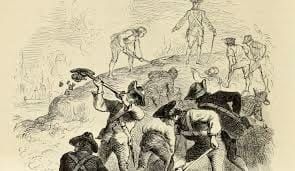
Washington carefully planned the operation and organized a diversionary bombardment of British positions while troops prepared materials for fortifications. Under cover of darkness, American soldiers quietly moved artillery, timber, and tools onto the heights, where they constructed fortifications and placed the cannons brought from Fort Ticonderoga in menacing positions. When British forces looked up to see fortified positions armed with heavy artillery, they knew the siege was over.
On March 17, 1776, British troops and loyalist civilians began evacuating Boston as approximately 11,000 soldiers and more than 1,000 loyalists boarded ships and sailed to Halifax in Nova Scotia.
The withdrawal ended the nearly year-long siege without a large-scale battle. Washington entered Boston soon afterward, greeted by cheering residents who celebrated the departure of British forces.
The evacuation was a remarkable success for the Continental Army. What had begun as an improvised militia force had managed to contain and ultimately force out one of the most powerful armies in the world.
Based on Washington’s strategic leadership, momentum seemed to shift to the Americans.
Washington had transformed a loose collection of militia units into an organized army. He introduced discipline, established supply systems, and encouraged cooperation among soldiers from different colonies. These efforts created a more unified, fighting force capable of carrying out complex operations.
Most importantly, Washington showed patience and strategic judgment. Instead of attempting risky frontal assaults potentially destroying the Continental Army, he focused on strengthening his position and waiting for the right opportunity. His decision to rely on artillery and maneuver rather than a direct attack proved crucial.
Washington’s leadership embraced a larger strategic view of the conflict by supporting innovative solutions that were risky but offered substantial rewards. His approval of Knox’s plan to retrieve the artillery from Fort Ticonderoga and transport it in winter over rough terrain demonstrated his willingness to trust capable subordinates. Without those guns, the siege of Boston would have continued unabated.
In the end, the secrecy, preparation, and timing of the maneuver reflected tactical planning to covertly place heavy artillery above Boston Harbor. Thus, Washington’s broad and comprehensive vision ensured that the cannons were strategically placed on a high point to force the British to leave.
The British evacuation of Boston had several important consequences for the American Revolution.
First, it provided the Continental Army with its first major victory. Up to that point, the war’s outcome remained uncertain. Forcing the British to abandon a major city demonstrated that the American cause was viable and strengthened confidence among soldiers and civilians alike.
Second, the victory boosted morale across the colonies. News of the British withdrawal spread quickly, encouraging support for the revolutionary movement and paving the way for the Continental Congress to seriously consider independence.
Third, the evacuation allowed Washington to gain valuable experience as commander-in-chief. The siege taught him important lessons about patience, organization, logistics, and strategy that would influence his leadership throughout the war. In many ways, the action in Boston was a precursor to crossing the Delaware River.
Finally, the British retreat shifted the focus of the conflict. After leaving Boston, British forces concentrated their efforts on New York, beginning a new phase of the war. Although the fighting would continue for many years, the events at Boston showed that American forces could challenge British power effectively. The British also saw their vulnerabilities in concentrating forces in an unfamiliar environment.
The British evacuation on March 17, 1776, was more than a simple retreat. It was a powerful demonstration that the Continental Army could organize, plan, and execute operations capable of overcoming British advantages. Success at Boston strengthened the revolutionary cause and helped set the stage for the long struggle that would ultimately lead to the Declaration of Independence four months later.
Will Sellers is a graduate of Hillsdale College and is an Associate Justice on the Supreme Court of Alabama. He is best reached at jws@willsellers.com.
Opinions do not reflect the views and opinions of ALPolitics.com. ALPolitics.com makes no claims nor assumes any responsibility for the information and opinions expressed above.