We Didn’t Just Change the Climate — We Weakened the Shield
How natural infrastructure loss, industrial incentives, and local decisions are amplifying environmental risk—Guest Opinion by Alicia Haggermaker
Guest Opinion by Alicia Boothe Haggermaker
The climate debate has turned into a cultural shouting match.
Apocalypse versus hoax.
Believe the models versus reject the science.
Meanwhile, something far less partisan — and far more measurable — is happening in plain sight.
We are dismantling the natural systems that once buffered environmental stress.
And then we are surprised when instability increases.
Warmer oceans are not a slogan. They are a physical response. Oceans absorb most of the excess heat trapped by greenhouse gases. A warmer atmosphere holds more moisture. Extreme rainfall events have increased in many regions, and the proportion of the strongest hurricanes has risen globally in recent decades.
That part is measurable.
But intensity is only half the story.
Damage is a function of exposure.
And we have dramatically increased exposure.
Wetlands that once absorbed storm surge have been drained.
Mangroves that reduced wave energy have been cleared.
Forests that stabilized soil have been cut.
Floodplains have been paved.
Watersheds have been degraded.
When storms hit today, they don’t meet resilience.
They meet pavement.
Even if storm intensity had not changed, damage would still be rising because we have stripped away the shock absorbers.
We didn’t just warm parts of the system.
We weakened the shield.
And this isn’t theoretical.
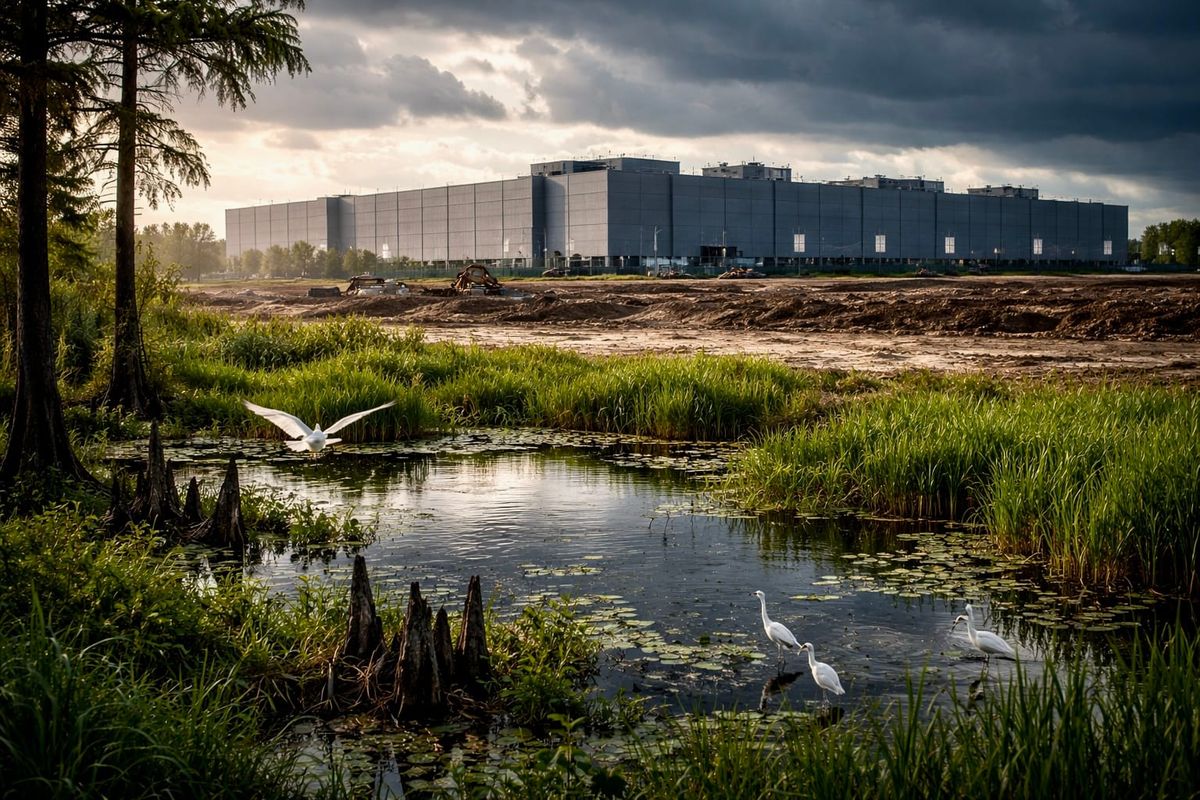
In South Alabama, residents are pushing back against plans to build a large data center over wetlands. The controversy isn’t about rejecting technology. It’s about location and consequence.
Wetlands are not “unused land.” They are natural infrastructure.
They absorb floodwater.
They filter pollutants.
They recharge aquifers.
They reduce storm surge.
Paving or altering wetlands for heavy industrial infrastructure doesn’t just change a landscape. It changes flood dynamics. It changes drainage patterns. It changes long-term resilience.
When people object, they’re often dismissed as anti-growth or anti-progress.
But the real question is simpler:
Why are we building on the very systems that protect us — and then wondering why flooding worsens?
Carbon emissions matter. But so does carbon storage.
Forests absorb carbon.
Healthy soil stores it.
Grasslands sequester it.
Oceans regulate it.
When we burn fossil fuels while simultaneously destroying forests and degrading soil through chemical-intensive agriculture, we amplify the impact. Emissions increase while the planet’s ability to absorb them declines.
That is not ideology. That is systems math.
And carbon is not the only stressor.
Microplastics are now found in human blood and placental tissue.
PFAS — so-called “forever chemicals” — persist in groundwater for generations.
Pollinator populations are declining in multiple regions.
Wildlife extinction rates are elevated due to habitat loss and pollution.
These are not abstract projections. They are observable biological consequences of industrial design.
The debate over “overpopulation” reflects a similar misunderstanding.
Some argue the planet cannot sustain eight billion people. Others insist there is plenty of room.
They are both half right.
Carrying capacity is not measured in square miles. It is measured in regeneration rate versus extraction rate.
Eight billion people living within regenerative systems is one scenario.
Eight billion people living within extractive, disposable, petrochemical systems is another.
The issue is not human existence. It is industrial design.
Modern systems are optimized for scale and efficiency. That increases output and lowers short-term costs. But it also reduces redundancy.
Centralized food systems.
Centralized energy grids.
Centralized supply chains.
Centralized regulatory oversight.
When disruption occurs — whether from storms, drought, contamination, or infrastructure failure — there is less local resilience to absorb shock.
Storms may be intensifying in some regions.
But the reason they are more destructive is not only what happens in the atmosphere.
It is what we have removed on the ground.
We did not just change the climate.
We weakened the shield.
And shields can be rebuilt.
Alicia Boothe Haggermaker is a lifelong resident of Huntsville, Alabama, and a dedicated advocate for health freedom. For more than a decade, she has worked to educate the public and policymakers on issues of medical choice and public transparency. In January 2020, she organized a delegation of physicians and health freedom advocates to Montgomery, contributing to the initial draft of legislation that became SB267.
Opinions do not reflect the views and opinions of ALPolitics.com. ALPolitics.com makes no claims nor assumes any responsibility for the information and opinions expressed above.