We Don’t Need Corporations Anymore — But We Do Need a Transition Plan
“The cities that will lead us into the future are the ones piloting it—rather than arguing endlessly about how it should look”—Alicia Haggermaker
For decades, Americans were told a simple story: Corporations create jobs. Corporations innovate. Corporations hold the economy together. And for a long time, that story was true enough.
Manufacturing required massive capital. Distribution required massive infrastructure. Marketing required access to centralized media. Logistics required networks only giant companies could build.
But here’s the part no one wants to say out loud—those barriers are gone.
Today:
- the internet is the marketing department
- AI is the administrative team
- small-batch and automated manufacturing is the factory
- shipping networks exist for anyone with a phone
- communities can build localized supply chains without multinational ownership
The corporate middleman isn’t essential anymore. He’s just still standing in the doorway insisting he is. Corporations aren’t powerful because we need them. They’re powerful because we keep acting like we do.
The New Economy Isn’t Coming — It’s Already Here
We already have the capacity for:
- a baker to ship nationwide
- a farmer to operate on direct subscription
- a designer to license a model without forming a corporation
- a small team to produce what once required billion-dollar scale
Yet instead of leaning into this shift, we cling to the outdated belief that innovation only “counts” when it’s stamped with a corporate logo and a CEO salary larger than the payroll beneath it.
Meanwhile, corporations—fully aware that their old dominance is fragile—are quietly buying up:
- farmland
- water rights
- housing
- medical systems
- software ecosystems
- supply chains
- and, in some cases, entire state-level policy pipelines
They know decentralization is coming. They’re trying to gatekeep the exit.
The Real Problem Isn’t Corporations — It’s What We Ask Them to Be
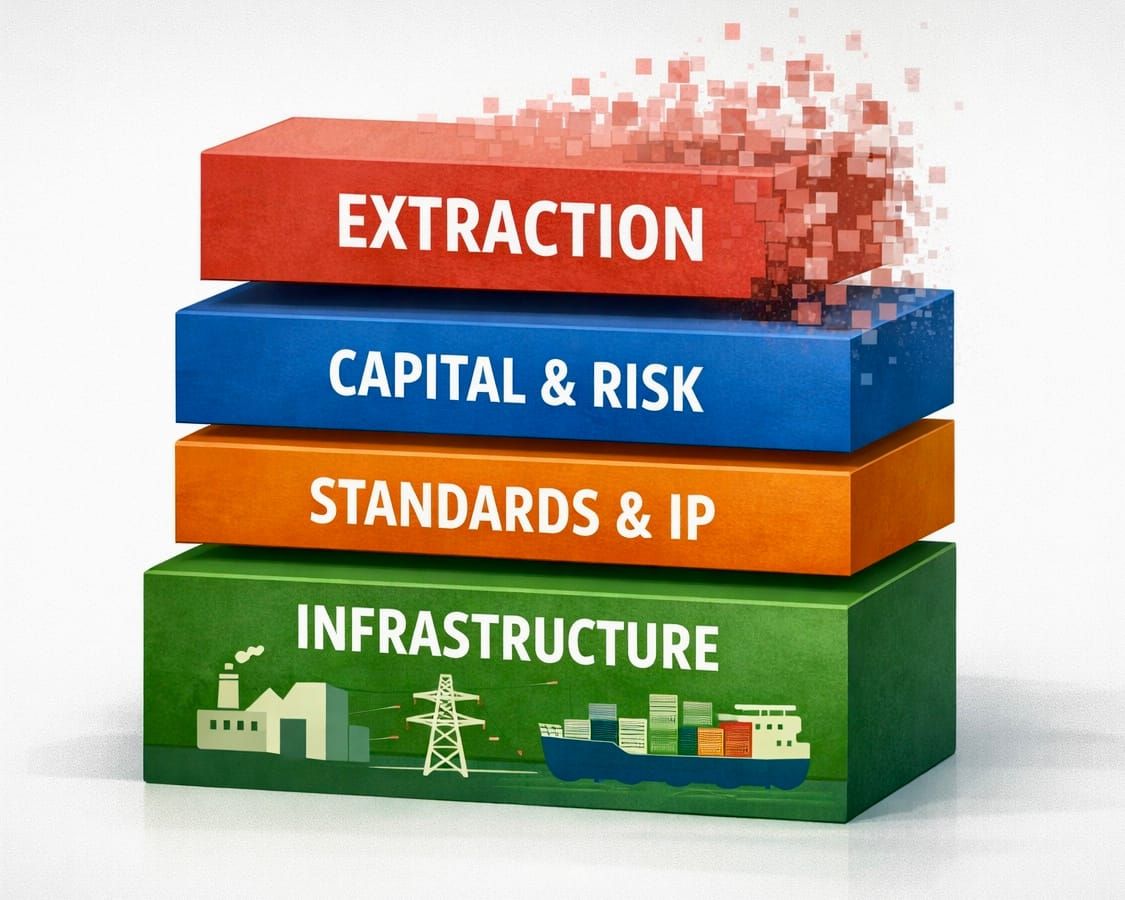
Modern corporations bundle together four very different functions:
1. Infrastructure (shipping, power, logistics, manufacturing facilities)
2. Standards & IP (processes, formulas, protocols, designs)
3. Capital pooling (insurance, financing, risk distribution)
4. Value extraction (rent-seeking, monopoly leverage, profit concentration)
Only the last function is inherently destructive. The mistake we’ve made is treating these roles as inseparable. They’re not. A healthy transition doesn’t destroy corporations—it unbundles them.
Infrastructure Doesn’t Need Owners — It Needs Stewards
Most major infrastructure already exists because of:
- public subsidies
- tax abatements
- public bonds
- eminent domain
- publicly absorbed risk
Which raises an uncomfortable question: If the public paid for the risk, why does the public have no say in how the infrastructure is used?
The answer isn’t seizure or nationalization—it’s reclassification.
Infrastructure becomes:
- community-governed
- cooperatively managed
- publicly accountable
Corporations don’t disappear. They become service operators, not toll collectors.
Shipping Is the Biggest Objection — and the Easiest Fix
Yes, shipping is still corporate-dominated.That doesn’t mean it has to remain extractive.A transition model looks like this:
- regional logistics cooperatives
- shared warehousing and fulfillment hubs
- pooled shipping contracts
- carrier services leased at regulated, non-exclusive rates
Amazon doesn’t vanish—it competes. FedEx doesn’t collapse—it carries freight. No shortages. No implosion. Just the loss of monopoly leverage.
Standards Without the FCC Problem
This is where skepticism is justified. We’ve all watched “standards bodies” turn into captured regulators.
The safeguard is simple and strict: Standards bodies must have no enforcement power.
They can:
- certify
- publish best practices
- inform insurance and liability
- provide reputation signals
They cannot:
- mandate compliance
- block access to commons
- punish nonparticipants
- profit from enforcement
Standards should guide markets—not cage them. And, unlike legacy regulators, these standards expire unless renewed and can be forked if corrupted. Authority remains optional—or it becomes abusive.
What Happens to Corporations?
They get options.
- convert to infrastructure trusts with capped returns
- shift into licensing and certification roles
- spin off assets to workers, municipalities, or cooperatives
- wind down extractive functions while preserving useful ones
This isn’t punishment—it’s modernization. Companies that adapt survive. Companies that don’t…won’t. That’s not ideology. That’s evolution.
What This Looks Like in Huntsville
Huntsville is actually a perfect case study.Public investment has already built:
- shipping corridors
- utilities
- broadband
- workforce pipelines
- industrial zoning
That infrastructure was designed to attract corporations. It is now mature enough to support community-scale production and distribution without corporate gatekeeping. The same logistics systems can serve:
- regional shipping cooperatives
- local manufacturers shipping nationally
- farm-to-consumer subscription networks
The same broadband can support:
- education platforms
- telehealth cooperatives
- small-business automation
The value no longer comes from owning the system—but from using it creatively.
A Wise City Pilot: Testing the Transition
A Wise City pilot doesn’t dismantle existing systems—it runs a parallel one.
A limited district or sector designates publicly funded infrastructure as shared-use by default. Local creators and producers license proven models, plug into cooperative logistics and broadband, and operate with local control. Standards remain voluntary and forkable. Corporations can still participate—but as partners and service providers, not gatekeepers.
The pilot measures outcomes: resilience, affordability, innovation, and local wealth retention. If it works, it scales. If it doesn’t, it sunsets. No collapse. No mandates. Just evidence.
The cities that will lead us into the future are the ones piloting it—rather than arguing endlessly about how it should look.
This Isn’t Socialism. It’s Accounting Reality.We already socialize:
- risk
- infrastructure
- bailouts
And privatize:
- profits
- control
- decision-making
That isn’t capitalism—it’s corporate welfare. Aligning control with contribution isn’t radical—it’s honest accounting.
The Handoff Is Already Underway
The post-corporate era isn’t a revolution—it’s a handoff. Corporations don’t need to die. They need to stop pretending they are the economy instead of a tool within it. The future won’t be built by bigger corporations. It will be built by braver communities—and by cities willing to test what comes next instead of clinging to containers that no longer fit.
Alicia Boothe Haggermaker is a lifelong resident of Huntsville, Alabama, and a dedicated advocate for health freedom. For more than a decade, she has worked to educate the public and policymakers on issues of medical choice and public transparency. In January 2020, she organized a delegation of physicians and health freedom advocates to Montgomery, contributing to the initial draft of legislation that became SB267.
Opinions do not reflect the views and opinions of ALPolitics.com. ALPolitics.com makes no claims nor assumes any responsibility for the information and opinions expressed above.