
What Is the Alabama Republican Party Doing?
Guest Opinion by Jarrod Schulte
Guest Opinion by Jarrod Schulte
Editor's Note: The Limestone Lowdown obtained a copy of the proposed bylaw amendment from a member of the Alabama Republican Party's State Executive Committee. The proposal is scheduled for consideration at the August 1st, 2026, State Executive Committee meeting. This article — which originally appeared in The Limestone Lowdown, and is reprinted here by permission of the author — is an opinion piece intended to encourage discussion about the proposal and its potential implications.
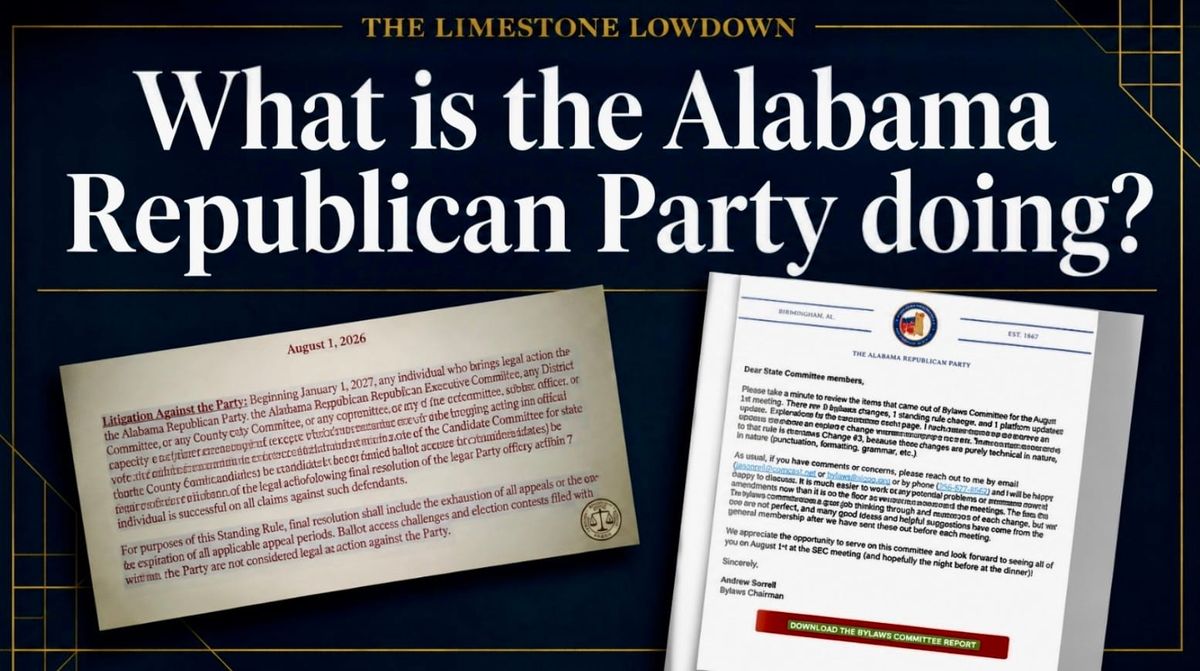
A member of the Alabama Republican Party's State Executive Committee recently reached out to The Limestone Lowdown with a proposed bylaw amendment scheduled to be considered at the Party's August 1, 2026, State Executive Committee meeting.
After reading it, one question immediately came to mind:
What is the Alabama Republican Party doing?

This proposal comes after one of the most contentious Republican primary and runoff seasons in recent Alabama history, making questions about fairness, transparency, and confidence in the Party's governing process even more important.
The proposal, submitted by Andrew Sorrell, Chairman of the Alabama Republican Party's Bylaws Committee and Alabama's elected State Auditor, would establish a new qualification for anyone seeking the Republican nomination for public office.
Beginning January 1, 2027, the proposed bylaw would prohibit an individual from qualifying as a Republican candidate for seven years if they bring legal action against the Alabama Republican Party, the Alabama Republican Executive Committee, a district or county executive committee, or a committee member or officer acting in their official capacity, unless they prevail on every claim they assert.
The proposal does state that ballot access challenges and election contests filed within the Party would not be considered "legal action" under the rule.
Still, the proposal raises an important question.
Why would a political party adopt a rule that appears to discourage its own members from seeking judicial review?
Our courts exist to resolve disputes and provide accountability. Whether someone files suit against a government agency, a corporation, or even a political organization, the judicial system exists so an independent court can determine whether the law and the rules have been followed.
If a lawsuit lacks merit, judges already have the authority to dismiss it. Courts can sanction frivolous litigation and, in appropriate circumstances, require payment of attorney's fees.
Those safeguards already exist.
So why create an additional political penalty?
A Question of Accountability
This proposal is especially significant because of who is bringing it forward.
Andrew Sorrell serves as Chairman of the Alabama Republican Party's Bylaws Committee. He also serves as Alabama's elected State Auditor, a constitutional office built on the principles of accountability, transparency, and public trust.
That role carries enormous responsibility.
The State Auditor is expected to promote integrity in government and maintain the public's confidence that oversight is fair, objective, and above reproach.
Recently, however, Sorrell has found himself in the headlines for reasons unrelated to the bylaws.
According to public reporting, approximately $71,000 in campaign contributions connected to a Georgia businessman accused by federal regulators of operating a massive Ponzi scheme flowed to Sorrell's campaign. Sorrell has publicly stated that he was also a victim, explaining that his political action committee made a loan to one of the businessman's companies and that he intends to return the campaign contributions. There has been no public allegation that Sorrell participated in the alleged fraud.
His explanation deserves to be heard.
But public officials, especially constitutional officers entrusted with oversight responsibilities, should also expect their judgment to be examined.
Even if Sorrell was a victim, Republicans have every right to ask whether this reflects the level of financial judgment they expect from Alabama's chief auditing official.
One Person Wearing Many Hats
This proposal becomes even more significant when viewed in the broader context of Andrew Sorrell's multiple roles within the Alabama Republican Party.
Sorrell is Alabama's elected State Auditor. He also serves as Chairman of the Alabama Republican Party's Bylaws Committee, where he helps shape the rules governing Republican candidates and Party members.
In addition, Sorrell has publicly acknowledged helping candidates during this year's heavily contested Republican primary and runoff elections.
There is nothing inherently improper about supporting candidates. Politics is, by its nature, political.
However, when the same individual is actively involved in contested Republican campaigns, chairs the committee responsible for writing the Party's governing rules, and now proposes a bylaw that could limit who may seek office after filing legal action against the Party, Republicans should ask whether those responsibilities are becoming too concentrated.
This is not about whether Andrew Sorrell has the legal authority to hold these roles.
It is about whether combining them creates the appearance of a conflict between advocating for particular candidates, writing the rules that govern future candidates, and serving as a statewide constitutional officer whose public duty is to promote accountability and public trust.
Republicans should expect the rules governing candidates to be written in a way that inspires confidence across the Party, especially during closely contested primaries and runoffs where neutrality is critical.
When Party leadership is actively involved in contested campaigns while simultaneously writing the rules that govern those same candidates, it is reasonable for Republicans to ask whether the process is as impartial as it should be.
Principles Should Apply to Everyone
Republicans have long championed constitutional rights, due process, transparency, and accountability.
Those principles should not stop when the conversation turns inward.
Strong organizations become stronger when members are free to ask questions, challenge decisions, and, when necessary, seek judicial review.
If Party leadership believes its actions will withstand scrutiny, there should be little concern about allowing members access to the courts without fear of political consequences.
The legal system already weeds out meritless lawsuits.
Adding a political disqualification on top of that risks sending the wrong message.
Not because it prevents frivolous litigation.
But because it could discourage legitimate challenges before they are ever heard.
Before August 1
This proposal has not been adopted.
It is scheduled to be considered by the Alabama Republican Party's State Executive Committee on August 1st.
That gives Republican Executive Committee members, and Republicans across Alabama, an opportunity to read the proposal, ask questions, and decide whether this reflects the values they want their Party to embrace.
Regardless of where you stand politically, every Republican should consider what this proposal represents.
Should members ever have to choose between exercising their legal rights and preserving their opportunity to seek public office?
Should accountability be viewed as a threat?
Or should it remain one of the core principles that defines the Republican Party?
Those are questions worth asking before a vote is cast.
Because accountability is not something to fear.
It is something to protect.
Jarrod Schulte is a husband, father and host of The Limestone Lowdown podcast.
Opinions do not reflect the views and opinions of ALPolitics.com. ALPolitics.com makes no claims nor assumes any responsibility for the information and opinions expressed above.