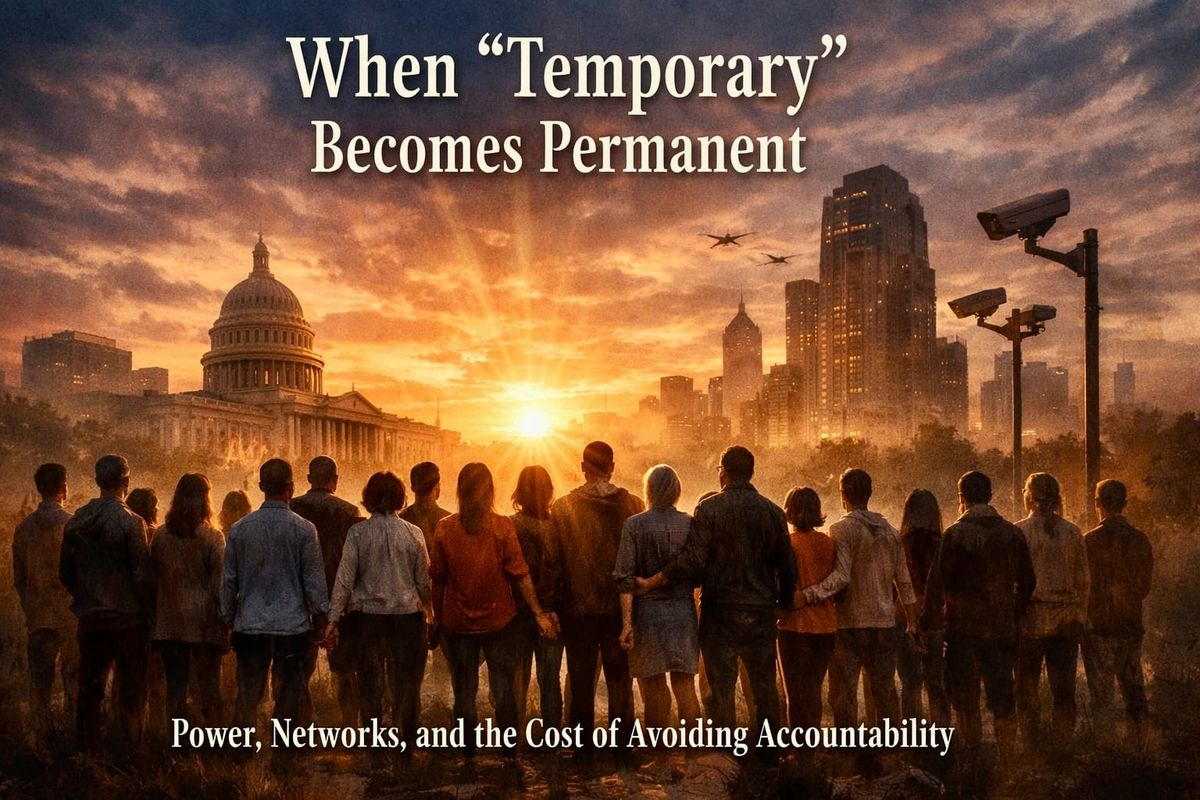
When “Temporary” Becomes Permanent: Why Institutional Reform Keeps Failing
How incentives, hierarchy, and "emergency" powers quietly become permanent systems—Guest Opinion by Alicia Haggermaker
Guest Opinion by Alicia Boothe Haggermaker
For more than a decade, some Americans have been warning that our institutions were drifting toward greater secrecy, greater consolidation of power, and weaker public oversight.
For years, those concerns were dismissed as alarmist.
People who raised them—myself included—were routinely branded “conspiracy theorists,” a label that functions less as an argument and more as a social deterrent.
It was easier to ridicule early warnings than to examine uncomfortable patterns.
But warnings are easier to ignore when they remain abstract.
They become harder to dismiss when they take physical form.
From Policy to Infrastructure
Imagine a society where emergency authorities quietly become permanent.
Where surveillance systems expand faster than oversight.
Where detention capacity grows with little public discussion.
Where complex digital systems manage human lives with minimal transparency.
No single development looks outrageous.
Each is justified in the language of efficiency, security, or necessity.
Together, they form a structure.
The Normalization of Exception
In such systems, extraordinary powers are always framed as temporary.
They are introduced during crises.
They are renewed quietly.
They are rarely reviewed.
Over time, “exception” becomes baseline.
Citizens adapt.
Institutions consolidate.
Accountability weakens.
Epstein and Institutional Failure
The Epstein case represents more than individual criminal wrongdoing.
It represents systemic breakdown.
Across decades and jurisdictions:
- Investigations stalled
- Evidence was mishandled
- Networks went unexplored
- Accountability was delayed.
This did not happen because no one noticed.
It happened because exposure threatened powerful interests.
Secrecy became policy.
Nodes, Not Just Names
Public debate often focuses on individuals.
- Who knew?
- Who was involved?
- Who is guilty?
That focus is understandable.
It is also incomplete.
Large-scale abuse networks do not function through isolated actors.
They operate through distributed cooperation.
- Financiers
- Lawyers
- Fixers
- Gatekeepers
- Security teams
- Media shields
Each participant is a node.
No single node is the network.
Remove one, and the structure remains.
The question is not whether one person failed.
It is how many systems quietly enabled the ecosystem.
Institutional Selection
Systems that protected abuse did more than fail.
They selected for it.
They rewarded discretion over integrity.
Loyalty over truth.
Silence over accountability.
Reputation over humanity.
Over time, moral corrosion became compatible with success.
Network Problems and Hierarchy Thinking
This is the central mistake:
Network problems thrive because of hierarchy thinking.
Hierarchies are built for command and image management.
Networks move sideways and adapt quickly.
While leaders look up and down organizational charts, real activity moves across them.
Each layer sees only its slice.
No one sees the whole.
When authority flows upward and accountability flows sideways, networks flourish.
Accountability gets centralized at the top, where it quietly disappears—like a fart in the wind—somewhere between committees and press releases.
Infrastructure and Control
This pattern did not begin with social media.
It began with utilities.
Smart meters were sold as efficiency upgrades.
They also normalized real-time monitoring, remote control, and automated enforcement.
They proved that behavioral management could be installed in private homes with minimal resistance.
They were the beta test.
More recently, new vehicle regulations have required impairment-detection technology.
On paper, this is about safety.
In practice, it builds infrastructure capable of limiting mobility.
History shows that powers introduced for limited purposes rarely remain limited.
They expand because the wiring exists, the incentives align, the contracts are calling, and resistance fades.
Mobility is freedom.
Control mobility, and leverage follows.
Behavioral Scoring and Compliance
Often called “trust systems” or “risk assessment,” behavioral scoring functions as social credit.
It converts digital behavior into access.
Visibility, opportunity, and credibility become conditional.
Not on legality.
On compliance.
Punishment becomes friction.
- Delay
- Restriction
- De-ranking.
Money, Taxes, and Housing
Behavioral scoring becomes far more powerful when tied to money.
Digital payments and regulated platforms turn access into permission.
You may technically own assets.
But ownership without usable access is symbolic.
Modern taxation is networked.
Federal, state, and local systems form a mesh.
Relief in one place reappears in another.
More and more, it arrives as fees, surcharges, and “adjustments.”
Punishment arrives in fine print.
Housing follows the same pattern.
If you own, you pay rising taxes and insurance.
If you rent, you pay bundled costs.
In a system where housing costs rise indefinitely, ownership becomes a tax instrument and renting becomes a subscription.
Either way, independence shrinks.
Why Reform Keeps Failing
Institutional reform fails because it avoids structure.
We replace leaders.
Rename agencies.
Rewrite mission statements.
Pass weak laws.
But we leave the hierarchy intact.
Corruption does not require conspiracy.
It requires compliance.
The Hard Part: Structural Change
There is a solution.
But it is uncomfortable.
Real repair requires questioning the architecture that allowed harm to persist.
It means:
- Identifying beneficiaries
- Creating consequences
- Redistributing authority
- Breaking closed networks
- Making records public
- Limiting gatekeeping
Without structural change, accountability becomes symbolic.
The Window of Opportunity
Reform windows are finite.
They open after exposure.
They close after fatigue.
At first, change feels possible.
Then inconvenient.
Then “divisive.”
Then “dangerous.”
By the time reform feels necessary, it is often too late.
A Human Ending
During the pandemic, comedian Leslie Jordan summed up the moment perfectly:
“Well shit. What are y’all doing? This is awful.”
That may be the most honest response to our current situation.
I would rather try to fix the problem before the house explodes than stand there watching it burn, shrugging and saying:
“Well shit.”
Maybe the real paradigm shift is this:
We stop putting our faith in failing institutions.
We stop fighting over whose interpretation of dysfunction is most accurate.
And we start putting our money, energy, and effort where our mouth is.
In people.
Our people.
As in:
Full Substack essay can be accessed here:
Alicia Boothe Haggermaker is a lifelong resident of Huntsville, Alabama, and a dedicated advocate for health freedom. For more than a decade, she has worked to educate the public and policymakers on issues of medical choice and public transparency. In January 2020, she organized a delegation of physicians and health freedom advocates to Montgomery, contributing to the initial draft of legislation that became SB267.
Opinions do not reflect the views and opinions of ALPolitics.com. ALPolitics.com makes no claims nor assumes any responsibility for the information and opinions expressed above.