$26.5 Billion for Southern Company. A Speech About Savings for Everyone Else.
Guest Opinion by Murray Edwards
Guest Opinion by Murray Edwards
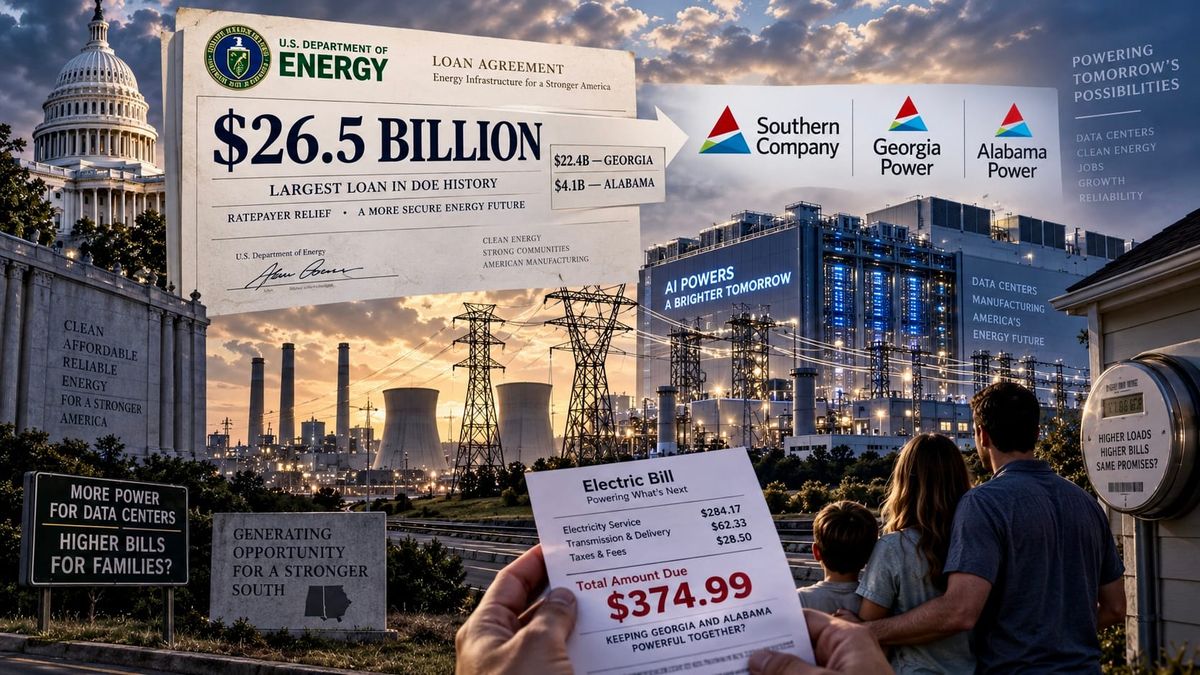
The Department of Energy just closed the largest loan in its history, $26.5 billion and handed it to Southern Company through Georgia Power and Alabama Power. Washington called it ratepayer relief. That is a generous reading of a deal that cheapens capital for a utility empire while locking households into decades of plants, lines, and authorized profit built to feed data centers.
The split tells you who this was written for. Georgia Power takes about $22.4 billion. Alabama Power takes about $4.1 billion. The loans run roughly 30 years. Draw window into the early 2030s. The pitch: more than 16 gigawatts of “firm” power, $7 billion in supposed customer savings, and $300 million a year less in Southern Company’s interest costs.
Notice the order. The company’s cost of money falls first. Households are asked to take the rest on faith.
This is not a gift to the mailbox
A subsidized interest rate is not a rebate. It is cheaper debt for assets that still go into the rate base. Southern Company does not build gas turbines, nuclear uprates, batteries, and 1,300 miles of transmission as charity. It builds them because load is exploding — especially computer warehouses that never sleep — and because regulated utilities earn a return on what they are allowed to capitalize.
DOE officials tied the package to data-center growth and manufacturing. That is the honest part. The dishonest part is pretending a record federal credit facility automatically shows up as a smaller bill for a family in Birmingham or Macon. Rate freezes already on the books in Georgia and Alabama have expiration dates. Construction programs of this size do not. When the freeze ends, the argument will be reliability, growth, and “we had no choice.” The invoice will be familiar.
If the savings were clean, Georgia lawmakers would not be scrambling to keep residential customers from subsidizing hyperscale load. You do not draft protection bills for a benefit that is already flowing to the kitchen table.
Follow the cheap money
Call it Energy Dominance Financing. Call it the Working Families Tax Cut. The mechanics are older than the branding. Federal credit lowers what Southern Company pays to borrow. Southern Company still owns the steel. Customers still pay to keep it used and useful. Shareholders still collect the return.
The administration wanted dispatchable power — gas and nuclear life-extension — and a headline about affordability after months of electricity prices running hotter than general inflation. Southern Company wanted a multi-year capital plan financed on terms no ordinary borrower gets. Those interests met. Ratepayers were invited to clap.
Alabama’s smaller slice does not make the model different. Same parent. Same rate-case logic. Same promise that this time the financing will “expedite lower costs.” Alabama customers have heard versions of that sentence for years while watching generation, transmission, and profit fights at the Public Service Commission. A Washington loan does not change who signs the bill.
The number that matters is not $26.5 billion
The number that matters are whether the next rate case shrinks after the cameras leave. Until then, the record is simple:
The federal government wrote the region’s dominant utility a historic check.
Data centers get the megawatts.
Southern Company gets cheaper money and a larger rate base.
Households get a press release about $7 billion in savings and a reminder that the freeze is temporary.
Largest DOE loan ever. Ask who eats the forecast if the data centers underperform, the gas plants run longer than advertised, or the transmission follows the server farms instead of the neighborhoods. Cheap federal credit does not socialize the upside. It socializes the construction. The profit stays private.
Originally published on The Newscasters’ Studio, reprinted here by permission.
Opinions do not reflect the views and opinions of ALPolitics.com. ALPolitics.com makes no claims nor assumes any responsibility for the information and opinions expressed above.