Alabama’s Judicial Override: Old Wrongs that Need Making Right
Alabama abolished judicial override death penalties in 2017. It’s past time to address the inmates sentenced to death before that year.
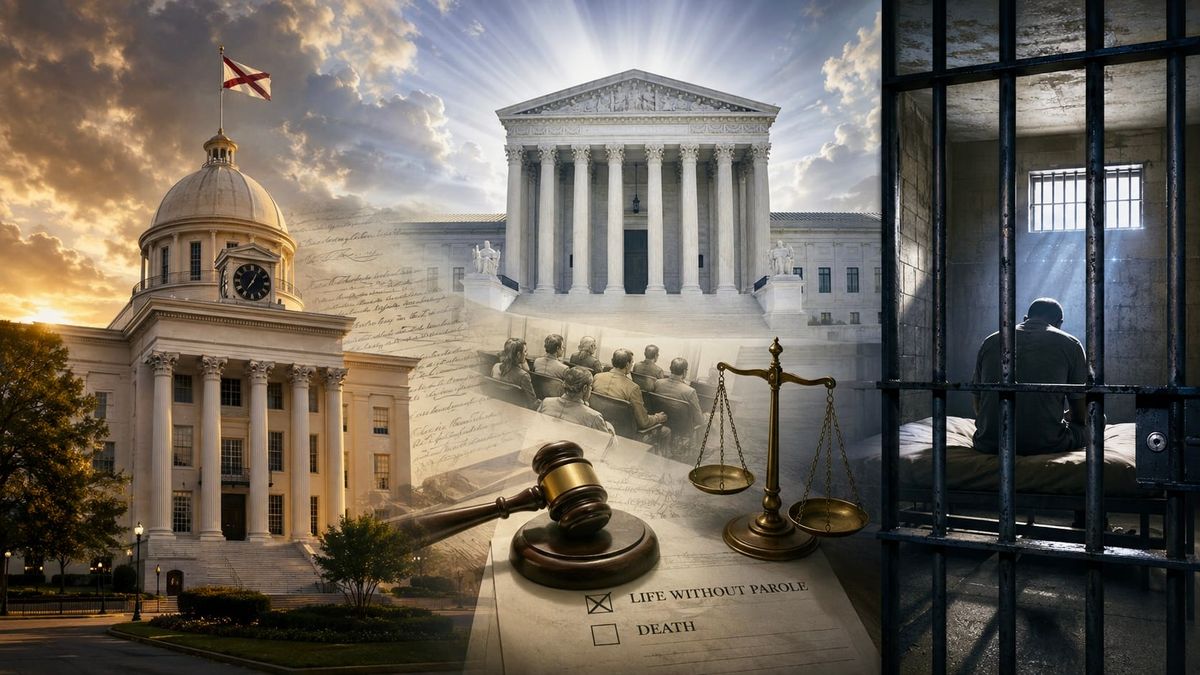
Judicial override — the mechanism whereby judges may overturn the decisions of juries or other judges under certain circumstances — is a well-established part of our legal system. It provides critical protections against miscarriages of justice and promotes a consistency of application of the law that benefits us all. Judicial override represents a balance between the democratic decision-making process of trials by jury, and the judiciary’s role in interpreting the law and administering justice. As such, it provides a safeguard against bias, errors, inequities and unfairness across the legal system.
In certain cases, however, judicial override has been questioned. One of the most striking instances of this is the ability of judges to override a jury’s sentence of life without parole, and impose a sentence of death.
Until 2017, Alabama was one of only four States (Florida, Delaware and Indiana being the others) which allowed judges this particular power of judicial override. However, in 2016, the U.S. Supreme Court ruled in Hurst v Florida that a capital sentencing scheme requiring a judge, rather than a jury, to make the factual findings necessary to impose a death sentence violates the Sixth Amendment. This invalidated part of Florida’s death penalty law at the time and, by implication, Alabama’s as well (Alabama and Florida having similar laws at that time).
In response to Hurst, the Alabama Legislature passed, and Governor Kay Ivey signed SB16 in 2017. SB16 (Act 2017-131) removed the ability of judges to impose the death penalty when a jury had recommended life in prison without parole. It also required a supermajority of 10 jurors to impose the death sentence. However, SB16 was a proactive bill only, and did not retroactively address any death sentences that had been previously handed down.
An attempt was made in the 2024 session to make the provisions of SB17 retroactive, but this bill — HB27, introduced by Rep. Chris England (D-Tuscaloosa) died in the House Judiciary Committee.
And so, here we are today, with more than two dozen Alabamians held on death row, under sentencing that may have violated their Sixth Amendment rights, as per Hurst.
That’s a problem.
Two respected Alabama Jurists have already written about this issue on this site. Justice Robert Bernard Harwood, Jr. framed it as a question of “fairness and justice,” asking, “Should individuals sentenced to death under a system our state has since rejected be executed simply because they were sentenced before the law changed?” Chief Justice Roy S. Moore urged readers to “Petition your Legislature to do what is right under our law and restore the sentence imposed by a jury of life without parole, to those condemned to death by "Judicial override" prior to 2017.”
I agree with both of them. The only questions I have left involve just how, exactly, we go about setting this to rights.
I understand that reexamining every one of these cases is highly fraught. Each involved heinous acts and serious crimes, and reopening them will almost certainly dredge up painful emotions for the families of both the perpetrators and the victims. Each at the time was sensational, at least in their region of the State. Each perpetrator was convicted by a jury of their peers — that is not in doubt. However, I do not know the details of each case, and what, if any, information may have come to light over the intervening years. All those are things which will need to be determined before a final decision is made.
The overriding question is, in light of Hurst and Alabama’s 2017 law, can each sentence of death be sustained? Because if not, those sentences should be commuted to life, or life without parole, as soon as possible.
The commutation itself is actually the easiest part. Commutation of sentences is part of the Governor’s usual powers, under Section 124 of the Alabama Constitution. One signature on the right document and done!
And as for the review needed to send a list to the Governor? I suspect the best way will be to establish a Commission to do the necessary work of the reviews and make recommendations to the Governor. And, the best way to do that is to get the Legislature involved, with a resolution something like this:
To establish an independent Life Without Parole Judicial Override Review Commission:
Whereas Alabama made Judicial Overrides illegal in 2017, when upon the signature of Governor Kay Ivey Act 2017-131 became law, and
Whereas The United States Supreme Court has ruled that Judicial Overrides are unconstitutional based on the Right of all Citizens to a trial by jury; and
Whereas Alabama has a number of persons currently on Death Row whose juries returned a verdict of Life without Parole yet still face an unconstitutional death sentence; and
Whereas Governor Ivey and the Alabama Legislature are the only two entities that can correct this legal anomaly;
Therefore, The Alabama Legislature, acting under authority of this Joint Resolution does hereby establish, in concert with the Governor of Alabama,
The Alabama Independent Life Without Parole Judicial Override Review Commission.
Said Commission shall be composed of seven (7) Members appointed by the Governor from recommendations by the Alabama Bar Association of not less than fourteen (14) nominees for said Commission.
Said Commission shall determine the names and history of those on Alabama’s Death Row by virtue of Judicial Overrides, and consider and make recommendations to the Governor on which cases, if not all, should be granted a judicial review which could grant “time served” or that such person be resentenced to Life or Life Without Parole, or such person have their sentence commuted to Life or Life Without Parole.
Said Commission Members shall only be entitled to reimbursement of actual expenses associated with attendance at meetings of the Commission, from funds appropriated by the Legislature to the Governor’s office.
That, I think, covers the basics of what needs to be done and how to do it. I’m sure there are more things that would need to be added — a timeline for the Commission, and a date certain for their final report, just to start — but the basic structure is there.
There’s a strong possibility that we have a number of people — determining exactly how many will be the first order of business for the Commission — sitting on Death Row unconstitutionally.
The sooner we address this, the better.
Dr. Bill Chitwood is the Managing Editor of ALPolitics.com. He is the author, under his nom de guerre Doc Contrarian, of Beyond MAGA: From Trump campaign slogan to political movement to restoring the Republic. He identifies as Conservatarian Contrarian and a staunch Constitutional Originalist. He enjoys being called a First Amendment Nazi — mainly because he is.
Opinions do not reflect the views and opinions of ALPolitics.com. ALPolitics.com makes no claims nor assumes any responsibility for the information and opinions expressed above.