Coach’s Closing Fight in Washington Is for Our Children
Guest Opinion by Perry Hooper Jr.
Guest Opinion by Perry Hooper Jr.
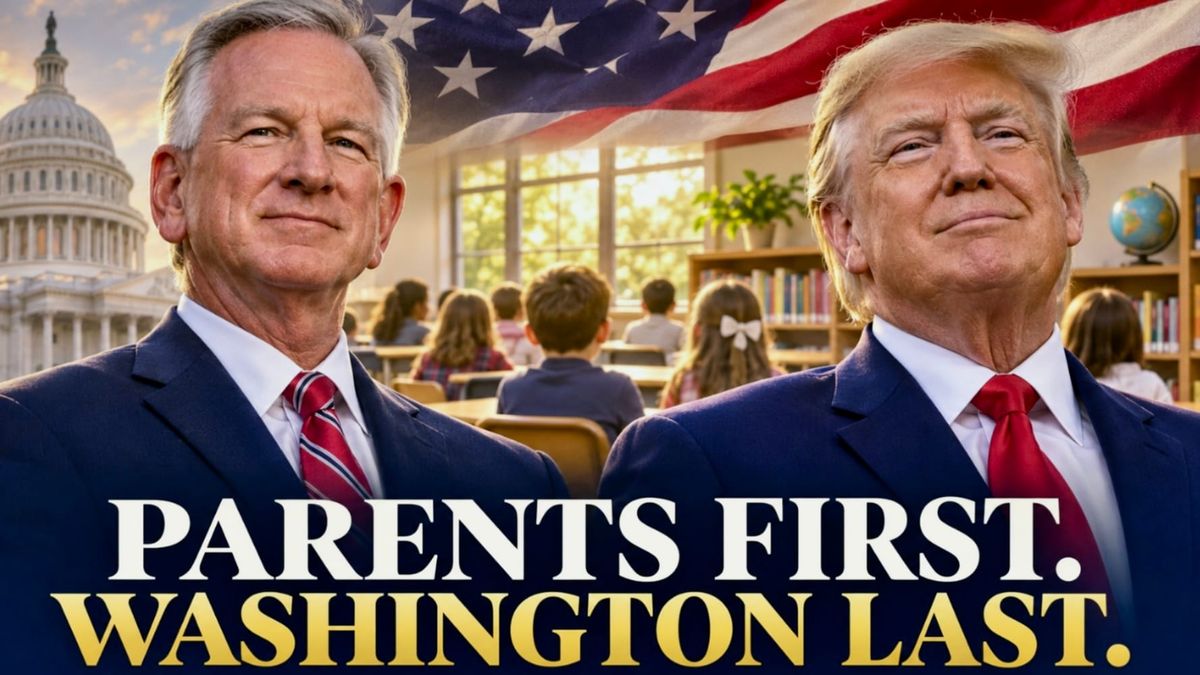
As Tommy Tuberville prepares to close his service in the United States Senate and come home to lead Alabama as governor, there is something fitting about his decision to make education reform one of his closing fights in Washington. Before Americans knew him as Senator Tuberville, generations of young people knew him as Coach. Now, as one chapter of public service gives way to another, he is pressing a principle that deserves to outlast any office he holds: our children’s education should be guided by their parents, their teachers and their communities, with Washington’s bureaucracy held accountable for serving them.
Coach has made his position clear, declaring that schools should prepare young Americans for life and challenging the ideological distractions that pull them away from that mission. His commitment to dismantling the Department of Education reflects a larger conviction that I share. Parents deserve a stronger voice in their children’s education, teachers deserve greater freedom to teach, and communities deserve more authority over the schools they support. A federal department should never become so important to Washington that preserving it takes precedence over improving the lives of the children it claims to serve.
That conviction is behind the ten bill “Less Bureaucracy, Better Education” package Coach has joined Senator Jim Banks and their colleagues in introducing. The legislation would put major elements of President Donald Trump’s education restructuring into law, transferring significant Department of Education responsibilities to other federal agencies. For Coach, this is an opportunity to help advance a promise before leaving the Senate. For Congress, it is a test of whether its members will follow through when reform requires challenging an established bureaucracy with powerful defenders.
Putting those changes into law matters because administrative reforms remain vulnerable to reversal by a future administration. Families and schools deserve greater stability than a system that changes direction whenever Washington changes hands. Congress should establish where federal responsibilities belong, who answers for carrying them out and how their performance will be judged. President Trump began this effort, and Coach and Banks are asking their colleagues to give it a more durable foundation.
The package would place federal student aid administration, including Pell Grants and student loans, at Treasury, while career and technical education functions would move to Labor. Other measures would assign certain health, tribal and international education responsibilities to agencies with related missions. The practical argument is that federal functions should be organized around the work they perform, with clear responsibility for delivering services. Maintaining a separate Department of Education should never become an end in itself.
Coach is sponsoring two central measures in that effort. One would transfer most federal elementary and secondary education functions, including Title I and rural education programs, to Labor. The other would transfer numerous higher education programs, including support for historically Black colleges and universities, TRIO and GEAR UP, to the same department. These are substantial changes, and Congress should examine the full legislation carefully, distinguishing the responsibilities being transferred from any provisions that eliminate existing authorities. Supporting reform means explaining what it does and insisting that every change serve a clear purpose.
For me, that purpose begins with restoring the proper relationship between Washington and the families whose taxes support these programs. Federal assistance should help schools fulfill their responsibilities without becoming a license to micromanage them. Parents should know what their children are being taught, have access to classroom materials and have meaningful educational choices when a school fails to meet their needs. Their concerns should receive a serious hearing, and their involvement should be welcomed as an essential part of a child’s education.
Teachers and local school leaders need that same respect. A teacher working every day with struggling readers understands challenges that cannot be captured fully in a federal reporting requirement. A rural superintendent knows the practical consequences of transportation distances, staffing shortages and limited resources. Local knowledge should carry real weight in educational decisions. We should demand fewer unnecessary mandates and less paperwork so that more of an educator’s time and energy can reach the students sitting in the classroom.
Greater local control also makes accountability more direct. Parents can attend a school board meeting, question a superintendent and demand answers from officials responsible for their children’s education. That relationship becomes harder to navigate when responsibility is scattered across layers of government. Authority should rest close enough to families that they can identify who made a decision and insist on an explanation. Local leaders must have the freedom to act and the obligation to answer for the results.
For Alabama, those results must include a stronger connection between education and opportunity. A young person preparing to become a welder, electrician, nurse, engineer or skilled manufacturing worker deserves an education that opens a real door. We should respect students who choose a trade with the same enthusiasm we show students entering a university. Closer coordination between career education and workforce programs can support those pathways, while local educators and employers contribute their knowledge of the opportunities available in their communities.
Those opportunities begin with the foundations of learning. Children must learn to read, write, work with numbers and think independently before they can make the most of the choices ahead of them. Teachers need time to concentrate on mathematics, science, American history and the other essentials of a sound education. Every administrative requirement should have to justify how it supports that work. Changing the agency that administers a program will matter only if it produces clearer responsibility and better service, which is why Congress must oversee the transition and insist that authorized funds and assistance reach the people depending on them.
As Coach prepares to move from Washington to Montgomery, the responsibility on Alabama’s side of this equation will become especially important. Greater state and local authority must be matched by the courage to make decisions, measure results and correct failures. We cannot demand more control and then look elsewhere for an excuse when our schools fall short. The principles Coach is advancing in his closing weeks in the Senate should help guide the work ahead at home: respect parents, support teachers, expect 9
There is something worth appreciating about a public servant approaching the end of one assignment with his attention still fixed on the next generation. I am grateful that Coach is using this closing chapter of his Senate service to press a cause that will matter long after the speeches and ceremonies are over. Congress should take up this package and pursue its promise of less bureaucracy, stronger parental authority and more responsive government. Our children get one chance at an education, and the most meaningful legacy any leader can leave is to help give them the freedom, preparation and opportunity to build a better life.
Perry O. Hooper Jr. is a longtime Alabama Republican figure, former Alabama Legislator and Montgomery businessman. He served as Co-Chair of “Alabama Trump Victory” in 2016, and served as an at-large delegate to the Republican National Convention. He is a noted civic leader in Montgomery with deep family roots in Alabama’s legal and political history.
Opinions do not reflect the views and opinions of ALPolitics.com. ALPolitics.com makes no claims nor assumes any responsibility for the information and opinions expressed above.