Epstein: Roberts Rewrote the Fourteenth Amendment
A leading constitutional scholar argues the Supreme Court ignored the original meaning of the Citizenship Clause and erased its limiting language
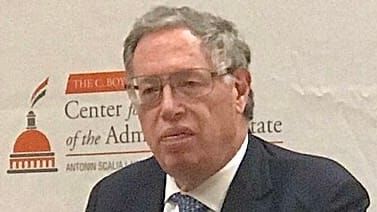
While much of the public debate over the Supreme Court's birthright citizenship decision has focused on immigration policy, one of the nation's leading constitutional scholars says the real issue is far more fundamental: whether the Court faithfully interpreted the Constitution at all.
Richard A. Epstein, Professor Emeritus at New York University School of Law and a Senior Fellow at the Hoover Institution, argues that the Court's majority opinion in Trump v. Barbara effectively rewrote the Citizenship Clause of the Fourteenth Amendment by stripping key language of its original meaning.
Writing in The Wall Street Journal, Epstein contends that Chief Justice John Roberts' opinion gives overwhelming weight to the first half of the Citizenship Clause—birth in the United States—while largely reading the second half out of the Constitution.
The amendment declares that, "All persons born or naturalized in the United States, and subject to the jurisdiction thereof, are citizens of the United States...."
According to Epstein, those final seven words are not surplus language.
"If every person born in the United States automatically became a citizen," Epstein argues, "there would have been no reason for Congress to include the additional requirement that a person also be 'subject to the jurisdiction' of the United States."
Instead, he says, the majority treated nearly everyone physically present in the country as satisfying both requirements, effectively collapsing two constitutional conditions into one.
That interpretation, Epstein argues, ignores the historical purpose of the Fourteenth Amendment.
The dispute centers on what the Reconstruction Congress meant when it required that a person be "subject to the jurisdiction" of the United States.
Roberts concluded that children born to parents who are unlawfully present or temporarily visiting the United States are generally subject to American law and therefore qualify as citizens at birth.
Epstein rejects that reading.
He argues that the framers of the Fourteenth Amendment used "jurisdiction" in the sense of complete political allegiance, not merely the obligation to obey criminal and civil laws while physically present.
Under that understanding, a tourist, student, temporary worker, or illegal immigrant remains politically subject to another sovereign nation, even while residing in the United States.
"The distinction," Epstein argues, "is between temporary obedience and permanent allegiance."
Epstein also challenges the historical foundation of the majority opinion.
He argues that the Citizenship Clause was drafted with a specific purpose: overturning the Supreme Court's infamous decision in Dred Scott v. Sandford and guaranteeing citizenship to formerly enslaved Americans and their descendants.
Nothing in the congressional debates, he contends, suggests that lawmakers intended to constitutionalize automatic citizenship for every child born within the nation's borders regardless of the parents' legal status or allegiance.
Instead, Epstein says, the Court relied too heavily on English common-law principles of jus soli, under which birthplace generally determined citizenship.
While England historically followed that doctrine, Epstein argues that the United States deliberately adopted a constitutional system emphasizing allegiance to the nation rather than simple geography.
For that reason, he says, Roberts imported a common-law principle that the text of the Fourteenth Amendment deliberately modified.
Epstein also criticizes the majority's approach to deciding the case.
Chief Justice Roberts has frequently argued that courts should avoid deciding constitutional questions unless absolutely necessary and should resolve disputes on the narrowest available grounds.
Critics say that is not what happened here.
Justice Brett Kavanaugh agreed that President Trump's Executive Order could not take effect under existing federal law, but he grounded his analysis primarily in the current citizenship statute rather than in a broad constitutional ruling.
Epstein argues that approach would have left Congress with greater flexibility to revisit federal citizenship laws in the future.
Instead, Roberts announced a sweeping constitutional interpretation that will likely govern the issue for decades unless the Court later changes course.
Several commentators have therefore accused the majority of abandoning judicial minimalism in favor of one of the Court's broadest constitutional pronouncements in recent years.
Although Epstein's principal argument is historical and textual, he also points to modern realities.
When the Fourteenth Amendment was ratified in 1868, international travel was slow, expensive, and relatively rare.
Today, commercial aviation, global migration, temporary visa programs, and organized birth-tourism businesses have created circumstances the amendment's framers could scarcely have imagined.
Epstein argues that constitutional interpretation should not change simply because society changes.
Rather, he says, changing circumstances make it even more important to apply the constitutional text as originally understood.
Critics of the Court's decision contend that treating physical birthplace as the controlling constitutional test creates incentives for birth tourism and illegal immigration because citizenship can be secured through the location of a child's birth rather than through the parents' legal relationship with the United States.
Supporters of the ruling reject that conclusion, arguing that the Citizenship Clause has long protected children regardless of their parents' immigration status and that concerns about immigration enforcement should be addressed by Congress and the Executive branch—not by narrowing constitutional citizenship.
For now, the Supreme Court's interpretation remains the law of the land.
But Epstein's critique has quickly become one of the leading scholarly responses to the decision and is likely to play a central role in future debates over the original meaning of the Fourteenth Amendment and the scope of American citizenship.