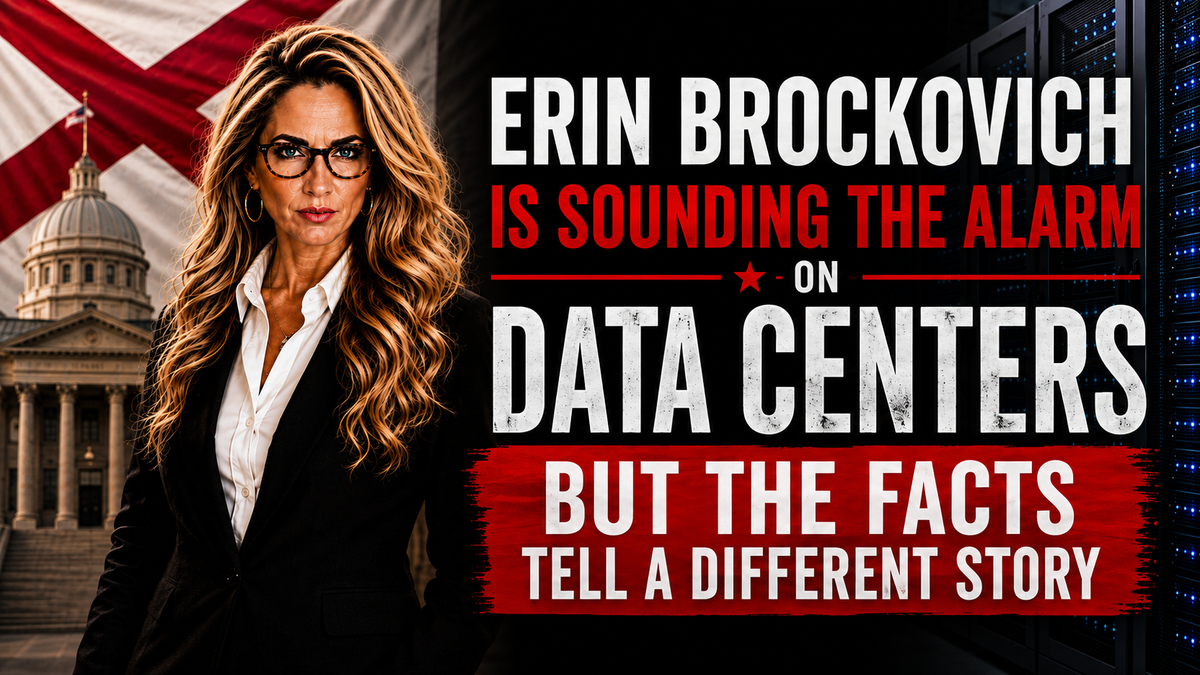
Erin Brockovich Is Sounding the Alarm on Data Centers —
But the Facts Tell a Different Story

I was contacted by Erin Brockovich’s people to see if I would be interested in having her on my podcast, Angela’s Sweet Tea and Politics, to discuss our differing positions on data-centers. Unfortunately, she has since seemed to have declined to come on the podcast and I assume it’s because she did not want to debate the issue with me.
I respect Erin Brockovich. I loved the award-winning movie starring Julia Roberts that carries Erin’s name. She built her reputation fighting powerful interests and asking hard questions about environmental contamination. But when it comes to America’s rapidly growing data-center industry, some of the rhetoric deserves the same scrutiny she demands from everyone else.
During her appearance on The Shawn Ryan Show, Brockovich painted an alarming picture of data centers spreading across America, consuming water and potentially exposing communities to PFAS, commonly called “forever chemicals.”
There is just one problem: a potential risk is not the same thing as proven harm.
Brockovich’s own data-center website now distinguishes between operational, under-construction, proposed, and community-reported locations. In my opinion, during The Shawn Ryan Show, viewers could easily be misled into believing that all the dots on the map across the nation represent operating data centers. That is simply not the case. Many of the locations are proposed facilities rather than operating data centers.
In addition, the community reports she mentions are exactly that—reports and concerns from residents. They are not scientific findings establishing that a data center caused an illness or contaminated someone’s drinking water.
Then there is PFAS.
Yes, certain PFAS chemicals are legitimate environmental concerns. But an Environmental and Energy Study Institute analysis discussing data centers acknowledges something extremely important: direct PFAS pollution from data centers is difficult to establish and is “likely limited” because cooling systems generally operate as closed loops.
That’s a pretty important detail.
If someone claims a data center poisoned a community, show me the facility. Show me the chemical. Show me the water testing. Show me the concentration. And most importantly, show me evidence establishing that the data center actually caused it.
We shouldn’t convict an entire industry based on what might happen. We have elected officials and regulatory agencies in Alabama whose responsibility is to oversee these facilities and serve as watchdogs for our communities.
The water argument deserves context, too. The U.S. Department of Energy says many modern facilities use closed-loop cooling systems that recirculate water and can drastically reduce consumption.
And what about what these facilities give communities in return?
DOE reports that Virginia’s data-center industry supports 74,000 jobs, $5.5 billion in labor income, and $9.1 billion in annual economic activity. Loudoun County alone received more than $875 million in data-center tax revenue in one year.
Alabama shouldn’t run away from that kind of opportunity.
Our own state tax laws recognize data processing centers as major capital-investment projects, and Alabama incentives contain employment requirements for qualifying projects. These aren’t imaginary investments. We’re talking about potentially hundreds of millions—or billions—of private-sector dollars flowing into our communities.
President Donald Trump understands the stakes. His AI Action Plan specifically calls for building American AI infrastructure, and his administration has moved to accelerate data-center development. Trump also secured commitments from major technology companies to build, bring, or buy the additional power their data centers require and to cover necessary power-delivery infrastructure rather than simply sticking families with the bill.
China isn’t going to stop building AI infrastructure while America debates whether computers use too much water.
I’m all for transparency. Require water-use reporting. Monitor environmental impacts. Protect ratepayers. Hold companies accountable when they actually violate environmental laws.
But let’s regulate facts—not fear.
Erin Brockovich became famous because she demanded evidence and accountability.
On data centers, Americans should demand exactly the same thing from her.
Opinions do not reflect the views and opinions of ALPolitics.com. ALPolitics.com makes no claims nor assumes any responsibility for the information and opinions expressed above.