
From Runnymede to Philadelphia
Guest Opinion by Justice Will Sellers
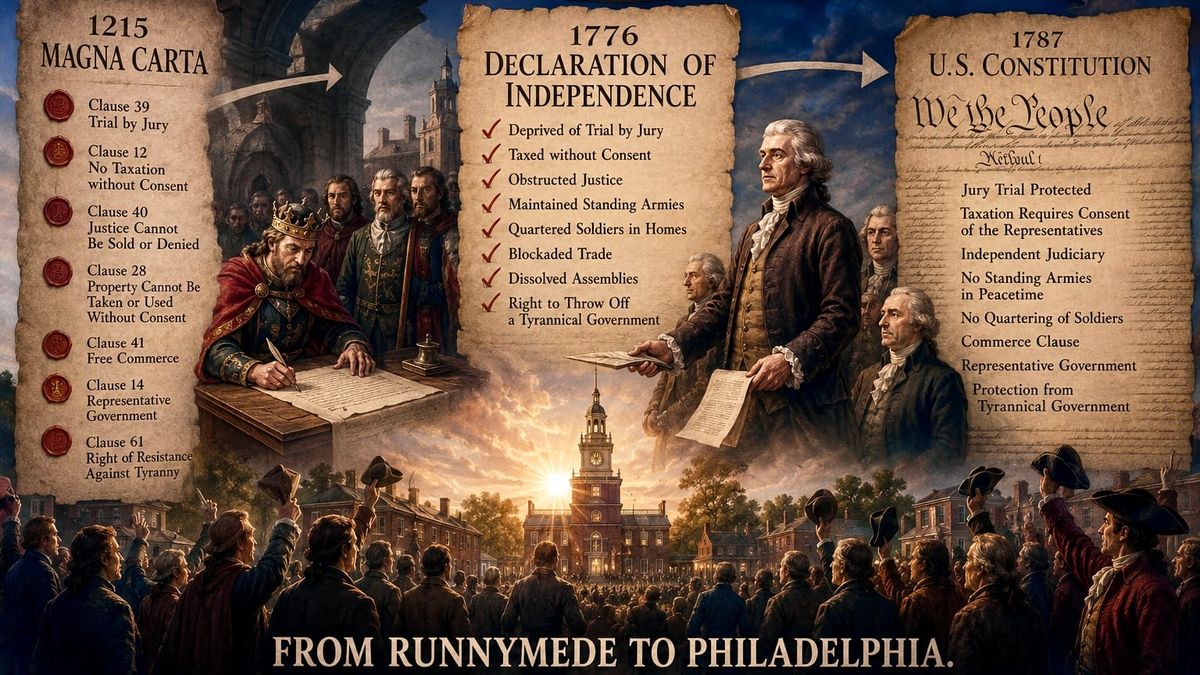
Guest Opinion by Justice Will Sellers
By the time Thomas Jefferson dipped his quill in ink in the summer of 1776, he was drawing from a wealth of ideas more than five centuries old.
Eight hundred and eleven years ago this month, English barons forced a reluctant King John to place his seal on a document they called the Magna Carta. At the time, it read more like a peace treaty between feuding factions than a declaration of universal principles.
The barons wanted their specific grievances addressed. Among their desires were a cessation of unlawful imprisonment, and end to arbitrary taxation, and a written acknowledgment from the king that even he was bound by law, not above it.
King John had no intention of honoring it. The Pope annulled it within weeks. And yet something extraordinary happened; the document survived, was reissued, revised, and over the centuries, transformed from a grievance list into the cornerstone of English constitutional law.
By the time the American colonists found themselves similarly situated in an increasingly bitter confrontation with King George III, the Magna Carta was not merely a historical artifact, it was the living vocabulary of liberty.
It provided a concrete, recognized, legally established set of rights that no English monarch could legitimately deny, so when Jefferson sat down to explain to the world why independence was not rebellion but remedy, the Magna Carta was the foundation supporting his words.
Jefferson's genius in the Declaration of Independence is often celebrated in its soaring philosophical passages: the self-evident truths, the equality of men, the God-given rights to life, liberty, and the pursuit of happiness. But philosophy alone does not make a revolution. What makes a revolution is the ability to say, with precision and force, here is what was done to us, here is why it was wrong, and here is our solution.
Jefferson understood that to win the argument for independence, he could not merely invoke abstract, natural rights. He could not philosophize about ideal forms of government or steps to create utopia. Rather, he needed to demonstrate that specific, recognized, inherited rights had been systematically violated. He needed a backboard. He needed precedent. He needed the Magna Carta.
The colonists did not think of themselves as revolutionaries claiming new rights. They thought of themselves as Englishmen appealing to rights they already had. Rights they had been born into. Rights that had been ratified more than five centuries ago. The Magna Carta was the title deed to those rights, and Jefferson's list of grievances was the evidence that the deed had been slandered.
Magna Carta established that the Crown could not levy taxes without the consent of the kingdom's common counsel. This was the medieval assertion of a principle the colonists would reduce to a rallying cry: “No taxation without representation!”
When Jefferson indicts King George for "imposing Taxes on us without our Consent," he is invoking a right that English law had formally recognized since Runnymede. The Stamp Act, the Townshend Acts, and the Tea Tax were violations of a constitutional principle older than the English common law itself.
Even obstruction of justice finds its parallel. The Magna Carta demanded that the king not "sell, deny, or delay right or justice to anyone." Jefferson charges King George with "obstructing the Administration of Justice" and making judges dependent upon royal will alone, denying, delaying, and corrupting the justice that the Great Charter had promised five centuries before.
When English settlers crossed the Atlantic, they carried with them their language, their customs, and their faith, but also their legal identity as Englishmen. They believed the protections of their English constitutional tradition traveled with them.
King George and Parliament shattered that assumption. They made plain that the colonists were considered non-citizens to be subjugated, taxed and denied justice. In addition to being bad policy, it was also a repudiation of the constitutional inheritance from Magna Carta.
Jefferson's masterstroke in the Declaration was to transform this repudiation into an argument for inevitability. He did not frame independence as a choice, an ambition, or a preference, but rather as a logical and necessary response to a proven pattern of tyranny. The grievance list is not rhetorical decoration. It is a legal brief.
By grounding each charge in rights that were recognized, established, and historically documented; rights that the Magna Carta had first articulated and that generations of English common law had reinforced, Jefferson could argue that the colonists had not abandoned their allegiance.
To the contrary. Their allegiance had been abandoned by a king who refused to honor the covenant that defined English kingship itself. A king who violated Magna Carta's terms was not a benevolent ruler exercising authority; he was a despot exercising arbitrary force.
The barons of 1215 included in their charter a "security clause,” a formal acknowledgment that when a king violated the charter's terms, resistance was not treason but remedy. Jefferson updated that remedy for a new world and a new century. He replaced baronial armed resistance with the sovereign authority of a free people. But the logic was the same; when a king breaks the compact, the people are free to seek new arrangements.
The Magna Carta gave Jefferson the precedent and moral authority to argue that they were not agitators seeking novelty, but Englishmen demanding what was theirs. It allowed Jefferson to move from the philosophical to the specific, to show, charge by charge, that King George had violated concrete, inherited, centuries-old rights.
Five hundred and sixty-one years after a reluctant king pressed his seal into wax at Runnymede, a Virginia lawyer turned those old grievances into a new nation's founding argument. The Magna Carta did not merely anticipate the Declaration of Independence. It made it necessary, made it credible, and made it permanent.
The Great Charter's most enduring legacy is the idea embedded in its very existence: that no one is above the law, and when a ruler pretends otherwise, it is the people's oldest right to object.
Will Sellers is a graduate of Hillsdale College and is an Associate Justice on the Supreme Court of Alabama. He is best reached at jws@willsellers.com.
Opinions do not reflect the views and opinions of ALPolitics.com. ALPolitics.com makes no claims nor assumes any responsibility for the information and opinions expressed above.