Fuel, Food, and Water: What Alabama Needs to Do Right Now
Fact-checked analysis by Alicia Haggermaker, of original research by Mark A. Shryock
Every conspiracy looked like an impossibility until it wasn't. This is not the moment for smirks. This is the issue that demands attention.
What Happened
On February 28, 2026, the U.S. and Israel struck Iran. Iran closed the Strait of Hormuz — the chokepoint through which roughly 20% of the world's daily oil supply moves. It has been effectively closed for over two months. A conditional ceasefire exists. The strait remains closed, with commercial traffic at approximately 5% of pre-war levels.
The last oil tanker from the Middle East reached California on May 3. There are no more coming until the strait reopens — and reopening does not mean recovery. It means the slow, months-long process of restart begins.
The Verified Numbers
- National gas average: $4.52/gallon as of May 7, up from $2.81 in January — a 53% increase since the conflict began
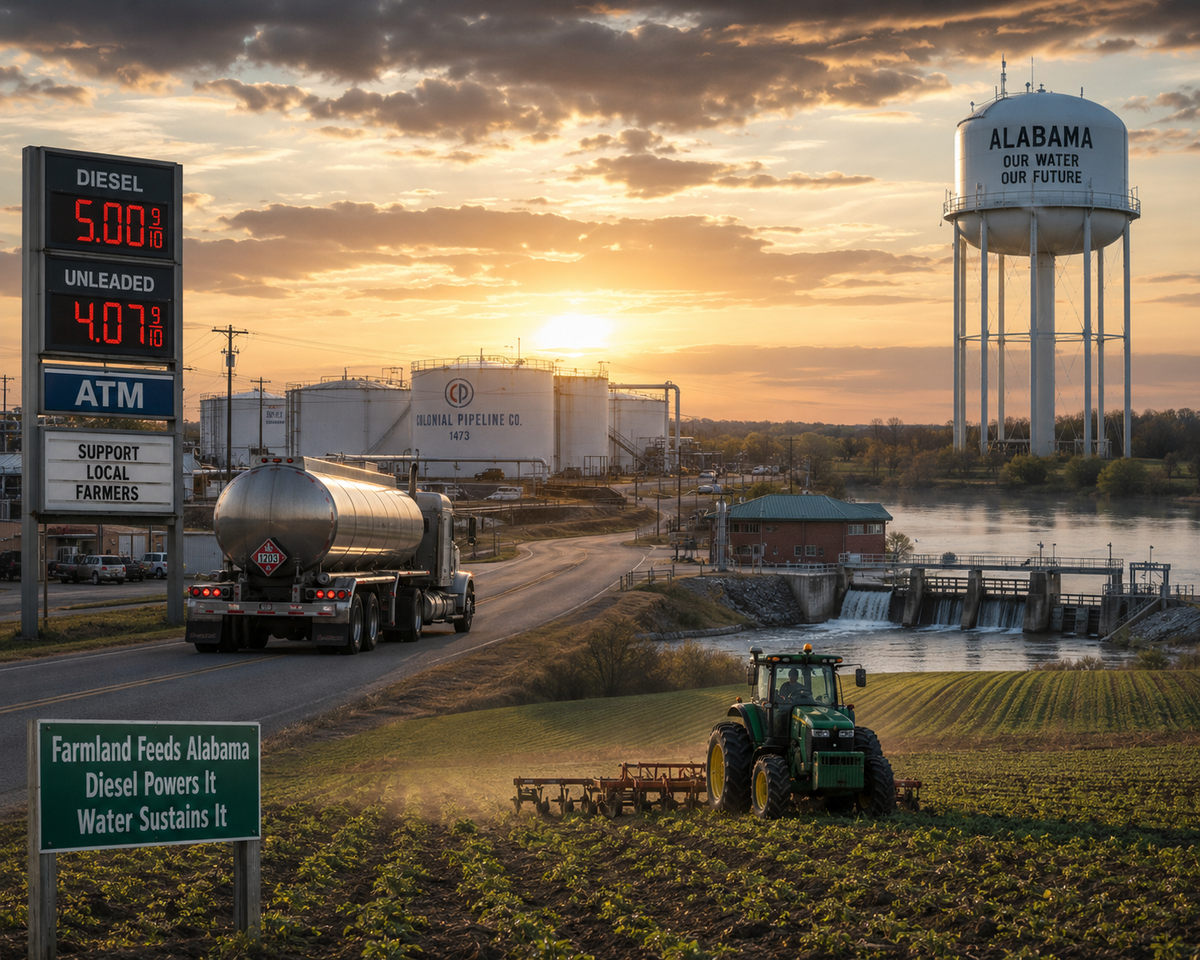
- Alabama gas average: $4.07/gallon — currently among the cheapest in the country
- Alabama diesel: approximately $5.00/gallon
- U.S. diesel and jet fuel inventories: 11% below the five-year average, the lowest since 2005
- U.S. gasoline stocks have fallen for eleven consecutive weeks
- Global oil inventories are at an eight-year low, per Goldman Sachs
Jeff Currie, senior advisor at the Carlyle Group, stated on Bloomberg Television on May 6 that U.S. oil storage tanks are on track to hit critically low levels "somewhere in that July 4th period" and that Europe could reach that threshold this month. "Tank bottoms" means the point at which pumps can no longer move fuel through the system regardless of price. It is a physical failure, not a price problem.
Spirit Airlines shut down entirely on May 2 — 17,000 jobs gone — after absorbing nearly $100 million in incremental fuel costs since March. This is confirmed by SEC filings, NBC News, NPR, and Al Jazeera.
Why Alabama Is Not Insulated
Alabama's prices are lower because we have less coastal import dependence. That is a window, not a guarantee.
Roughly 70% of all food products travel by diesel truck at some point before reaching a grocery shelf. Every tractor, combine, and refrigerated trailer in our food supply chain runs on diesel. When diesel becomes scarce, the food chain doesn't just get more expensive — it gets shorter.
The Southeast depends heavily on the Colonial Pipeline for refined fuel from the Gulf Coast. Gulf Coast refineries have been prioritizing exports to Europe, where shortages are more acute. Alabama could see localized shortages earlier than national averages suggest.
The summer driving season has not started yet. These are not final numbers.
Alabama's Water: Asset and Vulnerability
The USGS estimates that approximately 10% of all freshwater in the continental United States originates or flows through Alabama — 132,000 miles of rivers and stream channels, 14 river basins, and karst aquifer systems beneath roughly 25% of the state. Huntsville's Big Spring is not decorative. Blount County's Blue Spring flows approximately one million gallons per day from the Bangor Aquifer.
This natural wealth matters because municipal water systems run on electricity and diesel. Pumping stations need power. If fuel shortages cause rolling outages or backup generators run dry, tap water is not guaranteed.
Alabama's water delivery infrastructure was largely built between the 1870s and 1980s — aged well beyond intended service life, per the American Society of Civil Engineers. Rural and Black Belt communities are already the most vulnerable, with health-based violations reported at rates more than 40 times higher per capita than larger systems under normal conditions.
Natural water wealth and delivery infrastructure are two different things. We have the first in abundance. The second is fragile and fuel-dependent.

A Working Alternative Worth Knowing About
We apply asymmetric scrutiny to new technologies. Gasoline contains benzene. Diesel exhaust is a Class 1 carcinogen. We accept those systems because they're normalized. But when someone outside the established system builds something that works, the standard shifts: now it must be completely safe, completely tested, completely approved before anyone will entertain it.
Here is the question that standard ignores: is running out of fuel deemed safe?
Julian Brown, an inventor based in Selma, has developed Plastoline — fuel derived from plastic waste through pyrolysis. He demonstrated it publicly at a dragway in Huntsville, livestreaming in real time and running a V12 Rolls-Royce on fuel produced by his first reactor. I was there. It ran.
What we know: the process produces combustible fuel from plastic, with a flame consistent with more complete combustion. A diesel variant showed higher output. Brown states plastic has higher energy density than gasoline, diesel, or jet fuel. He is developing a mobile reactor (Mark 5) for broader deployment and plans to publish the blueprints publicly so anyone can build one. Plastic supply is not a bottleneck.
What we don't yet know: a full emissions analysis has not been completed. Independent testing of real-world combustion byproducts is still pending, with results expected this year.
That caveat is honest. It is also worth applying consistently — to this technology and to the systems we already depend on. In a genuine fuel-out scenario, a working intermediate system whose blueprints will be public is worth knowing about. I have his contact information.
Budget Priorities Need to Reflect Reality
Budgets are planned in advance. Crises are not.
Public money across Alabama is currently committed to projects that made sense when the future looked stable — skybridges, aesthetic development, downtown revitalization. None of that is wrong in a stable world. But a skybridge does not feed anyone. Decorative infrastructure does not pump water when diesel runs out.
Every governing body in Alabama needs to ask, now: given this crisis and its projected timeline, is this the right use of public money? What are we doing to ensure our people can survive a worst-case scenario, and what are we willing to pause to make that happen?
Resilience infrastructure — backup power for water systems, strategic fuel reserves, local food supply capacity, natural spring mapping — is not glamorous. It looks like nothing until it looks like everything.
Survival is a prerequisite for having a future worth investing in.
What To Demand From Representatives
- A state-level plan for fuel rationing if national shortages materialize
- An assessment of which municipal water systems are diesel-dependent and what backup capacity exists
- Public mapping of natural springs and aquifer access points as emergency resources
- Targeted water resilience planning for Black Belt and rural communities
- A review of current capital expenditures against resilience priorities
The Bottom Line
The danger is not panic. It is certainty — the certainty that the systems we depend on will keep working because they always have. The people most certain this crisis was manageable are the ones who put us here. Being wrong in the direction of preparation costs you a pantry. Being wrong in the other direction costs considerably more.
Alabama has a window. Windows close. The time to act — individually, communally, and legislatively — is now.
Sources: EIA Weekly Petroleum Status Report (May 6, 2026); AAA Fuel Price Averages (May 2026); Goldman Sachs Global Inventory Analysis (May 2026); Bloomberg Television, Jeff Currie interview (May 6, 2026); NBC News, NPR, Al Jazeera — Spirit Airlines shutdown (May 2, 2026); House of Commons Library Hormuz briefing (May 2026); USGS Alabama water resources; Alabama Cooperative Extension hydrogeologic provinces report; ASCE Alabama Infrastructure Report Card; Encyclopedia of Alabama.
The above was inspired by a much more extensive Facebook post by Mark A. Shryock, “EIGHT WEEKS TO EMPTY SHELVES. SIXTY DAYS TO FAMINE. WHAT CAUSED IT, AND WHAT YOU NEED TO DO IMMEDIATELY,“ available at THIS LINK. Readers are strongly encouraged to read the original post, as well as follow Mr. Shryock on Substack.
Alicia Boothe Haggermaker is a lifelong resident of Huntsville, Alabama, and a dedicated advocate for health freedom. For more than a decade, she has worked to educate the public and policymakers on issues of medical choice and public transparency. In January 2020, she organized a delegation of physicians and health freedom advocates to Montgomery, contributing to the initial draft of legislation that became SB267.
Opinions do not reflect the views and opinions of ALPolitics.com. ALPolitics.com makes no claims nor assumes any responsibility for the information and opinions expressed above.