Hudson's Filibuster Answer Reveals a Major Split with Trump
Hudson spent his entire response explaining why Trump is wrong on the issue.

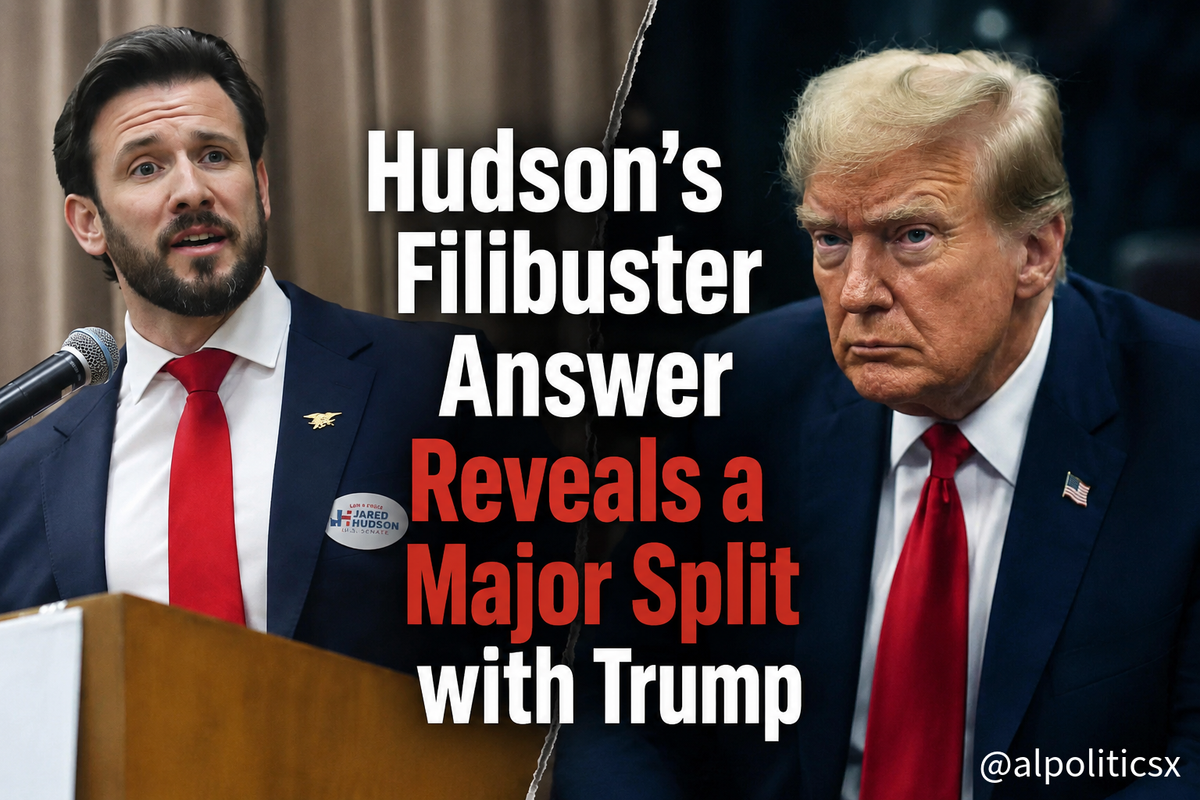
At the Marshall County Republican meeting this past Tuesday evening, held at Wentzell’s Oyster House Restaurant in Guntersville, Alabama, I asked Senate candidate Jared Hudson a simple question: Why had he gone on the record opposing President Donald Trump's position on the filibuster?
The answer was revealing—not because of what Hudson said, but because of what he avoided saying.
Rather than standing with Trump on one of the president's most important legislative priorities, Hudson spent his entire response explaining why Trump is wrong on the issue. He opened by acknowledging that "the president makes an unbelievably great case as the executive branch on why we should nuke the filibuster." But instead of supporting Trump's position, he immediately pivoted, saying, "With that being said, the only conservative tool we have is to make sure that we end the silent filibuster."
For Republican voters, that should raise an important question. If Trump is trying to advance a conservative agenda through the Senate, why would a Republican Senate candidate oppose one of the tools needed to make that happen?
Hudson's answer centered on preserving what he called a protection for the minority party. He argued that "if we completely do away with the filibuster, we no longer have a shield to protect the minority." His proposal would end the "silent filibuster" while keeping the filibuster itself. But that argument ignores a larger political reality: the filibuster has become one of the most effective roadblocks to passing legislation, regardless of which party is in power.
Conservatives often complain that Washington never gets anything done. Yet the filibuster is one of the primary reasons major legislation stalls in the Senate. Presidents campaign on promises, voters elect majorities to enact those promises, and then a Senate procedural rule allows a minority of senators to stop legislation from moving forward.
Trump's argument has always been straightforward. If voters elect a governing majority, that majority should be able to govern. Otherwise, elections lose much of their meaning.
Hudson's position embraces the opposite philosophy. Instead of focusing on how conservatives can deliver results when they have power, he focuses on how Republicans can slow Democrats when they lose power. Hudson made that clear when he warned, "At some point in time, if we lose control, which we will, we will see sweeping changes with a 51-50 vote."
That may sound strategic, but it reflects a defensive mindset rather than a governing mindset.
Even Hudson's support for ending the silent filibuster falls short of addressing the real problem. Requiring senators to physically hold the floor may create political theater and generate television clips, but it does not solve the underlying issue. A determined minority can still obstruct legislation. The result is often delay, gridlock, and frustration among voters who expect action from the people they elected.
The modern Senate already gives smaller states substantial influence. Adding a supermajority requirement for most legislation creates an additional hurdle that was never intended to become a routine feature of government.
What stood out most about Hudson's answer was that he never attempted to defend Trump's position. Instead, he explained why Trump's approach should not be adopted. In fact, after acknowledging that Trump "makes an unbelievable case to end the filibuster, to nuke the filibuster," Hudson concluded, "I don't think we need to nuke it."
For a Republican candidate seeking conservative support, that is a notable departure from the president's vision for how a Republican Senate should operate.
Voters can draw their own conclusions, but the exchange spoke for itself. When given a direct opportunity to stand with President Trump on one of Trump's key Senate priorities, Jared Hudson didn't do it. Instead, he spent his answer explaining why Trump's approach shouldn't be adopted. He praised the president's reasoning, then rejected the president's solution.
Hudson ultimately offered a different path, saying, "I think we need to end the silent filibuster and make people like Chuck Schumer stand on the floor and tell the American people why they will not pass legislation." But that is not the same as supporting Trump's proposal.
In a Republican primary where voters expect candidates to fight for Trump's agenda, Hudson made it clear he has a different vision. The question wasn't whether he likes President Trump. The question was whether he supports Trump's plan. Based on his own answer, the answer appears to be no.