
House Votes to End Clock Changes With Permanent DST
House approves permanent daylight saving time, but sleep experts say year-round standard time would better protect health and safety
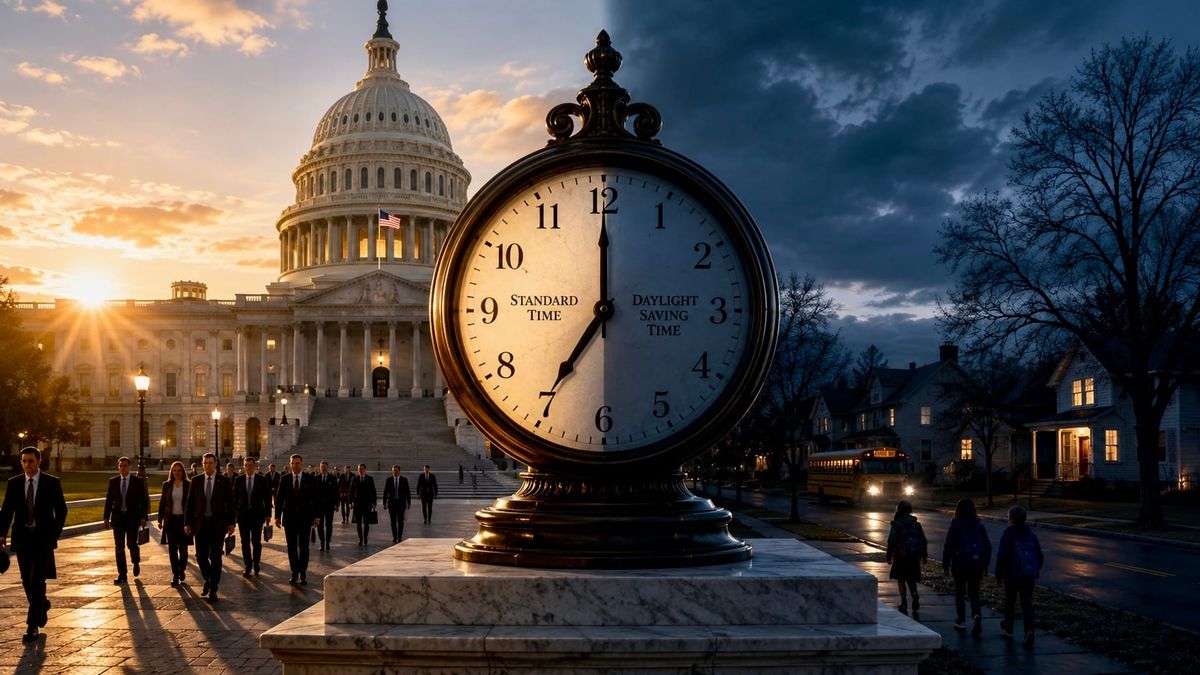
After decades of complaints about changing the clocks twice each year, the U.S. House of Representatives has voted to end the practice by making daylight saving time permanent nationwide.
The House approved the Sunshine Protection Act Tuesday by a bipartisan 308-117 vote. If enacted, Americans would no longer "spring forward" each March or "fall back" each November. The legislation now heads to the Senate, where a similar measure passed unanimously in 2022 before stalling in the House.
Supporters say the bill would eliminate a twice-yearly disruption that affects nearly every American household while providing more evening daylight for work, recreation, and commerce.
"Americans are ready to 'ditch the switch,'" Rep. Gus Bilirakis (R-FL) said during House debate, arguing that the current system creates needless disruption in daily life.
For Alabama Senator Tommy Tuberville, ending the twice-a-year clock change has long been a priority. In October of last year, Tuberville renewed his support for making daylight saving time permanent, calling the current system outdated and unnecessarily disruptive. His legislation mirrors broader efforts in Congress to put an end to seasonal clock changes.
While the House vote marks significant progress, many sleep physicians and public health experts argue Congress may be choosing the wrong permanent time.
Although most Americans agree that changing the clocks twice each year is frustrating, many researchers say permanent standard time would produce better health outcomes than permanent daylight saving time.
The American Academy of Sleep Medicine (AASM) has repeatedly endorsed permanent standard time, arguing it aligns more closely with the body's natural circadian rhythm. Morning sunlight helps regulate sleep cycles, hormone production, alertness, and overall health. Year-round daylight saving time would delay sunrise during winter months, leaving millions of Americans traveling to work and school in darkness for much of the season.
Researchers have linked the spring time change itself to measurable increases in heart attacks, strokes, workplace injuries, traffic crashes, and sleep disruption during the days immediately following the transition. Studies have also found increases in fatal automobile crashes after clocks move forward each spring.
Those findings have led many physicians to conclude that eliminating the twice-yearly clock changes should remain the goal—but by adopting permanent standard time rather than permanent daylight saving time.
As previously reported by ALPolitics.com, several medical organizations contend that standard time more closely reflects natural solar time and provides healthier exposure to morning light. The AASM has described permanent standard time as the option that "best aligns with human circadian biology." Studies published in journals including Current Biology and Sleep have also documented the health and safety risks associated with abrupt seasonal clock changes.
Supporters of permanent daylight saving time counter that additional evening daylight encourages outdoor activity, boosts retail spending, and gives families more usable daylight after work and school. Those benefits helped propel the House bill to overwhelming bipartisan approval, despite the significant body of evidence supporting permanent standard time.
Opponents point out that Congress has experimented with permanent daylight saving time before — with poor results. During the 1973 energy crisis, lawmakers passed the Emergency Daylight Saving Time Energy Conservation Act, placing the nation on year-round daylight saving time from Jan. 6, 1974, through what was intended to be April 1975. The experiment, however, quickly lost public support. Many Americans objected to children walking to school or waiting for buses in darkness on winter mornings, prompting Congress to end the program early. On Oct. 27, 1974, the nation returned to standard time during the winter months, and lawmakers ultimately abandoned plans to make permanent daylight saving time the law of the land.
As the AASM has said:
“The AASM agrees that it is time to stop the biannual time change, but it is also essential to recognize that permanent daylight saving time will have serious unintended consequences, as it did when it was enacted in 1973 and repealed less than a year later. The AASM believes that permanent standard time is the best option for our health.’
The legislation just passed would still allow States that already remain on standard time year-round, such as Hawaii and most of Arizona, to continue doing so under existing exemptions. Other States would have an opportunity to opt out under certain circumstances before the law takes effect.
Whether the Senate will follow the House remains uncertain. Despite broad public support for ending the clock changes, lawmakers remain divided over whether Americans should permanently adopt daylight saving time or standard time.
For many sleep researchers, however, the conclusion is clear: ending the twice-yearly clock changes would be a welcome improvement, but making standard time permanent would likely deliver greater long-term benefits for public health, safety, and sleep quality.