Ivey Halts Dyed Diesel Enforcement for 120 Days
With Alabama diesel above $6 a gallon, Ivey is easing dyed-fuel rules for farmers and timber crews during harvest season

TL;DR: Gov. Kay Ivey has ordered ALEA to halt enforcement of dyed diesel restrictions for 120 days, giving Alabama farmers and timber operators relief as diesel prices top $6 per gallon during harvest season. The move could save operators roughly 55 cents per gallon in State and federal fuel taxes, though Ivey has separately asked the IRS for federal penalty relief. The change took effect immediately and directs ALEA to focus commercial vehicle inspections on public safety rather than dyed fuel use.
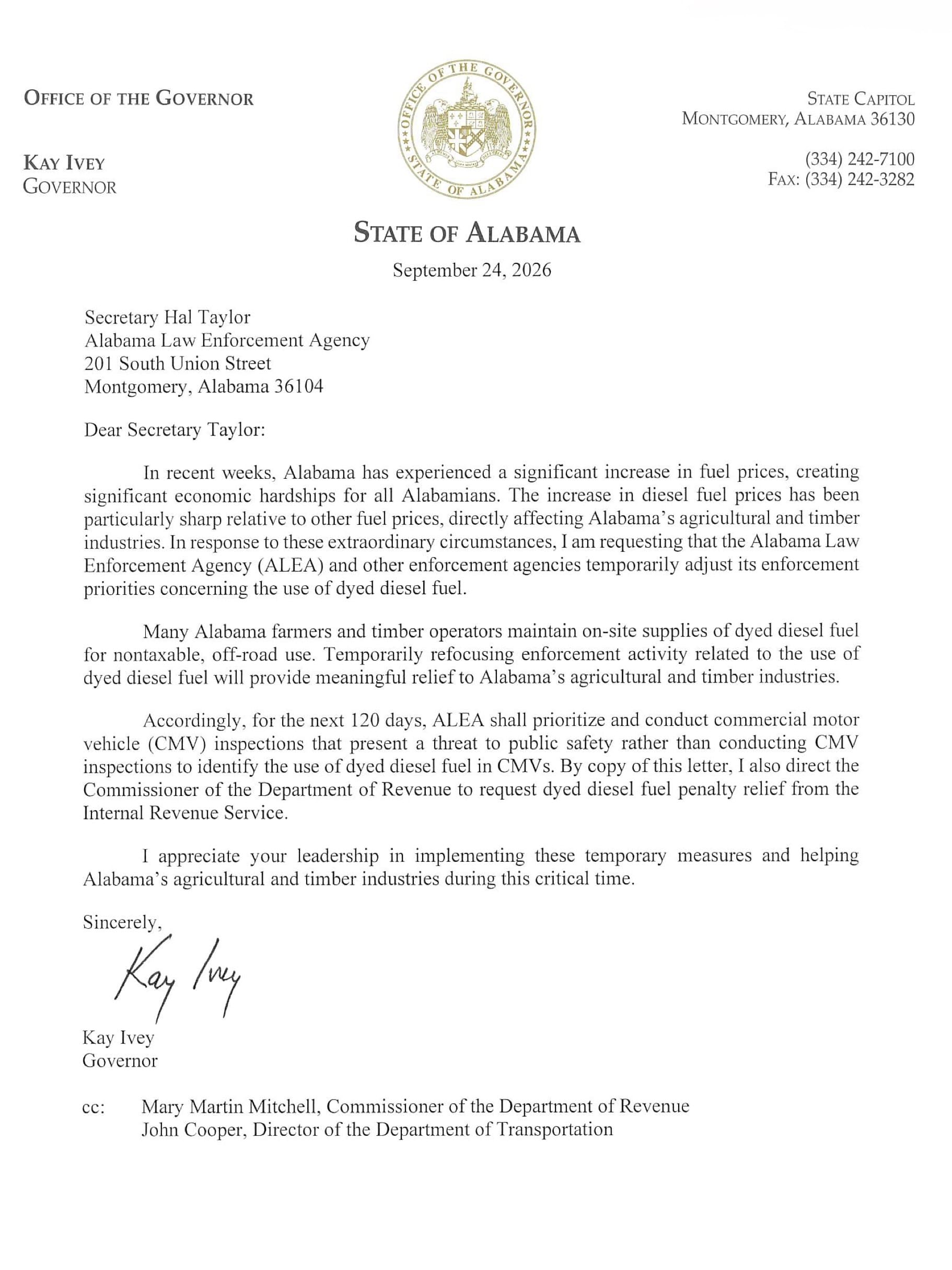
Governor Kay Ivey on Thursday ordered the Alabama Law Enforcement Agency (ALEA) to halt enforcement of dyed diesel fuel restrictions for 120 days, offering relief to farmers and timber operators as diesel prices hover near record highs.
The move is effective at once and comes just as Alabama enters the heart of its fall harvest season.
In a Sept. 24 letter to ALEA Secretary Hal Taylor, Ivey said the recent spike in fuel costs has created “significant economic hardships for all Alabamians,” with diesel taking an especially hard toll on agriculture and forestry.
“The increase in diesel fuel prices has been particularly sharp relative to other fuel prices, directly affecting Alabama’s agricultural and timber industries,” Ivey wrote. “In response to these extraordinary circumstances, I am requesting that the Alabama Law Enforcement Agency (ALEA) and other enforcement agencies temporarily adjust its enforcement priorities concerning the use of dyed diesel fuel.”
Dyed diesel is essentially diesel fuel marked with red dye to show that it is intended for tax-exempt uses, such as farm tractors, logging equipment and other off-road machinery. Because it is not normally permitted for taxable highway use, farmers and timber operators can keep bulk supplies on site for their equipment.
For the next 120 days, Ivey has told ALEA to focus commercial vehicle inspections on threats to public safety rather than checking fuel tanks for dyed diesel.
“Many Alabama farmers and timber operators maintain on-site supplies of dyed diesel fuel for nontaxable, off-road use,” Ivey wrote. “Temporarily refocusing enforcement activity related to the use of dyed diesel fuel will provide meaningful relief to Alabama’s agricultural and timber industries.”
The distinction has become much more important as diesel prices have soared.
As of Thursday, Sept. 24, AAA reported that regular highway diesel averaged $6.145 per gallon in Alabama, up from $5.38 a month ago and just $3.44 one year ago. That is an increase of roughly 78 percent in one year. Alabama diesel hit an all-time State average of $6.1596 on Sept. 20. Nationally, diesel stood at $6.514 per gallon Thursday, also near a record.
The timing is particularly painful for farmers, as most Alabamians know. Harvest season requires long hours of running combines, tractors, trucks and other diesel-powered equipment. Timber operations are also heavily dependent on diesel, both for heavy equipment in the woods and trucks hauling logs to mills.
Reuters reported last week that record diesel prices were squeezing farmers across the country during harvest season, with some producers reporting that daily fuel costs had doubled.
Ivey's action could provide a sizable break on each gallon used in affected highway vehicles, although the exact savings will vary.
Alabama imposes a 31-cent-per-gallon State excise tax on highway diesel, while dyed diesel sold for qualified off-road use is exempt. The Alabama Department of Revenue confirms that all sales of dyed diesel are exempt from the State's motor-fuel excise tax.
Federal highway diesel carries another 24.4 cents per gallon in federal taxes, while dyed fuel for nontaxable use is generally exempt from all but the 0.1-cent federal underground-storage-tank tax.
That puts the potential State-and-federal tax difference at roughly 55 cents per gallon, before any applicable local taxes or fees. A farmer or timber operator able to use 1,000 gallons of dyed fuel instead of taxed highway diesel could therefore see roughly $550 in tax-related savings. At 10,000 gallons, the difference could approach $5,500.
Those figures are only estimates, but they illustrate the significance of Ivey’s move. The Governor’s directive changes ALEA's enforcement priorities; it does not itself rewrite State or federal tax law or guarantee federal tax relief. The Governor separately directed Alabama Revenue Commissioner Mary Martin Mitchell to ask the Internal Revenue Service for relief from federal penalties associated with dyed diesel.
That federal issue is significant, and much will depend on the IRS’ response. The IRS normally imposes a penalty for knowingly using dyed diesel for a taxable purpose. The penalty can be the greater of $1,000 or $10 for each gallon involved, in addition to the tax due.
Ivey's directive is more narrowly drawn. Her letter states that during the 120-day period, “ALEA shall prioritize and conduct commercial motor vehicle (CMV) inspections that present a threat to public safety rather than conducting CMV inspections to identify use of dyed diesel fuel in CMVs.”
The Alabama Farmers Federation welcomed the decision.
“We appreciate Gov. Ivey and Alabama Law Enforcement Agency Secretary Hal Taylor easing restrictions on dyed fuel during harvest season,” Federation President Jimmy Parnell said. “Record-high diesel fuel is putting a strain on Alabama’s agricultural and forestry industries at a time when production costs are already high and commodity and timber prices are low. This flexibility is welcomed help during our members’ time of need.”
Alabama's harvest season runs through Nov. 15, putting Ivey's order in place through the remainder of this year's harvest and well into the winter.
“As we are in the beginning of peak harvest season in Alabama, I am committed to doing what we can to support our State’s farmers and their families,” Ivey said. “When we can responsibly provide relief, I am all for it, and this is a measured, doable and commonsense action to help out Alabama’s agricultural and timber communities.”
Taylor said ALEA will carry out the order while keeping its focus on road safety.
“Governor Ivey’s directive provides a practical and timely measure to support Alabama’s farmers and timber operators as they navigate the impact of increased fuel costs,” Taylor said. “These industries are vital to Alabama’s economy and to communities throughout our State. ALEA is committed to implementing the Governor’s directive while maintaining our steadfast focus on public safety and ensuring Alabama’s roadways remain safe for all who travel them.”
The 120-day enforcement change took effect immediately Thursday.
The Governor’s letter is attached below: