Jones Calls For Prison Overhaul at Columbiana Town Hall
Democratic nominee Doug Jones says Alabama’s prison crisis demands new leadership, parole reform and independent oversight
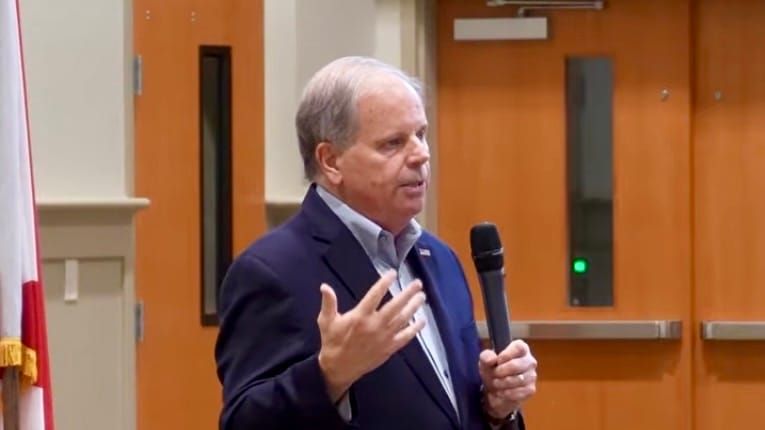
Democratic gubernatorial nominee Doug Jones focused his attention on Alabama's troubled prison system during the fifth stop of his Statewide town hall tour, arguing that the next Governor has both the power and duty to demand more accountability.
Jones was joined in Columbiana by journalist Beth Shelburne, a co-producer of the Oscar-nominated documentary The Alabama Solution. The film examines violence, deaths and alleged abuse inside Alabama prisons through years of reporting and video shot by incarcerated men.

Shelburne’s work on the film grew from a six-year probe into the State prison system. The Alabama Solution was nominated for the 2026 Academy Award for Best Documentary Feature.
Jones said Alabama taxpayers are already spending heavily on a prison system that has failed to solve long-running problems with violence, staffing and inmate deaths.
"Twenty-five cents of every dollar you give this state goes to prisons, between $900 million and a billion dollars a year, supporting facilities that are failing and are the deadliest in the nation," Jones said.
State budget records show just how large that cost has become. Alabama's fiscal year 2026 budget provides more than $826 million in General Fund money for the Department of Corrections, with other funds and prison-related costs adding to the total.
The State's prison death rate has also remained far above the national average. Alabama Political Reporter reported that 277 incarcerated people died in Alabama prisons in 2024. The State's inmate mortality rate was 1,358 deaths per 100,000 prisoners, more than four times the national State-prison average cited in the report.
The problem is not new. The U.S. Department of Justice found years ago that Alabama's men's prisons had the highest homicide rate in the nation based on the latest federal data then available. DOJ sued Alabama in 2020, alleging that conditions in the State's men's prisons violated the Eighth Amendment.
Shelburne pointed to efforts to change Alabama's Habitual Felony Offender Act through so-called "second look" or "second chance" sentencing. Such measures would allow a limited number of people serving old sentences to ask a judge to review their cases.
"We thought this was the year," Shelburne said. "It did not pass, even with the Governor's support."
Gov. Kay Ivey has previously backed legislation that would allow some nonviolent offenders sentenced under the State's old habitual offender law to seek resentencing. An earlier version passed the Alabama Senate with bipartisan support but stalled before becoming law.
Jones argued that a Governor does not have to wait for lawmakers to begin changing the system. He pointed to the Governor's influence over leadership at the Department of Corrections and Alabama Bureau of Pardons and Paroles.
"The Governor appoints the prison commissioner and picks the parole board," Jones said. "Right now, roughly 80% of people eligible for parole are still getting denied. You've got to have people in both of those seats willing to actually fix this, not look the other way."
The parole figure is close to the State's own recent data. Alabama Bureau of Pardons and Paroles records showed a fiscal year 2025 year-to-date grant rate of about 21 percent through June 2025, meaning roughly four out of five cases ended in denial. The bureau continues to publish monthly statistics for 2026.
The State's low parole rate has drawn criticism from both lawmakers and criminal justice reform groups. Alabama granted parole in 53 percent of cases in 2018, according to reporting by the Associated Press. That rate fell to just 8 percent in 2023 before climbing to about 20 percent in 2024.
Jones also called for independent review of prison spending, pointing to the Governor Kay Ivey Correctional Complex in Elmore County as a prime example.
"We were told this prison would cost $623 million. It's now $1.2 billion, and they're already planning another one," Jones said. "That's not building a safer State. That's a system with no accountability, and Alabamians are the ones paying for it."
The cost increase has been well documented. The Elmore facility was originally projected to cost about $623 million. By 2023, its estimated construction cost had climbed above $1 billion, consuming most of the money lawmakers had initially set aside to build two large prisons. State officials blamed much of the increase on inflation and soaring labor and material costs.
The new 4,000-bed prison was later named the Governor Kay Ivey Correctional Complex. The Department of Corrections has said the project is part of a prison modernization plan approved by lawmakers and signed by Ivey in 2021. ADOC has stressed that the plan replaces old prison beds rather than expanding the overall capacity of the system.
The new prison, however, does not end Alabama's larger corrections debate.
Recently, federal oversight at the Julia Tutwiler Women’s Prison was ended. However, the State continues to face federal scrutiny over violence, staffing and conditions inside its men's prisons. Meanwhile, the high cost of new construction, historically low parole rates and continued inmate deaths have fueled calls from both sides of the political aisle for changes beyond simply replacing aging facilities.
Jones is making the issue part of his campaign for Governor, arguing that Alabama's next chief executive should use the powers already available to the office rather than wait for another round of studies or another billion-dollar construction project.
Jones’ conversation on prison reform may be seen on YouTube and below: